


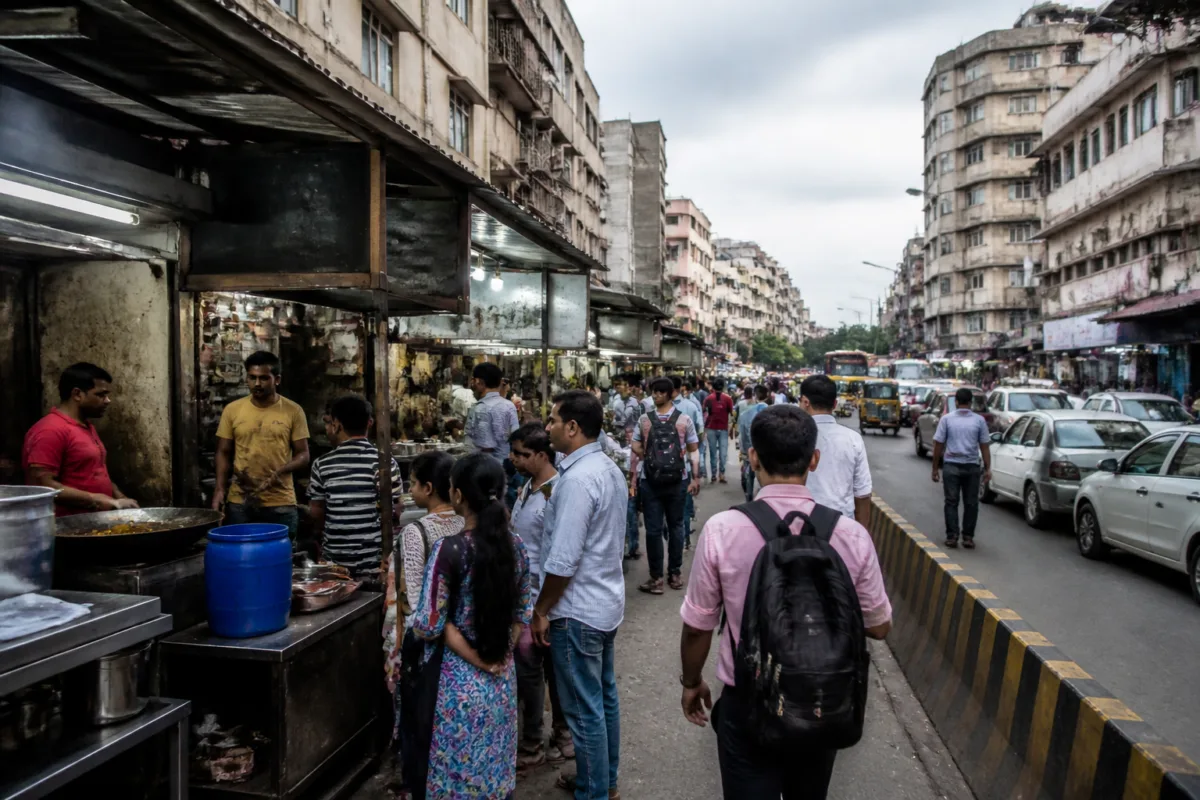
Pune FDA action against five food establishments in MG Road’s Khau Galli has exposed a basic regulatory gap in one of the city’s recognised food clusters: businesses were operating without valid Food Safety and Standards Authority of India licences or registrations. The action followed a special inspection drive in Pune Camp on October 16, during which 15 establishments were examined by the Pune Division of the Food and Drug Administration under the state government’s ‘Safe Food, Safe Maharashtra’ campaign.
The FDA said five establishments were found operating without the mandatory approvals and were issued stop-business notices under the Food Safety and Standards Act. The establishments named in the report are Classic Club Sandwich, Shri Krishna Chhole Bhature, A-1 Sandwich, Let’s Barbecue and Shri Krishna Chowpatty, all located on Taboot Street, MG Road, in Camp.
The immediate issue is licensing. The supplied report does not say that the five outlets were found serving contaminated food, nor does it record any specific food sample failure, hygiene violation or illness linked to them. The stated basis for the notices was that the businesses did not possess valid FSSAI licences or registrations. That distinction matters because food regulation operates through several layers: businesses must first be identifiable to the regulator, legally authorised to operate and subject to inspection under the relevant framework.
In a dense commercial area such as Khau Galli, that administrative chain is closely connected to the everyday functioning of the street. Food outlets share a concentrated public environment, draw customers from across the city and operate alongside roads, pavements, adjoining shops and other commercial premises. A licensing requirement is therefore not only a document-level formality. It is also the mechanism through which the regulator records food businesses and establishes which establishments are subject to compliance checks.
The inspection figures provide the clearest indication of the scale of the problem identified during this drive. Fifteen food establishments were inspected, and five were found without the mandatory FSSAI licence or registration. That is one-third of the establishments covered by the exercise. The number does not establish the compliance position of every food outlet in MG Road or Pune, but it does show that the problem was not confined to a single premises during this particular inspection.
The notices also reveal the enforcement sequence used by the FDA. After identifying establishments without the required approvals, officials directed them to stop business operations. The action was taken under the Food Safety and Standards Act, according to the report. The FDA has appealed to food business operators to obtain valid licences or registration certificates before beginning operations and warned that legal action would follow where establishments operate without the mandatory approvals.
This sequence places responsibility on both sides of the regulatory relationship. Food operators are expected to secure the required approval before commencing business. The regulator, meanwhile, must identify operating establishments, inspect them and act when the required documentation is absent. The inspection in Khau Galli demonstrates the enforcement side of that system, but the supplied material does not establish when the five businesses began operating, whether they had previously applied for approval, or whether any applications were pending when the notices were issued.
Those unanswered questions are important for understanding whether the episode represents a one-time enforcement action or a recurring licensing challenge in the city’s informal and semi-formal food economy. The report does not provide the duration of the closures, the process for lifting the stop-business notices, the fees or documentation required for compliance, or the number of establishments across Pune that currently hold valid licences or registrations. It also does not state whether the FDA conducted follow-up inspections after issuing the notices.
The institutional roles in the operation are clearly identified. The drive was conducted under the guidance of Joint Commissioner (Food) Shrikant R. Karkale and Designated Officer N. R. Sarkate. Food Safety Officers Satish Hake, Pooja Bagade, Dipali Ghodke, Priya Rajgolkar and Namrata Mohite were part of the inspection team. The report identifies the action as part of the state government’s ‘Safe Food, Safe Maharashtra’ campaign, connecting a local market inspection to a wider state-level enforcement effort.
That connection is significant because food safety in cities depends on routine administration as much as on campaign-based inspections. A special drive can locate non-compliant establishments at a particular moment, but a sustained regulatory system also requires current records, clear communication to operators, repeated checks and follow-up after notices are issued. The available information confirms the inspection and the notices, but it does not provide evidence on the wider monitoring system or on how frequently similar drives are conducted in other food markets.
The location adds a public-space dimension to the matter. MG Road’s Khau Galli is a concentrated food destination in Pune Camp, where multiple establishments operate within a limited urban area. The FDA’s decision to inspect 15 establishments together treats the area as a connected commercial cluster rather than as a collection of isolated businesses. That approach can make enforcement more efficient, but it also means that a regulatory action can affect the functioning of a whole food street, including operators, workers and customers.
For customers, the immediate information supplied by the FDA is that five named establishments were directed to stop business operations because they lacked valid FSSAI licences or registrations. The material does not state whether the outlets continued operating after the notices, whether they have since obtained approvals, or whether customers were exposed to any confirmed food-safety incident. Those facts remain separate from the licensing finding and should not be conflated.
For operators, the FDA’s public warning establishes the expected order of compliance: obtain a valid FSSAI licence or registration before starting business. The warning also indicates that the department intends to pursue legal action against establishments that operate without the mandatory approvals. However, the report does not specify the penalties imposed beyond the stop-business notices, or whether the five establishments face additional proceedings under the Act.
The episode also illustrates why the administrative visibility of small and street-facing food businesses matters. In a city, commercial activity can expand faster than formal records are updated. A regulator may know that a food street exists while still needing to verify each operator’s licence, registration status and premises-level compliance. The inspection results show that physical visibility alone does not guarantee regulatory compliance. They also show why area-based inspection drives can identify gaps that may remain hidden when enforcement is limited to individual complaints or isolated visits.
At the same time, the evidence available here has clear limits. The report is based on the Pune FDA’s stated findings as carried by Punekar News. It does not include copies of the stop-business notices, responses from the five establishments, details of any inspection checklist, or an official account of subsequent corrective action. It therefore supports reporting the licensing action and the authorities’ warning, but not a broader conclusion about food quality, hygiene or deliberate wrongdoing by the named businesses.
The next stage will determine whether the action produces a documented compliance outcome. The FDA has called on food business operators to obtain valid licences or registration certificates and warned of strict legal action for continued operation without the required approvals. The supplied report does not give a follow-up date or reopening timeline for the five outlets. For now, the confirmed record is narrower but still consequential: an inspection of 15 establishments in Pune’s MG Road Khau Galli found five operating without the approvals required under the food-safety framework, and the regulator ordered them to stop business operations.

