


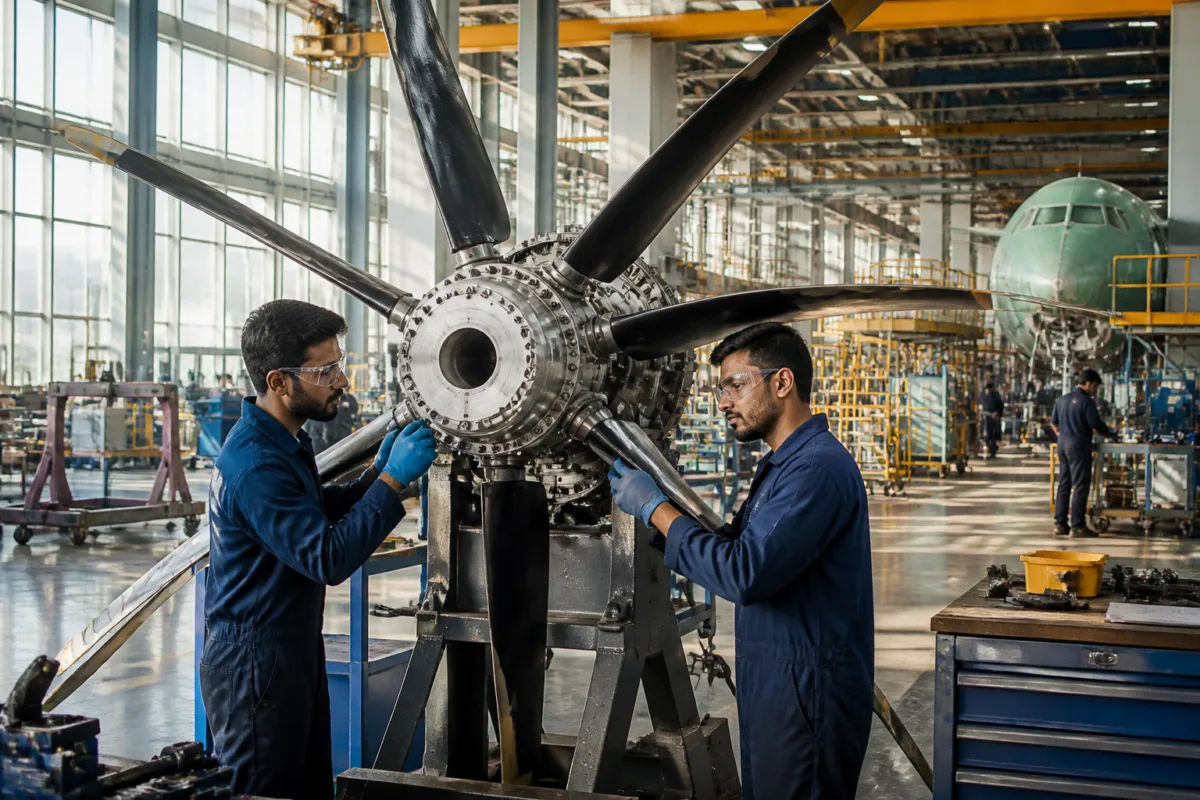
Collins Aerospace has broken ground on a multi-million-dollar Bengaluru MRO hub that is expected to service propellers from around 500 aircraft operating across the Asia-Pacific region, strengthening the city’s position as a base for specialised aviation engineering and maintenance.
The facility, announced at the company’s Collins India Operations Centre in Bengaluru, will maintain the 568F series propeller system used on ATR 42, ATR 72 and Airbus C295 aircraft. It is expected to begin operations by the end of 2028 or early 2029, according to Ajay Mahajan, president of Advanced Structures at Collins Aerospace.
The Bengaluru centre will be Collins Aerospace’s third propeller maintenance, repair and overhaul facility globally and its first in the Asia-Pacific region. The company’s existing facilities are in France and the United States. The French facility serves the IATA-2 region, while the US facility serves the IATA-1 region. Bengaluru will serve the IATA-3 region, which covers Asia-Pacific.
Mahajan said the company had identified around 500 aircraft in the region using the relevant propeller system, with the fleet expected to grow. Propellers typically require repair once every five years, creating a recurring maintenance requirement for aircraft operators.
The company has not yet finalised the Bengaluru facility’s annual maintenance capacity, number of bays or equipment requirements. These details are expected to be worked out over the next two years. The centre is planned to employ up to 50 specialised technicians and engineers and will progressively develop capabilities covering inspection, dismantling, repair, reassembly and complete overhaul of the specified propeller systems.
Aircraft operating in India currently send propellers requiring repair to Collins Aerospace’s facility in France. Mahajan said local servicing could reduce turnaround time by several weeks, depending on the repair and transportation method. Air shipment for a propeller’s journey to France and back can take around a week, while sea freight may take multiple weeks. Servicing the components in India is also expected to reduce freight costs.
The company selected Bengaluru after evaluating multiple locations in Asia. Mahajan cited the city’s growing aviation market, aerospace manufacturing and engineering ecosystem, and support from the Karnataka government as key factors. Collins said its existing operations centre provides a base of aerospace skills, safety and quality processes, and manufacturing capabilities that can be used by the new MRO operation.
Collins Aerospace has invested more than $200 million in India over the past five years in engineering, manufacturing and testing capabilities. The company employs around 7,500 people across seven sites in the country. Its Bengaluru operations include its second-largest engineering facility outside the United States and a manufacturing footprint of around 750,000 square feet.
K Binu, managing director of Collins Aerospace India, said the new MRO capability would support the company’s efforts to attract more complex manufacturing work to India. The company also plans to strengthen its local supplier network as its operations expand.
Binu said India had made progress on aerospace policy but could do more to attract investment. He cited incentive programmes in Singapore, Poland, Morocco and Puerto Rico as examples that India could study while assessing how its own policy support could be improved. The Bengaluru facility’s capacity, equipment and detailed operating plan are expected to be finalised before operations begin in late 2028 or early 2029.

