


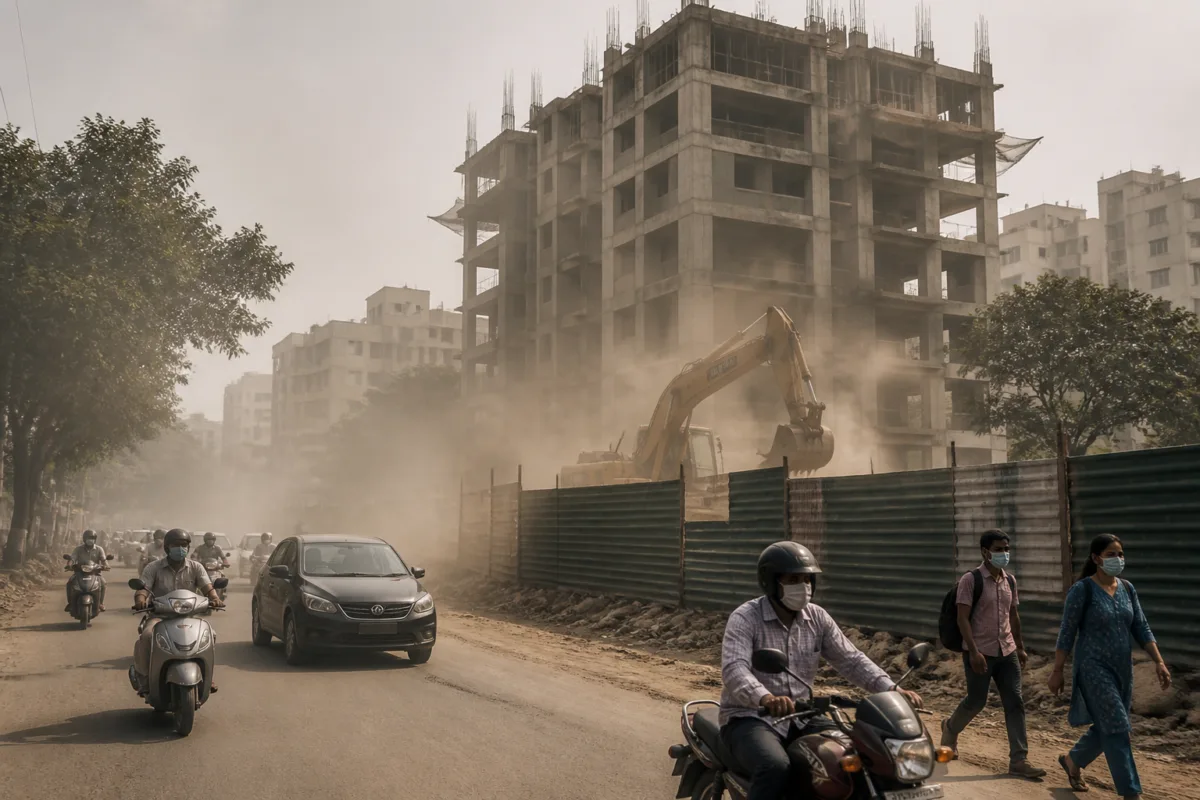
Pune’s air pollution problem is being experienced not only through AQI readings but inside homes, hospitals and daily routines. As construction dust mixes with post-monsoon pollution and vehicular emissions, doctors cited in a Times of India report say respiratory and allergy-related cases are rising, while residents are keeping windows shut, mopping floors repeatedly and buying air purifiers to limit exposure.
The report places Pune’s AQI at around 130 on Monday and 125 on Tuesday, with air quality categorised as moderate on both days according to the Central Pollution Control Board. Those figures do not represent an extreme pollution episode on their own. Yet the health response described by doctors and residents shows why a city’s air-quality challenge cannot be understood through a single daily number. Exposure depends on where people live, how much construction is taking place nearby, how dry conditions allow dust to move and whether homes, workplaces and roads provide any relief.
That distinction is important for a rapidly changing city such as Pune. Construction activity is spread across established neighbourhoods and expanding edges, while traffic continues to add emissions to the urban air. During dry spells, particulate matter deposited on roads, open plots, building sites and roadside surfaces can be lifted again by vehicles and wind. The result is not necessarily a dramatic pollution event visible across the entire city. It can instead be a series of localised exposure zones, particularly around construction sites and transport corridors.
The medical accounts in the report connect that exposure to a range of symptoms. Dr Danish Memon, head of internal medicine at Noble Hospital, said the hospital was seeing more respiratory cases, with some severe patients requiring bronchodilators. He attributed the situation mainly to October heat and post-monsoon pollution. The report also records seasonal asthma, allergic coughs and skin allergies, while children under five were reported to be developing allergic colds and eye infections linked to dust and dryness.
The evidence supplied is primarily clinical observation rather than a citywide epidemiological study. That limitation matters. The report does not establish how many cases across Pune are directly caused by construction dust, nor does it provide a comparison of particulate concentrations across different neighbourhoods. It also does not distinguish systematically between pollution-related illness, seasonal viral infections and other causes of respiratory symptoms. Doctors, however, describe a pattern that is relevant to urban management: residents are seeking care for conditions that may be aggravated by the combined effect of dust, dryness, heat and emissions.
Dr Rahul Kendre, chief lung transplant physician and transplant and interventional pulmonologist at DY Patil Hospital, said asthma, bronchitis and overall respiratory cases were higher than the previous year. He also referred to paediatric cases and said many cases from Kharadi were dust-related because of construction in the area. This is a significant urban signal because it connects health complaints to a specific growth geography rather than treating pollution as an undifferentiated citywide problem.
Kharadi’s example also illustrates the institutional difficulty of managing construction-related pollution. The source material identifies construction as a contributor but does not specify which projects, contractors or agencies are responsible for the dust described. Nor does it provide details of enforcement, site inspections, road-cleaning schedules, dust-suppression measures or penalties. Without that information, the public can observe the health consequences but cannot easily identify the chain of responsibility between a construction site, a local road, a municipal authority and an air-quality regulator.
This gap between measurement and management is central to Pune’s air-pollution challenge. AQI data offers a broad indication of air quality, but residents experience exposure at street level. Dust may settle on window sills, balconies, furniture and floors before being resuspended. Residents quoted in the report said they were keeping windows and balconies closed, mopping several times a day, using vacuum cleaners and air purifiers, replacing filters and wearing masks. These are household responses to a problem whose sources are largely outside individual control.
The burden is not distributed equally. Families with young children, elderly people or members with asthma and other respiratory conditions face greater risks from indoor and outdoor exposure. A paediatrician in Wanowrie said young children were particularly vulnerable because their immune systems were still developing, with many cases taking longer to resolve. In Bavdhan, a resident said his family had purchased an air purifier because two people at home were above 90. Such accounts show how the cost of poor air quality can move from public infrastructure into private household spending.
That shift has an equity dimension. A household that can purchase an air purifier, replace filters, use a vacuum cleaner or modify windows has more options than one that cannot. Keeping windows closed may also be difficult in homes without effective ventilation or cooling. The report does not provide income data or a comparison of household coping strategies, so the scale of this inequality cannot be quantified from the available evidence. But the coping measures described indicate that residents are being asked to manage an urban externality through personal expenditure and behavioural changes.
The report also complicates the question of what counts as a pollution-related health case. Dr Abhijit Lodha, an internal medicine physician at Mirayee, Balewadi, said influenza or flu-related cases were also circulating and described many patients with coughs, colds and sore throats as seasonal viral cases. This distinction is essential for responsible public communication. A rise in respiratory illness during the post-monsoon period cannot automatically be attributed to construction dust or AQI. At the same time, the presence of viral infections does not remove the possibility that dust and pollution are aggravating symptoms or increasing discomfort among vulnerable residents.
For policymakers, the implication is that air-quality governance must connect environmental measurement with construction regulation and public health. The source material identifies the CPCB as the authority behind the reported AQI readings and cites medical observations from hospitals in different parts of Pune. It does not establish the specific administrative arrangements for controlling dust at construction sites or maintaining roads in the affected neighbourhoods. That missing detail is precisely where a routine pollution story becomes an institutional question: which agency monitors the source, which agency acts, and how is compliance demonstrated to residents?
Construction dust is also difficult to manage because it is generated through several activities rather than a single emissions point. Excavation, movement of soil, demolition, loading, unloading, uncovered transport and traffic over dusty access roads can all contribute to particulate pollution. The supplied report does not list the control measures adopted at individual sites, so it cannot establish whether required practices were followed or breached. It does, however, indicate that residents in areas such as Kharadi are associating construction activity with worsening local conditions and that doctors are observing related respiratory complaints.
The available numbers tell a limited but important story. Pune’s reported AQI readings of 130 and 125 were both in the moderate category, yet the same period was associated with increased respiratory cases described by doctors and significant protective measures by residents. The comparison offered by the report is also limited: Dr Kendre said respiratory cases were more than last year, but no case counts or time period are provided. This means the evidence supports concern and closer examination, not a precise estimate of the city’s health burden.
A stronger urban response would require more granular public information than a citywide AQI label. Residents need to know how pollution varies near major construction clusters, whether dust-control conditions are being inspected, and what action follows complaints. Hospitals and public-health agencies would also need consistent data to separate seasonal viral illness from pollution-aggravated respiratory conditions. None of those datasets is included in the supplied material, and their absence prevents a definitive assessment of trends.
What the report does establish is a chain connecting urban growth to everyday health management. Construction and transport activity contribute to particulate pollution; dry conditions make dust easier to resuspend; doctors report respiratory, allergic and paediatric cases; and households respond by sealing themselves indoors and purchasing protective equipment. The central issue is therefore not only whether Pune’s AQI is moderate or poor on a particular day. It is whether the city’s growth systems prevent avoidable dust exposure before the burden reaches clinics and homes.
Pune’s next challenge is to make that chain measurable and accountable. The reported AQI readings, hospital observations and resident experiences point to a problem that sits between environmental regulation, construction management and public health. What remains uncertain from the available evidence is the scale of the citywide health impact, the performance of individual dust-control measures and the enforcement record at construction sites. Those are the questions that deserve attention as the dry season continues and construction activity remains a defining feature of Pune’s urban expansion.

