


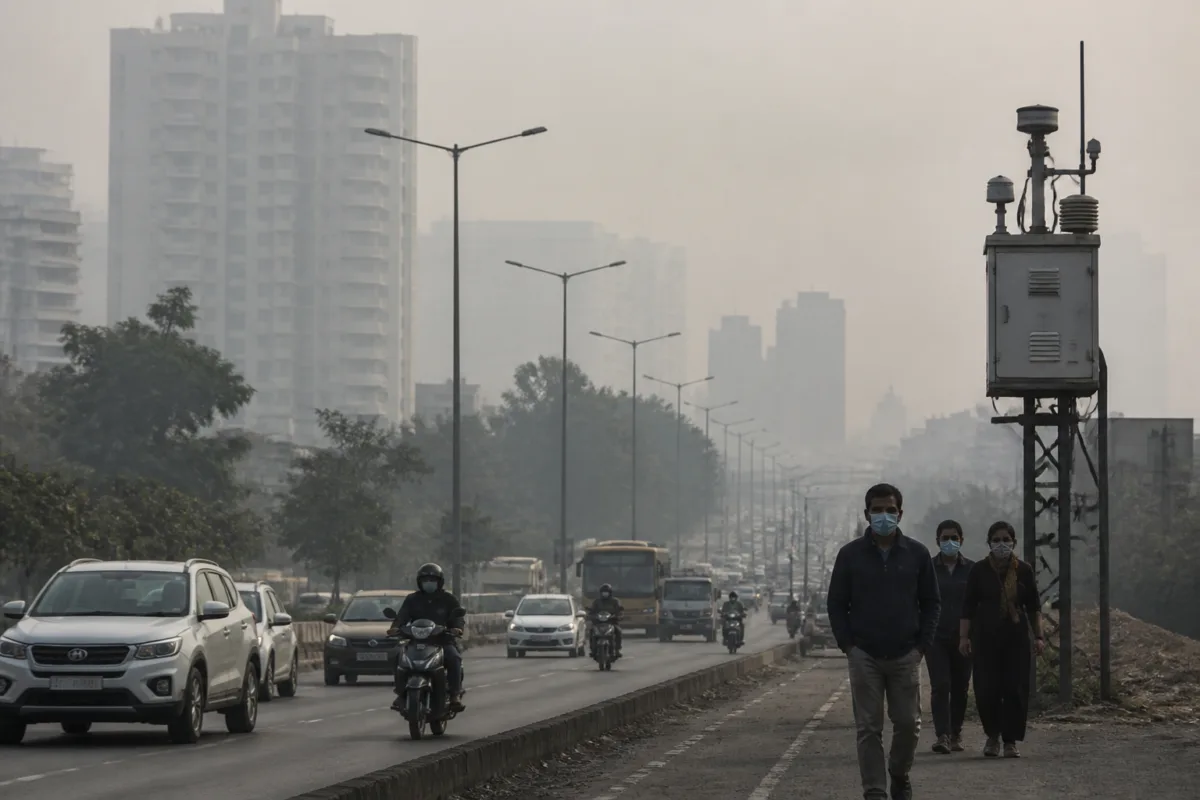
Pune’s Diwali air pollution spike was not only a story about fireworks. It was also a stress test of the city’s enforcement capacity, pollution-control spending and air-monitoring systems—and the evidence supplied in a new report points to weaknesses in all three.
The report says Pune’s air quality index reached about 432 after fireworks continued across much of the city until midnight. The most severe readings were recorded during the night of November 8 and into the morning of November 9, when particulate pollution rose sharply at several monitoring locations. Hadapsar was identified as the most polluted area for both PM2.5 and PM10 during the observation period.
The reported figures were far above the 24-hour limits cited from the national ambient air quality standards. Around midnight, Pune’s average PM2.5 concentration reached 661.2 micrograms per cubic metre, compared with the stated limit of 60 micrograms. PM10 reached 828.6 micrograms per cubic metre against a stated limit of 100 micrograms. These are not marginal exceedances. They describe a short-duration pollution episode in which particulate concentrations rose to several times the applicable standards.
At Hadapsar, the average PM2.5 concentration during the observation period was reported at 185.32 micrograms per cubic metre, compared with a city average of 124.9 micrograms. The area’s average PM10 concentration was 322.59 micrograms per cubic metre, against a city average of 260.6 micrograms. After 9 pm on November 8, the Hadapsar monitor recorded PM2.5 at 939.36 micrograms per cubic metre. PM10 reached the sensor’s maximum recorded value of 999.99 micrograms per cubic metre.
The figures from the MHADA Colony monitoring station were also high. Its average PM2.5 concentration was reported at 173.57 micrograms per cubic metre, while the highest individual PM2.5 reading at the station reached 997.74 micrograms per cubic metre. Pollution remained elevated beyond the night-time peak: on the morning of November 9, PM2.5 levels at some stations reportedly stayed above 300 to 500 micrograms per cubic metre until 10 am.
These numbers establish the scale of the reported episode, but the same report also raises a critical qualification: the monitoring record was not complete or uniformly consistent. Several stations recorded unusually low pollution between 4 pm and 6 pm on November 8. At Hadapsar, PM2.5 was reported at only 16.57 micrograms per cubic metre during that period. The Karve Road and MIT-Kothrud stations had no data available for the observation period, while some stations showed missing hourly readings during the night.
That gap matters because air-monitoring data is the basis for determining both the intensity of a pollution event and the adequacy of a public response. Missing readings do not erase the high concentrations recorded elsewhere, but they limit the precision with which the city can reconstruct when pollution rose, how long it lasted and how different neighbourhoods were affected. The report therefore says the missing and unusually low readings should be checked before drawing firm conclusions about the exact scale and timing of the post-Diwali increase.
The monitoring problem is part of a wider institutional question. Pune Municipal Corporation and the Maharashtra Pollution Control Board had issued guidance and time restrictions relating to fireworks, but the report says the restrictions were widely breached. A named representative of Pune Air Action Hub said fireworks were being set off openly from the evening until midnight, including around 11.30 pm, after the prescribed time limit. The report also says fireworks were seen near hospital areas.
The issue, therefore, was not simply whether rules existed. It was whether the city could make those rules visible, enforceable and consistent across neighbourhoods. A time restriction that is not followed, or is not effectively enforced, provides little protection during the hours when pollutant concentrations are rising fastest. The report attributes the alleged enforcement failure to inadequate action by the civic administration, while environmental activists and others expressed concern over the city’s response.
Pune’s investment in pollution-control infrastructure adds another layer to the story. The report refers to earlier coverage by Civic Mirror stating that the municipal corporation had spent Rs 275 crore on pollution-control measures under the National Clean Air Programme. It specifically cites fountains intended to create mist at 10 major traffic junctions and fog cannons promoted as pollution-control equipment. According to the report, the fountains were not operating and had become largely ornamental, while fog cannons were rarely seen on roads.
The supplied material does not establish the technical effectiveness of these systems or whether they were designed to address a short, extreme fireworks-related particulate spike. It does, however, raise a governance question about how public funds are translated into operating capacity. Equipment procurement, installation and inauguration are different from regular maintenance, deployment, performance measurement and public reporting. During a high-pollution episode, the practical test is whether a system is available and functioning when needed—not whether it exists in an asset register.
The health implications described in the report also show why the pollution episode cannot be treated as a one-night nuisance. Dr Aparna Birajdar of Pune Air Action Hub said severe pollution can worsen conditions for people with asthma, chronic obstructive pulmonary disease and pulmonary fibrosis. She also cited symptoms such as throat irritation, dry cough, wheezing and breathlessness among otherwise healthy people. The report attributes to her the further assessment that prolonged exposure can increase the risk of chronic respiratory illness and affect other organs, while exposure during pregnancy may affect foetal growth and increase the risk of premature delivery.
These comments do not turn the reported readings into a citywide health-impact assessment; the supplied material does not provide hospital admissions, emergency-room data or a measured estimate of affected residents. They do show, however, that the consequences of a pollution spike are unevenly distributed. People with existing respiratory illness, pregnant women, children and residents living near high-intensity fireworks activity may face greater exposure or greater health risk, even when the city publishes a single average AQI figure.
The report also places the Diwali episode within a broader pattern. Shweta Vernekar, a senior project associate at Parisar, said the relationship between fireworks and deteriorating air quality could not be denied and argued that the city already has fewer days of good air quality. Her comment, as reported, shifts the focus from a festival-specific event to the cumulative burden of pollution across the year. The supplied material does not provide the annual trend data needed to quantify that claim, but it identifies the policy problem clearly: a seasonal spike is easier to notice than the less visible accumulation of ordinary urban emissions.
That distinction is important for municipal administration. If pollution control is activated only during Diwali, the city’s response will remain event-based rather than system-based. Dr Birajdar said enforcement should also cover weddings, political gatherings and celebrations such as cricket victories, where fireworks and crowd activity can contribute to pollution at other times of the year. The report therefore presents festival enforcement as one part of a larger question about whether pollution rules are applied consistently across public and private events.
The episode also exposes a mismatch between the scale of the problem and the way it is communicated. An AQI figure of about 432 is immediately legible as a warning, but the underlying particulate readings show how much variation can exist between a city average, a station average and an individual hourly peak. Hadapsar’s reported PM2.5 peak of 939.36 micrograms per cubic metre and PM10 reading at the sensor ceiling cannot be understood through the city average alone. At the same time, missing readings and unusual low values make it harder to compare locations or establish a complete exposure timeline.
For Pune, the immediate institutional task is therefore twofold: establish what happened in the monitoring network and account for how the fireworks restrictions were implemented. The report identifies both the evidence of extreme pollution and the limitations in that evidence. It also points to a spending and operations question around the Rs 275 crore pollution-control programme. What remains unresolved in the supplied material is whether the missing readings resulted from equipment failure, data-processing problems or another cause; whether the reported AQI was calculated from all available stations; and what enforcement action, if any, followed the alleged violations.
The Diwali episode confirms that Pune can experience severe particulate pollution within hours of concentrated fireworks activity. It also shows that the city’s ability to respond depends on more than issuing advisories or installing equipment. Reliable monitoring, continuous enforcement, functioning infrastructure and transparent post-event review are all necessary to understand and manage the urban air residents are asked to breathe. The next meaningful step is verification of the monitoring anomalies and a clear account from the civic and pollution-control authorities on enforcement, equipment operation and follow-up action.

