


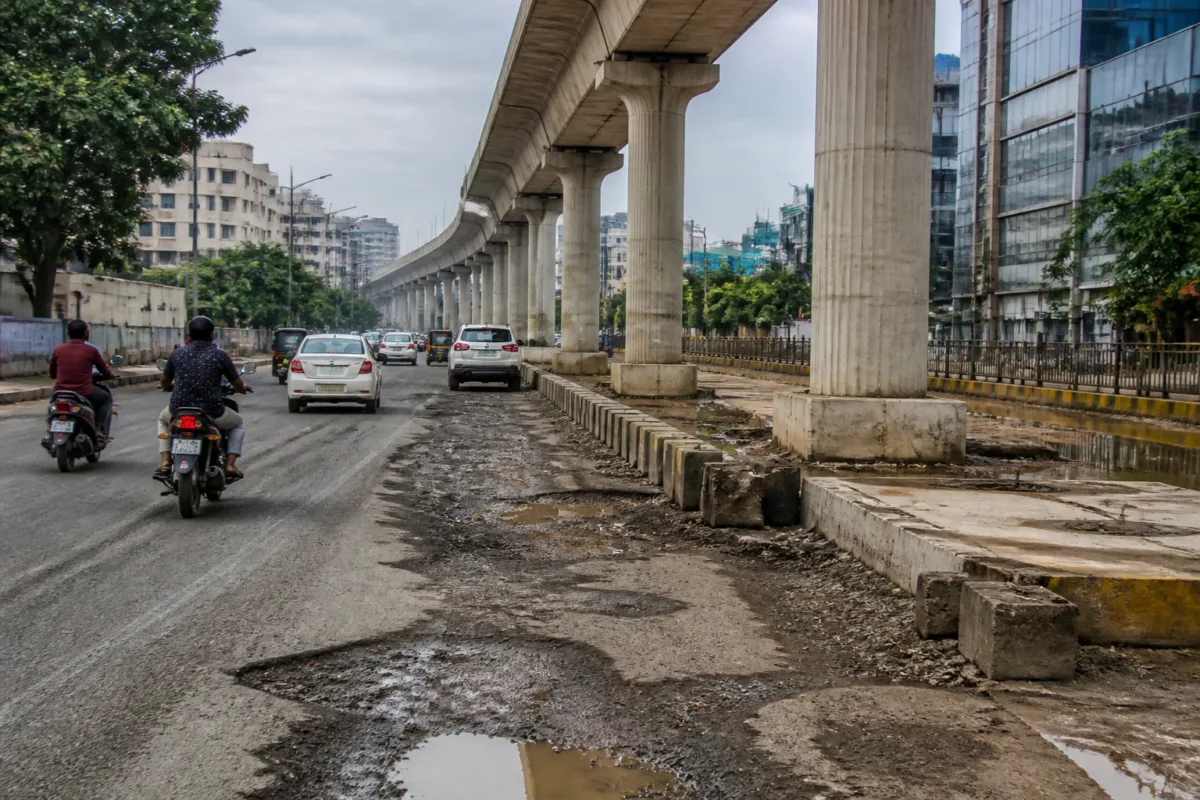
The opening of Pune’s Maan-Hinjewadi-Shivajinagar Metro has improved travel options for passengers, but the roads beneath and around the corridor remain damaged in several locations. The contrast exposes a recurring urban infrastructure problem: a major transport project can become operational before the surrounding street network has been restored to an equivalent standard.
According to a report by Civic Mirror – Pune, motorists have continued to complain about potholes, uneven surfaces and incomplete repairs on roads affected by metro construction. The reported problem extends beyond Ganeshkhind Road to parts of Baner, Balewadi, Wakad and Hinjewadi. While the metro has begun carrying passengers, road users in the same corridor are still dealing with the physical after-effects of construction.
The third metro corridor was inaugurated by Prime Minister Narendra Modi in the week before the report was published, and services began for passengers on 4 November. The new line has received a positive response from commuters, the report said. That benefit, however, has not removed the need to examine how the project has affected the public roads used to reach stations, connect neighbourhoods and move traffic beneath the elevated alignment.
This distinction matters because a metro corridor is not only a line, a station and a set of pillars. It is also a street-level system. The roads around stations carry pedestrians, buses, two-wheelers, cars, service vehicles and construction traffic. When those roads are dug up, narrowed or repeatedly patched, the disruption is experienced by people who may never use the metro itself. The quality of the surrounding road restoration therefore becomes part of the project’s public impact.
The reported damage is not uniform. Parts of Baner Road were excavated during construction, while roads between some stations remain damaged or uneven even after repairs were undertaken before the inauguration. The report also refers to the condition of the medians connecting metro pillars, where stones have reportedly not been arranged properly. Similar concerns have been raised around Baner Road, Balewadi Phata, Balewadi, Wakad and areas beyond it.
The uneven nature of the damage points to a coordination challenge rather than a single pothole-repair issue. Different road sections may have different owners, construction histories, surface materials and restoration requirements. A concrete road cannot necessarily be restored through the same method used on an asphalt road. Yet the report says that some damaged concrete sections on Baner Road have been covered with asphalt as a temporary measure, rather than rebuilt with concrete.
For residents and motorists, the immediate concern is usability. Priya Lokhande, identified in the report as a local resident, said the metro had made travel easier for many people but that attention was also needed below the viaduct. She described driving daily on uneven roads as difficult. Another resident, Kunal Chandere, questioned whether asphalt patches placed over damaged roads would remain durable under rainfall and continuous traffic and called for permanent repairs and an inspection of the entire corridor by officials.
These concerns reveal the difference between making a road appear repaired and restoring it as a functioning piece of infrastructure. A fresh patch can temporarily remove a visible pothole, but it does not necessarily resolve uneven levels, drainage problems, damaged edges, weak joins or the underlying failure of the road surface. The report does not provide an engineering assessment of the repairs, so the long-term performance of the patches cannot be independently established from the available material. It does, however, record a clear local demand for repairs that match the original road construction.
The responsibility described in the report rests within a multi-agency project structure. The Pune Metropolitan Region Development Authority, or PMRDA, is identified as the authority responding to the complaints. Its information and public relations officer, Purushottam Sangle, said the metropolitan commissioner had instructed the company concerned to complete repairs to roads damaged by metro works immediately. He said potholes had been filled in several locations, roads and service roads had been repaired, and work on the remaining roads was under way.
That response establishes that restoration has been treated as an active project obligation, rather than as an unrelated municipal complaint. It also leaves an important implementation question: how will completion be assessed? The statement says the remaining roads will soon be restored, but the supplied report does not specify a completion date, a road-by-road inventory, technical standards, inspection mechanism or details of who will certify the work.
Such information is important for projects built in dense urban corridors. Construction work frequently affects roads in stages: traffic is diverted, medians are altered, utility lines are accessed, station areas are excavated and surfaces are reinstated in sections. If the final condition of each section is not recorded and inspected, responsibility can become difficult to trace after the contractor has moved to another phase of work. Residents then experience the result as a series of local defects rather than as a single project-level obligation.
The report also shows how the timing of infrastructure delivery can shape public perception. The metro’s opening created a visible and immediate benefit for passengers. Road repairs, by contrast, are less prominent and can remain incomplete across multiple locations. A transport project can therefore be judged through two parallel experiences: the passenger inside the system and the road user outside it. The first may experience a new connection, while the second continues to encounter dust, uneven surfaces, potholes or temporary traffic arrangements.
This is particularly relevant in a corridor linking Maan, Hinjewadi and Shivajinagar, where metro infrastructure intersects with established roads and growing urban activity. The supplied report does not provide traffic counts, repair costs or a detailed map of affected stretches, so it cannot establish the total scale of the road damage. It does establish that complaints are spread across several locations and that the condition varies from one section to another. That makes a corridor-wide inspection more meaningful than isolated patchwork repairs.
The institutional question is therefore not simply whether potholes have been filled. It is whether the project’s restoration process can demonstrate that the street network has been returned to a safe, usable and technically appropriate condition. The PMRDA statement indicates that instructions have been issued and that work is continuing. Residents, meanwhile, are asking for permanent repairs and an inspection of the full route. The gap between these two positions is a question of verification and accountability.
The metro’s operational success and the road network’s condition should not be treated as competing outcomes. A functioning public transport corridor depends on access roads, service roads, crossings, footpaths and safe movement around stations. Damage to these elements can affect passengers as well as motorists, particularly those reaching stations by two-wheeler, bus, auto-rickshaw or on foot. The report does not quantify those effects, but its account of uneven roads around station areas indicates that the street-level environment remains part of the metro’s unfinished work.
What the evidence confirms is limited but significant: Pune’s new metro corridor is carrying passengers, while road restoration in and around the alignment remains incomplete or disputed in multiple places. Local residents have raised concerns about the durability and quality of repairs, and PMRDA says further work is in progress. What remains unestablished in the supplied material is the precise number of damaged road sections, the technical standard being applied to each surface, the responsible contractor for each location and the final deadline for completion.
The next measure of the project will therefore be visible at street level. PMRDA has said that the remaining roads will be restored soon. Until that work is completed and inspected across the corridor, the metro’s public infrastructure story will remain only partly finished.

