


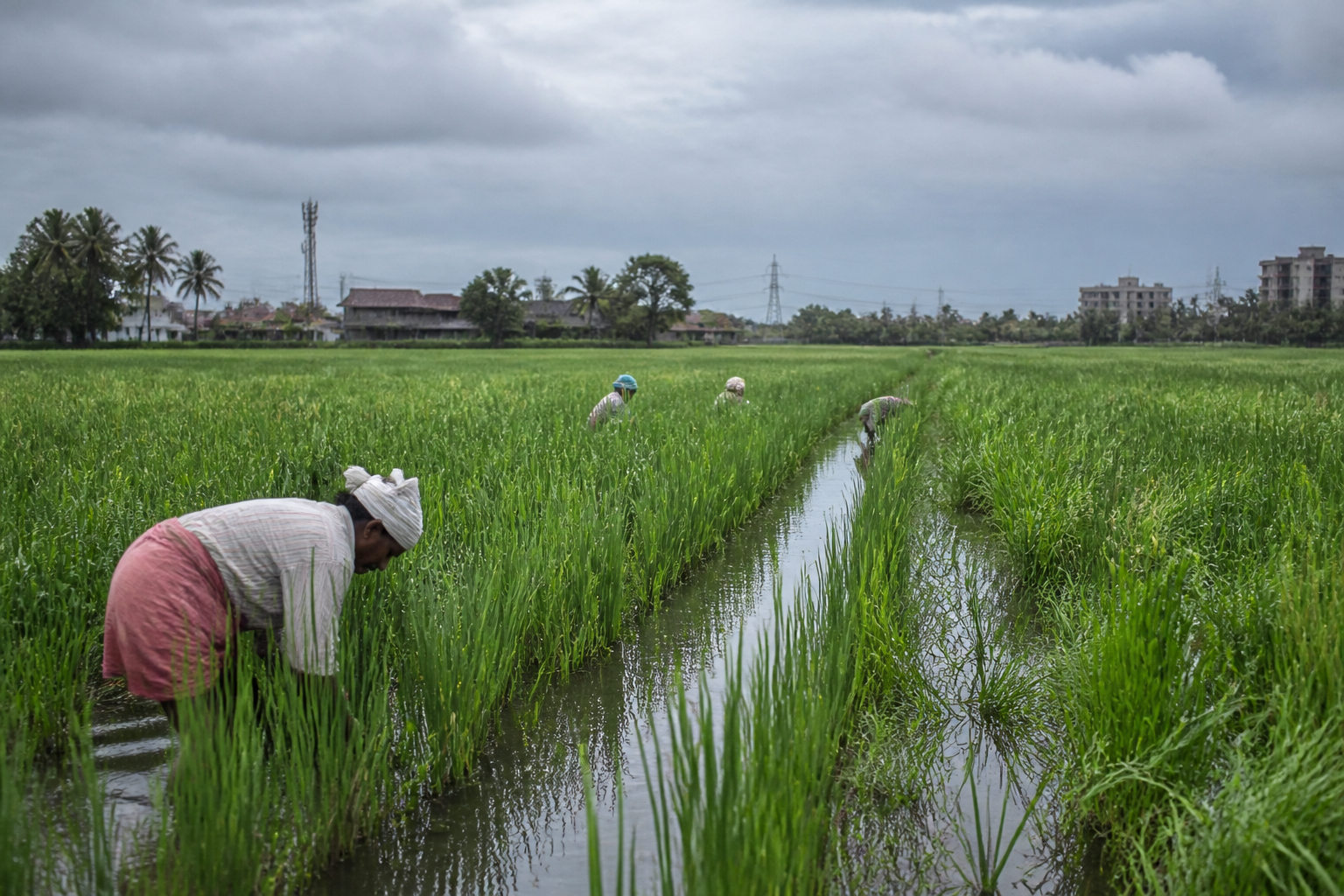
Pokkali rice farming is showing tentative signs of revival in the coastal belt around Kochi, but the recovery is taking place after decades of contraction driven by rapid urbanisation, changing livelihoods, labour shortages and the weakening economics of cultivation. The revival matters because Pokkali is not simply a crop. It is a farming system adapted to saline coastal landscapes, and its decline reflects the growing pressure on the wetlands and rural edges that sit within the wider Kochi urban region.
The paddy fields of Kadamakkudy, Varapuzha, Kottuvally, Ezhikkara, Vypin, Chittatukara and parts of Chellanam were once regarded as the rice bowl of the region. Land preparation, sowing, weeding and harvesting were once part of the local agricultural calendar. The Mathrubhumi report says that these activities have become increasingly rare, with most paddy fields left fallow and cultivation continuing only in a limited number of holdings.
The scale of the decline is visible in the area under cultivation. Pokkali paddy fields once covered approximately 24,000 hectares across the coastal areas of Ernakulam, Thrissur and Alappuzha. That area has now reduced to around 5,000 hectares, according to the report, while actual Pokkali rice cultivation takes place on less than 2,500 hectares. In Ernakulam district, cultivation currently covers about 350 hectares. The reduction is not merely a decline in agricultural output; it represents a shrinking landscape that historically absorbed and accommodated the conditions of the coastal environment.
Pokkali is cultivated in brackish-water zones and is described as a naturally grown rice variety that requires no fertiliser. The crop can tolerate saline conditions and grows to around 1.5 metres. A single ear can contain approximately 300 grains. These characteristics make it particularly suited to the low-lying coastal areas where conventional farming can be difficult. The crop’s adaptation to saltwater intrusion gives it an importance that extends beyond its market value, although the supplied report does not establish a separate quantified assessment of its economic or ecological contribution.
The pressures that pushed farmers away from cultivation are both economic and institutional. Income from farming declined, while finding sufficient workers for harvesting became increasingly difficult. For some landowners, Pokkali cultivation was retained only in connection with fish farming, which forms part of the traditional agricultural cycle in these coastal areas. As cultivation became less viable, fallow fields expanded and farming activity diminished.
This relationship between rice cultivation and fish farming is important for understanding why Pokkali cannot be assessed as a standard paddy crop. The system operates within a landscape shaped by tides, salinity and seasonal changes in water conditions. The report describes Pokkali as a crop that thrives in areas where seawater enters the fields. Its decline therefore raises a wider question about whether urbanising coastal regions can retain land-use systems that are adapted to local environmental conditions rather than replacing them with uses that may not perform the same function.
The recent revival has been driven by a combination of community participation and institutional support. Some farmers have returned to cultivation, while groups associated with the rural employment guarantee programme and Kudumbashree have entered the fields. Collective farming initiatives involving these groups have helped bring fallow paddy fields back under cultivation. The report also attributes support to local cooperative institutions, which have provided financial assistance, and to local governments and agricultural offices that have intervened to encourage cultivation.
This is a significant shift in the governance of the landscape. The return of cultivation is not being presented as the result of one large project or a single policy intervention. Instead, it has emerged through several local institutions operating together: farmers, employment-guarantee workers, Kudumbashree groups, cooperative bodies, local governments and agricultural offices. Their roles address different constraints, from labour availability and financing to technical and administrative support. The report does not provide the value of the financial assistance or identify the specific local bodies involved, but it shows that institutional coordination is central to the revival.
The revival also exposes the gap between recognition and implementation. Pokkali received a Geographical Indication certificate in 2009 and the Plant Genome Community Award from the Union Agriculture Ministry for 2010-11. It has also been elevated as a special rice variety. Yet formal recognition has not prevented the area under cultivation from collapsing. The contrast suggests that certification and awards can establish identity and prestige without, by themselves, ensuring that farmers have the labour, income, seed access and institutional conditions needed to continue cultivation.
The shortage of Pokkali seed has created another constraint. The report says that limited availability of Pokkali seed has led to the development of other varieties, including Chettivirippu and Vyttila-8. This indicates that preserving the crop is not only a question of protecting existing fields. It also depends on maintaining access to planting material and sustaining the knowledge required to cultivate a variety adapted to a specific coastal environment.
The existence of the State Pokkali Land Development Agency points to an established administrative mechanism for the welfare and development of Pokkali cultivation and its farmers. The report also notes a long-standing demand to preserve these environmentally vulnerable agricultural areas as heritage farming villages. That proposal places the fields within a broader planning debate: whether coastal agricultural landscapes should be treated as residual land awaiting conversion, or as heritage and environmental assets requiring active protection.
The urbanisation challenge is particularly relevant in the Kochi region, where coastal settlements, transport connections, housing expansion and other human activities have reshaped land use. The supplied report attributes the reduction of Pokkali fields partly to rapid urbanisation and human interventions. It does not identify individual projects or quantify the area converted to non-agricultural use. What it does establish is the direction of change: the landscape that once supported cultivation over approximately 24,000 hectares has contracted to about 5,000 hectares, with less than half of that remaining area under active Pokkali cultivation.
That pattern makes the current green cover in selected paddy fields both a revival and a warning. It demonstrates that cultivation remains possible where farmers and institutions can overcome labour, finance and organisational barriers. At the same time, the limited scale of the recovery shows that isolated cultivation cannot reverse the larger contraction without sustained support. The report describes the change as gradual, with only some farmers returning and only some fields becoming productive again.
For the coastal belt, the central issue is therefore not whether Pokkali can be revived in individual fields. The evidence in the report already shows that it can. The larger question is whether the institutions responsible for agriculture, local governance and land-use management can maintain the conditions that allow the system to continue. Those conditions include access to seed, farm labour, financial assistance and local administrative support, as well as the retention of the fields themselves.
Pokkali’s decline shows how a crop can lose ground even after receiving cultural, geographical and institutional recognition. Its tentative return shows that local collective action can reopen a path to cultivation. The next phase will depend on whether this support remains sufficient to expand beyond the current pockets of farming and whether the demand to protect Pokkali fields as heritage farming villages moves from longstanding advocacy into an operational land and agricultural policy. For now, the green fields around Varapuzha, Kadamakkudy, Kottuvally, Ezhikkara, Chittatukara, Vypin and Chellanam represent a limited but important countertrend to the coastal landscape’s continuing urban pressure.

