


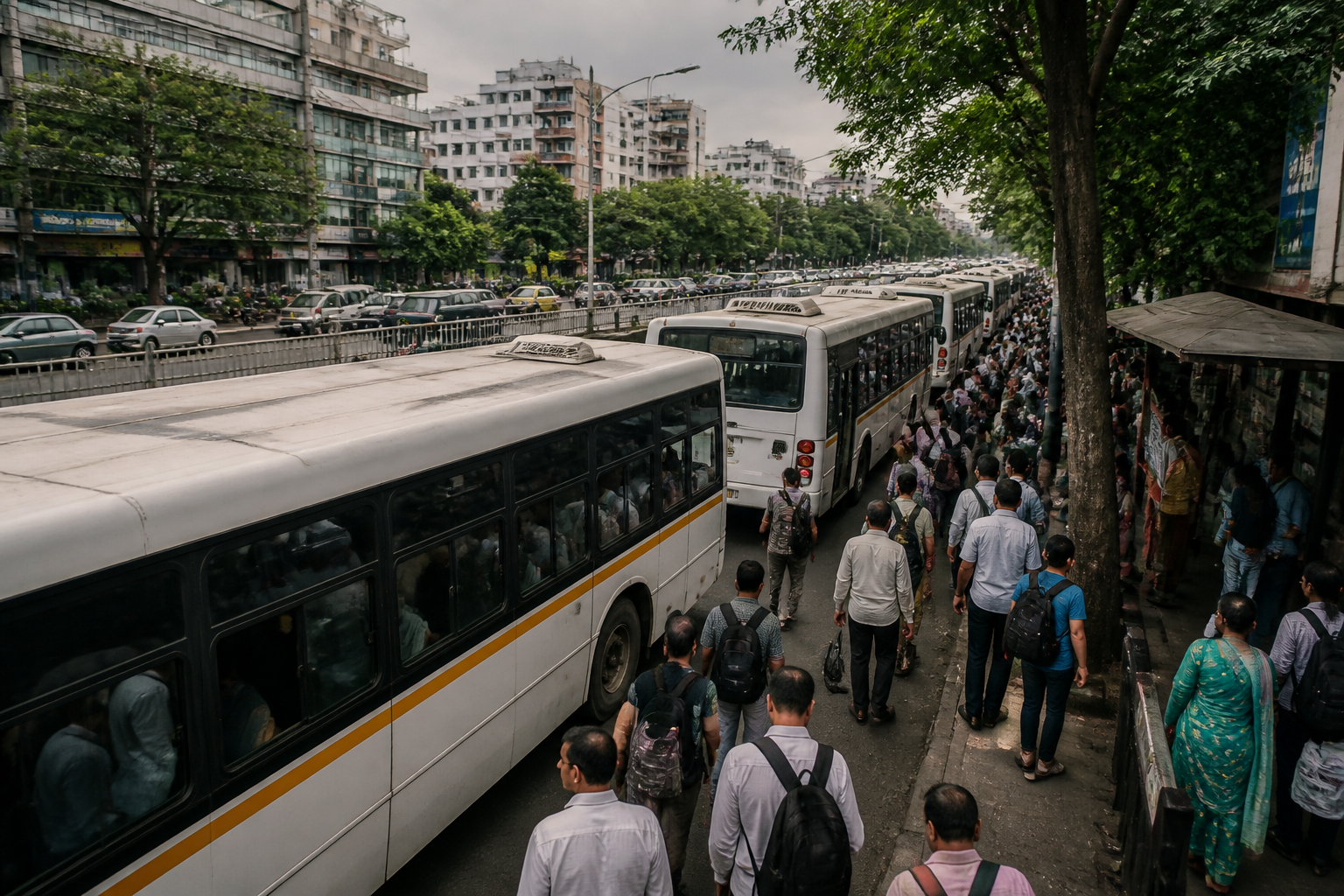
Pune’s public transport crisis is no longer only a question of how much money is available. A report by Loksatta – Pune says the Pune Mahanagar Parivahan Mahamandal Ltd (PMPML) has not added a single new bus to its fleet even though the Pune Metropolitan Region Development Authority (PMRDA) transferred Rs 230 crore about one-and-a-half years ago to support the purchase of 500 buses.
The delay matters because PMPML is reported to carry around 13 lakh passengers every day. In a city where public transport is expected to absorb some of the pressure on roads, the absence of funded buses is not simply a procurement story. It is a measure of how urban institutions convert budgetary commitments into operating services.
According to the report, the PMPML board placed a resolution for the purchase of new buses on 25 March 2025. The board minutes reportedly recorded that PMRDA had transferred Rs 230 crore to PMPML’s account for buying 500 buses. The funding was part of a wider plan to purchase 1,000 new buses, with contributions expected from the Pune Municipal Corporation, the Pimpri-Chinchwad Municipal Corporation and PMRDA.
Yet the report says that no new bus from this procurement has begun running on Pune’s roads. The explanation attributed to PMPML chairman is a chain of technical and administrative stages: resolutions, negotiations, tendering, performance testing, contracting, re-examination and changes. Each stage may have a formal purpose, but together they have created a long gap between the availability of funds and the delivery of public transport capacity.
## The gap between funding and service
Urban infrastructure is often measured through announcements, sanctioned amounts and project approvals. For passengers, however, the relevant measure is whether a bus arrives, whether routes can be served reliably and whether the system has enough capacity to meet daily demand. The PMPML case highlights the distance between those two forms of measurement.
The Rs 230 crore transfer is an important administrative milestone, but it is not the final outcome. Funds held in an account do not automatically produce vehicles, and a board resolution does not create additional capacity until procurement is completed. The reported delay shows that the implementation chain is as important as the financial allocation itself.
The process described by Loksatta – Pune also indicates that procurement is not a single decision. It involves multiple points at which specifications can be negotiated, bids can be evaluated, vehicles can be tested, contracts can be prepared and terms can be reconsidered. These safeguards are intended to protect public money and ensure that the vehicles meet operational requirements. But when the stages are not completed within a defined and publicly visible timeline, they can become a source of institutional delay.
For PMPML, the consequence is that the organisation is expected to serve a large daily passenger base without the additional buses that the funding was intended to provide. The report does not establish the current size, age or availability of the existing fleet, so the precise operational effect of the delay cannot be quantified from the available information. It does, however, establish that the planned expansion has not yet translated into buses on the road.
## One procurement, several institutions
The proposed purchase also reflects the divided institutional structure of Pune’s public transport funding. PMPML is the operating entity responsible for bus services, while PMRDA and the two municipal corporations are identified as funding partners for the 1,000-bus programme. This arrangement can make large purchases possible by pooling resources, but it also creates a need for clear coordination between the bodies involved.
The available report confirms PMRDA’s contribution for 500 buses and identifies the broader funding arrangement. It does not provide the contribution amounts of the Pune and Pimpri-Chinchwad municipal corporations, nor does it state whether their funding has been transferred. It also does not specify the procurement model, the technical specifications, the number of tenders received, the names of bidders or the revised delivery schedule.
Those missing details are significant because they determine where the delay is located. If the bottleneck is in the tender, it would raise questions about the procurement design or market response. If it is in performance testing, the issue would relate to technical compliance. If the contract is being revised, the critical question would be what changed and why. The supplied report attributes the delay broadly to the technical process but does not identify one decisive failure point.
That distinction is important for accountability. A general explanation that procurement is under way can keep a project politically and administratively alive without giving passengers a clear expectation of when service capacity will improve. A more useful public record would connect each stage to a date, a responsible institution and an outcome.
## Why the 25 March 2025 resolution matters
The date of the PMPML board resolution provides a reference point for judging progress. By September 2026, the resolution was about 18 months old. The report says the PMRDA funding had also been received about one-and-a-half years earlier. This means the delay is not an initial approval problem alone; it has extended across the subsequent phases of procurement and implementation.
The chronology also shows why the story is better understood as an administrative performance issue than as a routine announcement. The public commitment was made, the funding was reportedly transferred and the board recorded the proposed purchase. The unresolved question is how long a public transport agency should take to convert that sequence into operating buses, and how that performance is monitored when several public bodies are involved.
The report does not state that the funds have been diverted, lost or withdrawn. Nor does it establish that the delay was caused by wrongdoing. The evidence supports a narrower conclusion: the money was reportedly made available for the intended purchase, but the procurement process had not delivered buses by the time of the report.
## The passenger-facing cost of delay
The passenger impact is clearest in the scale of PMPML’s reported daily ridership. Around 13 lakh people depend on the system each day, according to the report. Any planned increase in fleet strength therefore has a direct relationship with the city’s ability to provide public transport at scale.
The available material does not provide route-level data, frequency figures, cancellation numbers or passenger complaints, so it cannot show which corridors are most affected. It also does not establish whether existing buses have been withdrawn, whether services have been reduced or whether the planned 500 buses were intended to replace ageing vehicles or expand the fleet. Those questions would be necessary to assess the operational consequences more precisely.
Even without those details, the case demonstrates a structural problem common to urban transport: capital spending and daily operations are treated as separate administrative subjects when passengers experience them as one service. A sanctioned bus purchase affects route planning, depot capacity, maintenance, staffing and scheduling. Until the vehicles are delivered and integrated into operations, the financial decision remains incomplete from the commuter’s perspective.
## What remains to be established
The next stage of scrutiny should focus on the procurement record rather than on the announcement alone. The key documents would include the board resolution, tender notices, bid evaluation status, performance-testing records, contract drafts or signed agreements, and any revised procurement timeline. The public record should also clarify whether the full Rs 230 crore remains earmarked for the 500 buses and whether the wider 1,000-bus programme is proceeding on the same schedule.
The source report does not provide those documents or a final delivery date. It also does not record a detailed response from PMRDA or the two municipal corporations on their respective roles. As a result, the central fact is clear—the buses have not entered service despite the reported funding—but the precise administrative cause and the next implementation milestone remain unclear.
Pune’s bus procurement delay therefore offers a useful test of urban governance. The challenge is not only to approve transport spending, but to make the chain from funding to tender, testing, contracting and service delivery visible and time-bound. Until that chain produces buses on the road, the Rs 230 crore allocation remains an input rather than an improvement in public mobility.
