


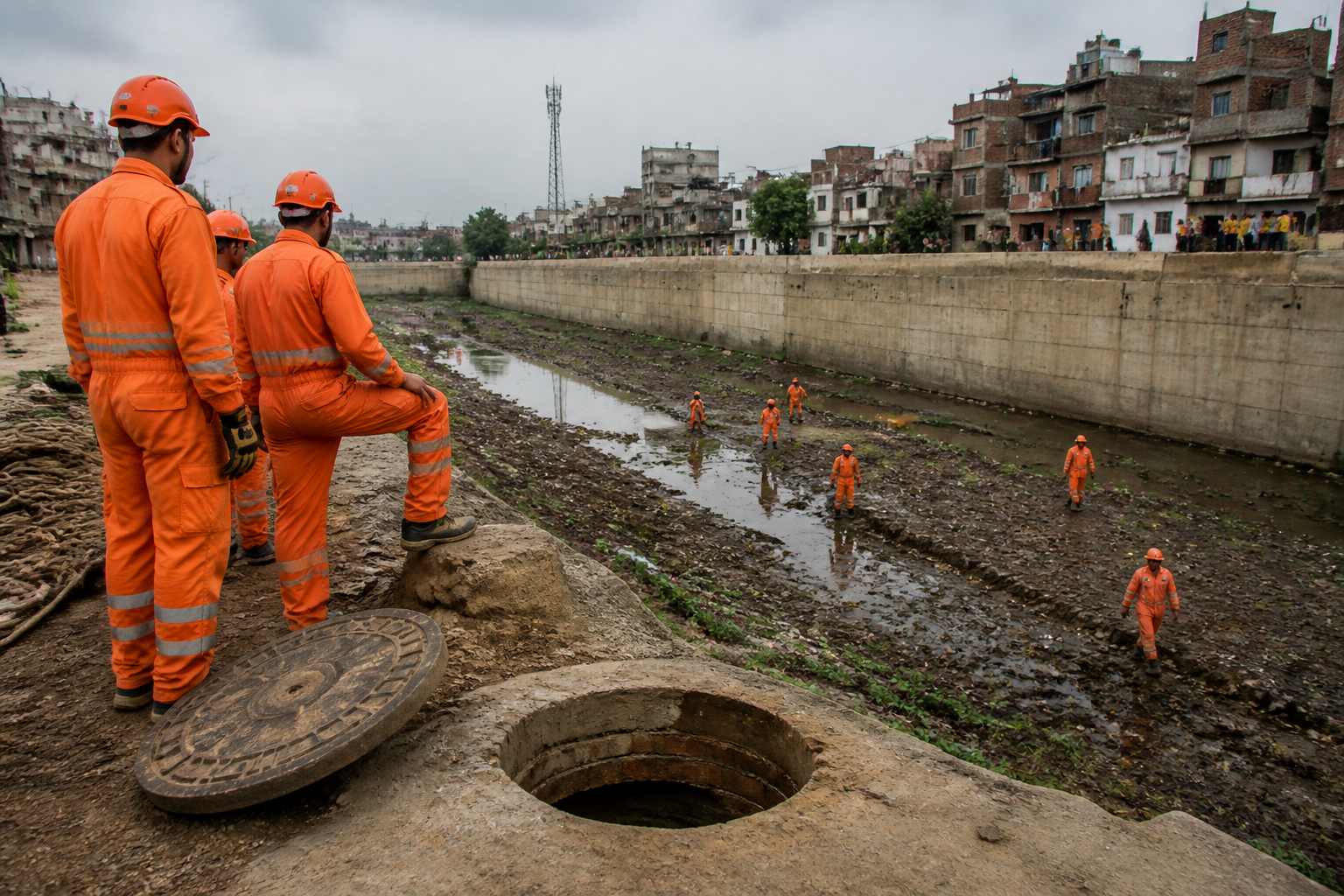
The Piplaj drain rescue operation in Ahmedabad entered its fourth day on October 13, with the missing girl still not found despite round-the-clock searches by the fire department, drainage officials and the National Highways Authority of India. Five previously closed manholes were excavated and inspected, while teams also searched the riverbed into which the drain water flows.
The incident, reported by Sandesh, began after a girl fell into a drain near Piplaj. The supplied report does not provide her name, age, the precise time of the incident or the circumstances that led to the fall. It does, however, show how a local emergency quickly became a multi-agency operation involving underground drainage infrastructure, road-related authorities and open water channels.
That institutional overlap is central to understanding the search. The fire department is leading rescue activity with the drainage department and NHAI teams. Their work has continued for 24 hours at a time, covering possible sections of the drain line and points where the child could have become trapped. The report says teams have examined the hazardous flow within the drainage system and monitored all possible access points.
The decision to excavate five closed manholes was one of the operation’s most significant steps. According to the report, these manholes had earlier been closed by NHAI. They were dug open so that rescuers could enter the line and inspect it with equipment. The action indicates that the search could not be confined to visible openings or accessible sections of the drain. Investigators had to reopen infrastructure that had previously been sealed in order to examine the full route.
This detail also exposes a practical difficulty in urban emergency response: infrastructure designed to remain closed during normal operations may become a barrier when a rescue requires access. The available report does not establish why the five manholes had been closed, when they were sealed or whether their condition complied with any specific maintenance or safety standard. It only records that they were excavated as part of the ongoing search.
The search has also moved beyond the underground network. Rescue teams examined the riverbed and open areas along the riverbank in the direction in which the drain water travels. The report says the operation was extended across a large area, with teams monitoring the riverbed and adjacent open spaces. This expands the operational challenge from locating a person inside a defined drain line to covering a wider downstream area.
The continued absence of information about the girl after four days makes the incident more than a short-duration rescue alert. It has become a test of how Ahmedabad’s agencies map, access and monitor drainage infrastructure during an emergency. The supplied report does not establish the length or layout of the relevant drain, the flow rate, the location of the outfall, or the distance between the Piplaj site and the riverbed. Without those details, the public cannot independently understand the complete search area or evaluate how it has been prioritised.
The operation’s structure nevertheless reveals that the drainage system is not being managed as a single, easily accessible asset during the rescue. Fire personnel, drainage officials and NHAI teams are working together, with different responsibilities likely attached to the underground line, access points and surrounding infrastructure. The source does not specify the formal command structure, which agency is coordinating the operation or whether a unified incident log is being maintained. Those administrative details matter because prolonged searches require clear responsibility for decisions, information sharing and public communication.
The Piplaj incident also highlights the safety implications of open or hazardous urban drainage environments. The report describes the drain as having a dangerous flow and says that teams have been checking every possible section. It does not state whether the opening through which the girl fell was marked, barricaded, covered or located near a pedestrian route. Nor does it say whether authorities have inspected similar drain points in the surrounding area after the incident. These facts remain unestablished in the supplied material, but they are directly relevant to understanding whether the event was isolated or connected to a wider access and maintenance problem.
For residents, the immediate issue remains the search. For the agencies involved, the operation requires decisions across different physical environments: confined underground spaces, excavated manholes, active drainage channels, riverbanks and open riverbed areas. Each location presents different access and safety conditions. The report confirms that searches have been conducted in all these areas, but it does not provide a site map, the number of personnel deployed, the equipment being used or the precise sequence in which locations have been cleared.
The absence of such operational information limits public understanding of progress. A four-day rescue operation generates a need for regular, precise updates: which sections have been searched, which manholes have been opened, whether water flow has been controlled, how far downstream teams have checked and what remains pending. The supplied report confirms that five manholes were excavated and the riverbed searched, but it does not include a formal progress statement or a timetable for the next stage.
The incident also raises a governance question about infrastructure ownership. NHAI’s involvement suggests that at least part of the relevant access or drainage environment is connected to infrastructure under or near a national highway authority’s jurisdiction. The drainage department and fire department are separately involved. The report does not define the legal or operational boundaries between these agencies. That missing information is important because responsibility can become unclear when a drainage line, road corridor, closed access point and downstream watercourse intersect.
A rescue operation can reveal weaknesses that routine infrastructure inspections may not capture. A manhole may be adequate for ordinary maintenance but difficult to reopen quickly. A drain may be mapped administratively but not understood as a continuous route during an emergency. A downstream riverbed may fall outside the immediate jurisdiction of the agency responding to the original incident. In Piplaj, the teams’ decision to search both the closed manholes and the riverbed shows that the physical system extends beyond the location where the incident was first reported.
What the available evidence confirms is limited but serious. A girl is missing after reportedly falling into a drain near Piplaj. The search had continued for four days by October 13. Fire, drainage and NHAI teams had been conducting round-the-clock operations. Five previously closed manholes were excavated and inspected, and searches were extended to the riverbed and riverbank areas. The girl had not been located when the report was published.
What remains unclear is equally important: the condition of the drain opening, the exact route of the drainage line, the reason the manholes were closed, the command structure for the rescue, the total area searched and the next official milestone. Those gaps should be addressed through authoritative updates as the operation continues. Until then, the Piplaj case remains both an unresolved rescue and a stark indicator of how difficult it can be to secure, access and govern interconnected urban drainage infrastructure.

