


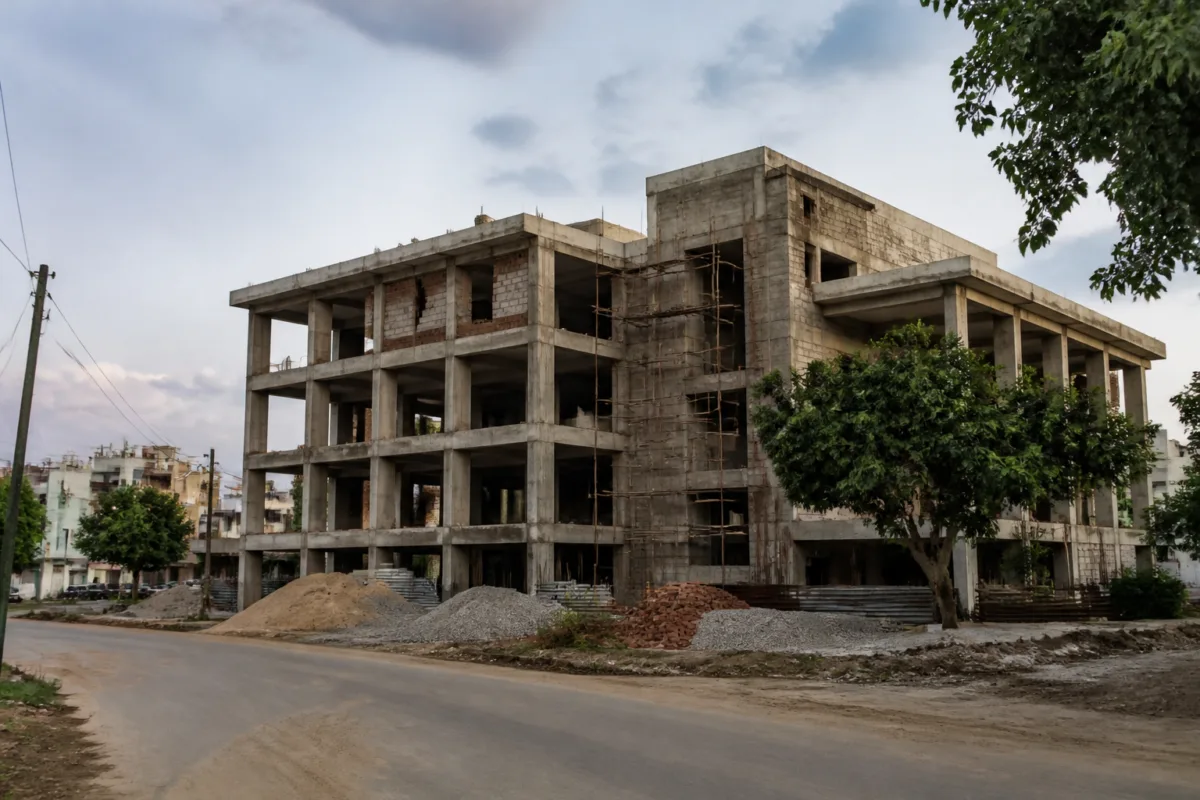
The latest failed tender for Panchkula municipal corporation’s headquarters is not merely another delay in a public construction project. It has extended an institutional problem that began when the corporation was formed in 2010: the civic body responsible for managing the city still does not operate from a single, completed administrative base. Its offices remain divided across three sectors, forcing employees and residents to navigate a fragmented system.
The immediate development is that no contractor responded to the latest tender for the remaining work on the proposed headquarters in Sector 3. The project, now valued at ₹17.6 crore for the unfinished portion, requires eight months of work according to the report. Yet the corporation was unable to finalise an agency after re-inviting contractors, prolonging a construction stoppage that has already lasted three years.
That sequence is significant because the building is not a newly announced proposal awaiting approval. The five-storey structure, with a basement and spread across a 1.2-acre plot, was initiated in 2020. A ₹29.49-crore contract had been awarded in December 2019, with completion originally scheduled for April 2021. The project therefore missed its first deadline before the civic body was forced to deal with a much larger contract and administrative failure.
The original contractor completed work valued at ₹11 crore before the municipal corporation terminated the agreement in February 2023. According to the report, the termination followed allegations of unauthorised sub-contracting, execution discrepancies and chronic delays. More than ₹17 crore of finishing and balance construction work remained pending. The latest tender was intended to restart that work, but the absence of bidders has left the project without a new executing agency.
This makes the headquarters a useful case study in how urban institutions can become trapped between contract termination and re-tendering. Terminating a contractor may be necessary when work quality, compliance or timelines fail. But termination does not by itself restore public capacity. The authority must also establish the remaining scope, assess the condition of incomplete work, determine the financial and contractual liabilities, and create terms that contractors are willing and able to accept. The source report does not establish which of these issues prevented bidding, but the failure to attract a contractor shows that the project has not yet moved from dispute resolution to effective delivery.
The construction problem has also become an operational problem. Panchkula municipal corporation currently functions from facilities in Sectors 4, 12A and 14, with one branch operating from a local community centre. The arrangement means that the corporation’s departments are not physically consolidated, even though they belong to the same civic institution. For residents, this can turn a routine municipal matter into a sequence of visits to different locations. For staff, the lack of adequate office space affects the day-to-day functioning of the organisation.
S K Nayar, president of the Panchkula Citizens Welfare Association, described the consequences in direct terms, saying employees were suffering because of limited space and residents had to visit different sectors to complete work or meet officials. He also questioned why the corporation continued to float tenders without first examining why contractors were unwilling to take up the project. His comments connect the construction delay to the public-facing performance of the municipal body rather than treating the building as an isolated capital works issue.
The institutional contradiction is clear. A municipal corporation is expected to plan and deliver services across a city, coordinate departments, manage public assets and provide residents with accessible administrative channels. Yet its own administrative infrastructure remains unfinished more than a decade after its inception. The fragmented office arrangement does not automatically prove that every civic service is failing, but it creates additional friction in the relationship between the institution and the public it serves.
The project’s financial history adds another layer. The original contract was worth ₹29.49 crore, while the latest tender concerns ₹17.6 crore of work. The report separately states that more than ₹17 crore of finishing and balance construction remains pending after ₹11 crore of work was executed. The figures indicate that a substantial share of the project remains incomplete, while also showing why a restarted project cannot be treated as a simple continuation of the original contract. The corporation is now dealing with unfinished construction, a terminated agreement and a fresh procurement process.
For public construction, the tender stage is often presented as a procedural milestone. In practice, it is also a test of whether the project has been made commercially and technically legible to the market. Contractors need clarity on the remaining quantities, site conditions, design responsibility, payment arrangements, prior work and risk allocation. When no bidders respond, the public record needs to explain whether the problem lies in cost, scope, contractual conditions, the condition of the partially built structure or the perceived risk of taking over a delayed project. The report records the failed tender but does not provide the corporation’s explanation for the lack of response.
That missing explanation is now central to the project’s future. Repeating the same tendering approach without identifying the reason for non-participation could produce another cycle of invitations, non-response and delay. The citizens’ association has raised precisely this concern, asking the corporation to evaluate where the process is failing rather than simply reissue tenders. Whether the civic body changes the procurement strategy, revises the scope or addresses unresolved contractual matters has not been established in the supplied report.
The headquarters also demonstrates how delays in civic buildings can remain politically and administratively less visible than delays in roads, bridges or transit systems. A stalled municipal office does not always produce an immediate traffic disruption or visible service shutdown. Its costs are dispersed: employees work in constrained spaces, departments remain separated, visitors travel between facilities and coordination becomes dependent on an arrangement that was never intended to be permanent. Over time, a temporary workaround can become the operating model.
For Panchkula, the next important milestone is not simply the announcement of another tender. It is the corporation’s ability to secure a viable agency for the remaining eight months of work and establish a credible completion path. The available information confirms the original deadline, the contractor’s termination, the value of completed and pending work, and the latest failed tender. It does not establish a revised completion date or the specific reason bidders stayed away.
The unresolved headquarters therefore remains both a construction project and a measure of municipal capacity. Until the civic body explains the procurement failure and completes the Sector 3 building, Panchkula’s administration will continue to function across three sectors, while residents will continue to experience the practical consequences of an institution that has yet to build a permanent home for itself.

