


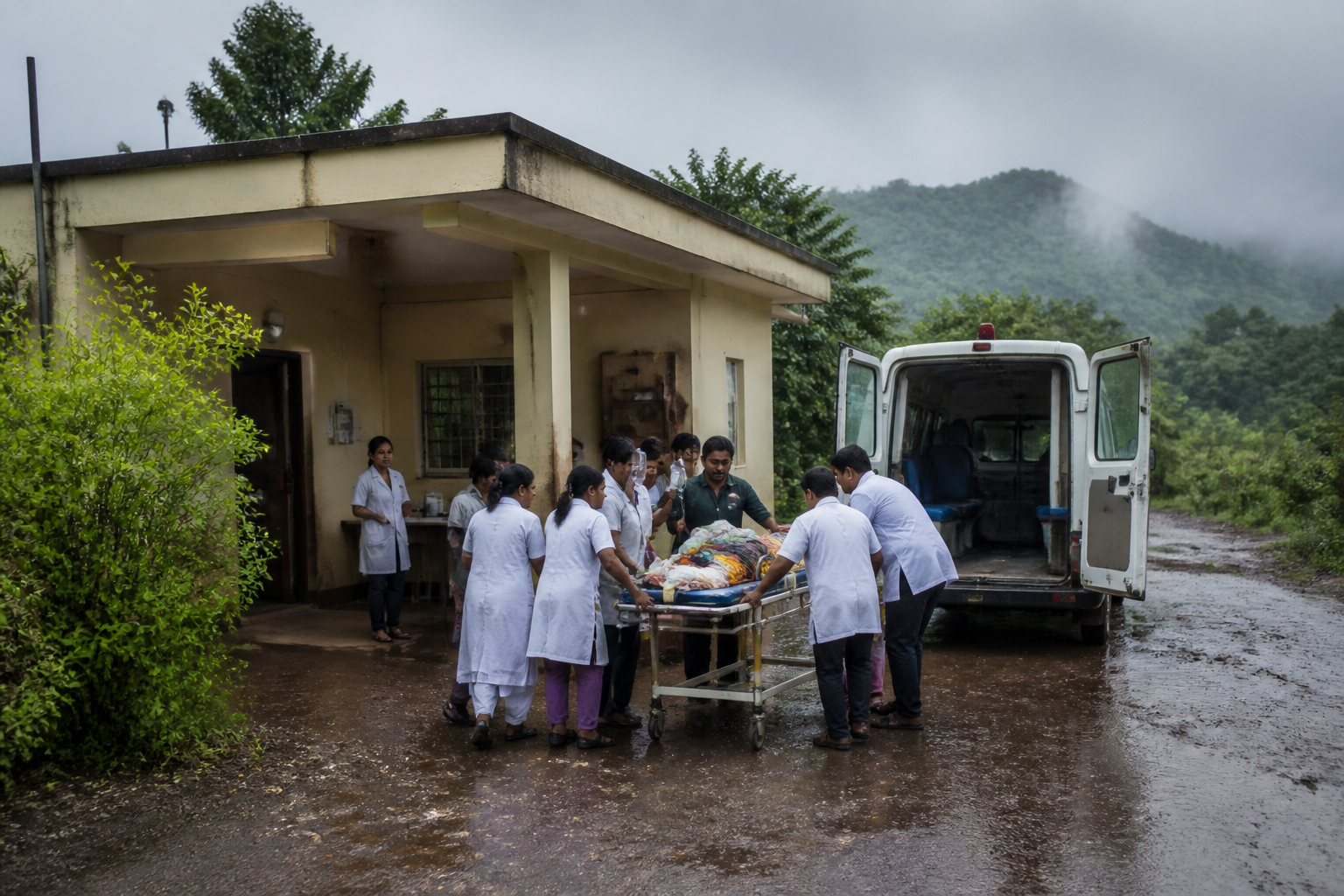
Palghar’s reported fall in infant and child deaths offers a measurable example of how local administration can use monitoring systems, emergency transport and seasonal planning to address health risks in difficult-to-reach rural areas. The district recorded 453 deaths among children below one year in 2014-15, the year associated with its establishment. That number fell to 220 in 2025-26, according to a report by Loksatta – Palghar. Deaths among children up to six years declined from 626 in 2014-15 to 262 in 2025-26.
The figures do not establish that one intervention alone caused the decline. They do, however, point to a broader shift in how Palghar’s health administration is managing periods when risks rise sharply. The district has created special control rooms for the four monsoon months, introduced separate contact numbers and activated a tracking system for pregnant women, infants and children. The stated purpose is to identify vulnerable patients earlier, coordinate transport and ensure that they reach health facilities in time.
This approach matters because Palghar’s health risks are shaped not only by clinical conditions but also by geography, mobility and household livelihoods. The report identifies Jawhar, Mokhada, Vikramgad, Talasari and Wada as areas where many families migrate to urban locations after Ganesh festival and Diwali in search of work. They return to their villages around June. Poor living and working conditions at migration destinations can leave adults and children in weakened health, making the transition back to remote villages particularly difficult during the monsoon.
The seasonal pattern creates a compound access problem. Illness may spread or worsen when families return, while heavy rain and difficult terrain can delay medical care. Pregnant women may need transport for delivery, children may require urgent treatment, and health workers may have to coordinate across settlements that are not easily connected. In such circumstances, a control room is not simply an administrative office. It functions as a coordination point linking information about patients with the movement of ambulances and the availability of health institutions.
According to the report, Palghar’s health department established control rooms at district and taluka levels for the monsoon period. It also assigned mobile phones for contact and created a tracking system for pregnant women and children. When a child was reported to be ill, the system allowed the control room to coordinate with health personnel and arrange an ambulance to take the child to a health institution. For pregnant women considered to be at higher risk, the administration reportedly arranged relocation to safer and more accessible places several weeks before delivery.
That preventive step changes the timing of intervention. Instead of waiting for a medical emergency in a remote settlement, the health system attempts to move a vulnerable woman closer to a facility while contact can still be maintained. The report says health officials continued to collect information about these women and directed them to health institutions when required. The effectiveness of such a system depends on accurate lists, regular follow-up, reliable communication and transport that is available when the need arises.
The ambulance network has been a central part of the problem. Palghar’s rural areas have relied on 108 emergency ambulances and 102 ambulances attached to primary health centres. The report says 108 services were sometimes unavailable for different reasons, while 102 ambulances could be occupied with collecting medicines, transporting supplies or travelling to the district headquarters for administrative work. When the same vehicles are expected to serve both logistics and patients, emergency access becomes vulnerable to competing demands.
The health department has therefore introduced a separate arrangement for bringing medicine stocks to primary health centres, according to the report. This has released health-centre ambulances for children requiring treatment and pregnant women needing transport for delivery. District Health Officer Dr Santosh Chaudhari told Loksatta that the greater availability of ambulances had helped the health system provide timely care and contributed to a significant decline in infant, child and maternal deaths.
The reported data shows both progress and continuing seasonal pressure. In 2025-26, 220 deaths of children below one year were recorded, compared with 453 in 2014-15. By the end of July in the current year, 64 infant deaths had been recorded. Among children up to six years, 262 deaths were recorded in 2025-26, compared with 626 in 2014-15. The number recorded up to July in the current year was 81. The report says deaths have historically been higher during the monsoon, but that the increase this year remained under control.
The figures require careful interpretation. The report does not provide a full annual series, population denominators, cause-of-death classifications or a detailed comparison between talukas. It also does not specify how much of the decline is associated with better vaccination, ambulance availability, nutrition services, changes in migration patterns or other factors. The numbers are therefore evidence of a substantial reduction in recorded deaths, but not a complete evaluation of the district’s health interventions.
Vaccination is another part of the district’s reported response. Palghar is said to have achieved its 100 per cent vaccination target during the year. The report links this achievement with protection for newborns and children against several infectious diseases and says that illness declined to some extent. Without details of the vaccines, target population, coverage methodology or comparison period, the claim cannot be independently assessed from the supplied material. It nevertheless shows that the district’s strategy extends beyond emergency response to preventive public health.
The same report makes clear that lower mortality does not mean the underlying vulnerabilities have disappeared. Malnutrition remains a concern, and the administration still faces the challenge of improving social conditions that influence children’s health. Seasonal migration can disrupt continuity of care. Families may return from insecure work and inadequate housing with children whose health has already deteriorated. The report also refers to bonded labour in the region and calls for effective government action to address migration driven by the search for employment.
This is where Palghar’s child mortality issue becomes an urban and infrastructure question as well as a health question. Families move between rural villages and urban work sites, carrying health risks across that geography. Their access to housing, sanitation, food, transport and medical services is shaped by both the place where they work and the village to which they return. A district health system that tracks only the location of a patient’s permanent residence may miss the periods when a family is most exposed to risk.
The report’s proposed responses include creating local employment, improving health-institution infrastructure, strengthening hospitals and ensuring more carefully planned newborn-care facilities. It also identifies the need for neonatal ambulances when newborns must be referred between facilities. These are not described as completed measures; they are areas where further work is considered necessary. The distinction is important because monitoring and coordination can reduce delays, but they cannot substitute for adequately staffed, equipped and connected health institutions.
Palghar’s experience also exposes the importance of administrative design. A control room can improve response only if information flows from families and frontline workers to decision-makers, and if the system has authority and resources to act on that information. A tracking list has limited value when contact numbers fail, an ambulance is unavailable or the receiving institution lacks the necessary facilities. The reported separation of medicine transport from patient transport addresses one such operational conflict by protecting ambulances for clinical emergencies.
The district’s remaining challenge is to convert a seasonal emergency arrangement into a durable public-service system. The monsoon control rooms are designed for four months, but the conditions they respond to migration, malnutrition, difficult terrain, gaps in transport and limited healthcare infrastructure exist throughout the year. Seasonal planning can identify the period of greatest risk, while longer-term investment is needed to reduce the exposure that makes each monsoon dangerous.
The available evidence confirms a major reduction in recorded infant and child deaths in Palghar between 2014-15 and 2025-26, alongside reported improvements in tracking, vaccination and ambulance coordination. It does not yet show the precise contribution of each intervention or whether gains are evenly distributed across the district. The developments that warrant continued monitoring are the quality of rural health infrastructure, the availability of neonatal referral transport, the effect of migration and employment conditions, and whether lower mortality can be sustained beyond the monsoon response period.
