


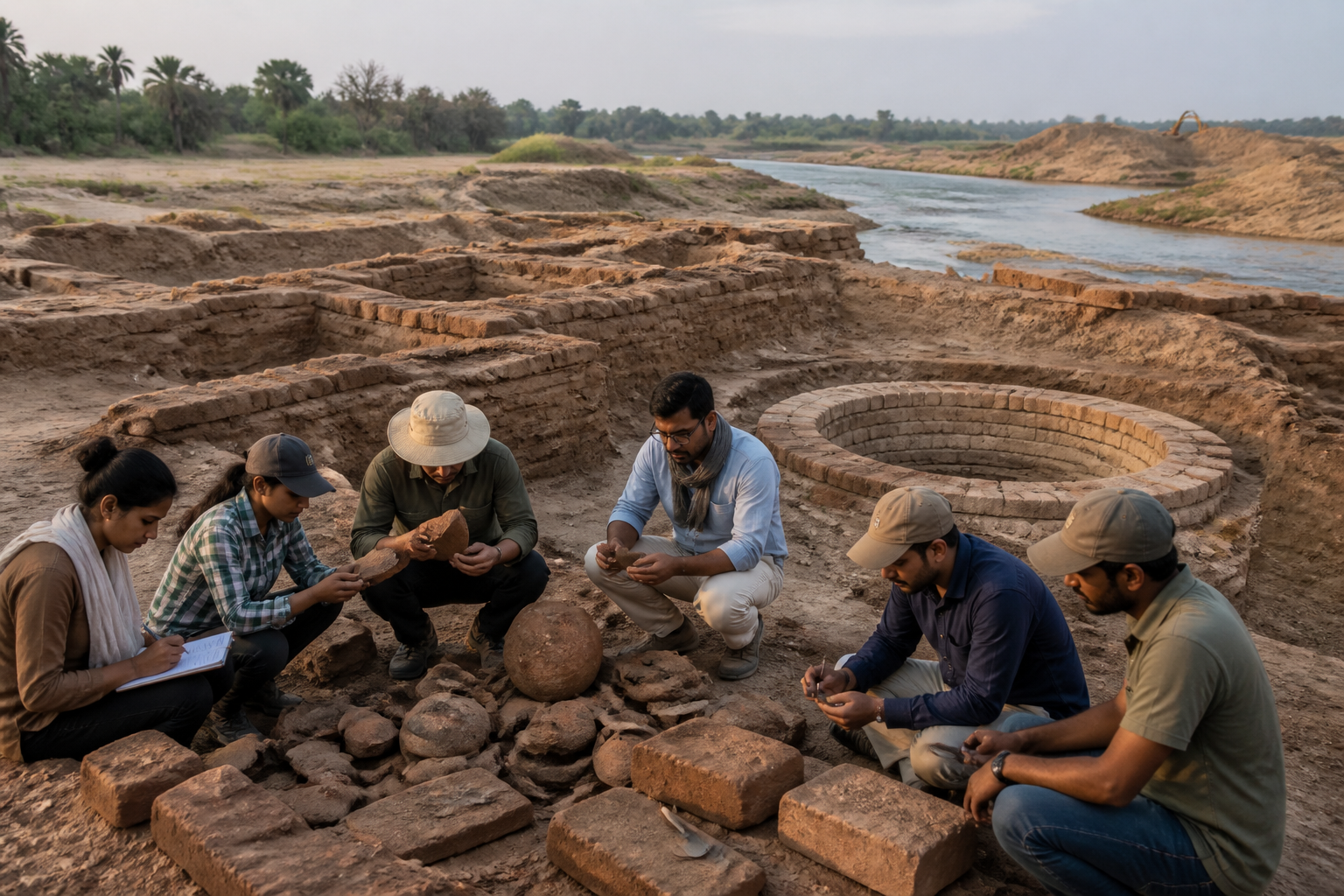
A university-led field survey in Kuppakurchi near Tirunelveli has uncovered brick structures, ring wells and other archaeological remains believed to be between 1,000 and 2,000 years old, while large parts of the wider site have already been damaged by soil extraction for brick production.
The discovery was made near Mundan Temple in Kuppakurchi village, close to the point where the Chittar joins the Tamiraparani River near Sevalaperi. Students of Manonmaniam Sundaranar University first identified signs of ancient habitation in the area. Following the discovery, a team of professors and students led by C. Sudhakar, acting head of the university’s archaeology department, conducted a surface field survey.
The survey found ring wells measuring about 2 feet in diameter, semi-precious stone beads, circular discs, terracotta earrings, white pottery with floral designs, terracotta objects identified as ‘thaggalis’ and remains of ancient brick construction. The finds were examined by archaeology professors Murugan and Madhivanan.
The bricks used in the structures are about 30 cm wide, 9 cm high and more than 39 cm long, according to the report. They are larger than bricks recorded at the Keeladi excavation, which measured about 24 cm in width, 6 cm in thickness and 36 cm in length. The difference in dimensions has been highlighted by the researchers as a notable feature of the Kuppakurchi remains.
Similar brick structures have also been identified near Mundan Temple in Madathupatti village, south of Kuppakurchi. The report says ancient construction remains once spread across hundreds of acres in the area, but many were destroyed after soil was removed for brick manufacturing. The surviving portions are also reported to be at risk of further deterioration.
The location is around 20 km from Adichanallur along the Tamiraparani riverbank. Adichanallur is associated with major archaeological findings, but the habitation area of the people who lived there has not yet been identified, according to the report. This regional connection gives the Kuppakurchi discovery significance beyond the individual artefacts and structures found during the survey.
Researchers have provisionally placed the remains between 1,000 and 2,000 years old, but the exact age of the ancient bricks has not yet been established. C. Sudhakar said steps were being taken to send the bricks for scientific examination to determine their date more precisely.
The immediate challenge is the condition of the surviving site. The discovery has identified evidence of ancient settlement and construction, but the reported loss of large portions of the archaeological landscape shows how unprotected remains can be affected by local material extraction before detailed excavation and documentation are completed. Further dating and archaeological examination will determine the site’s chronology and relationship with other settlements along the Tamiraparani basin.
