


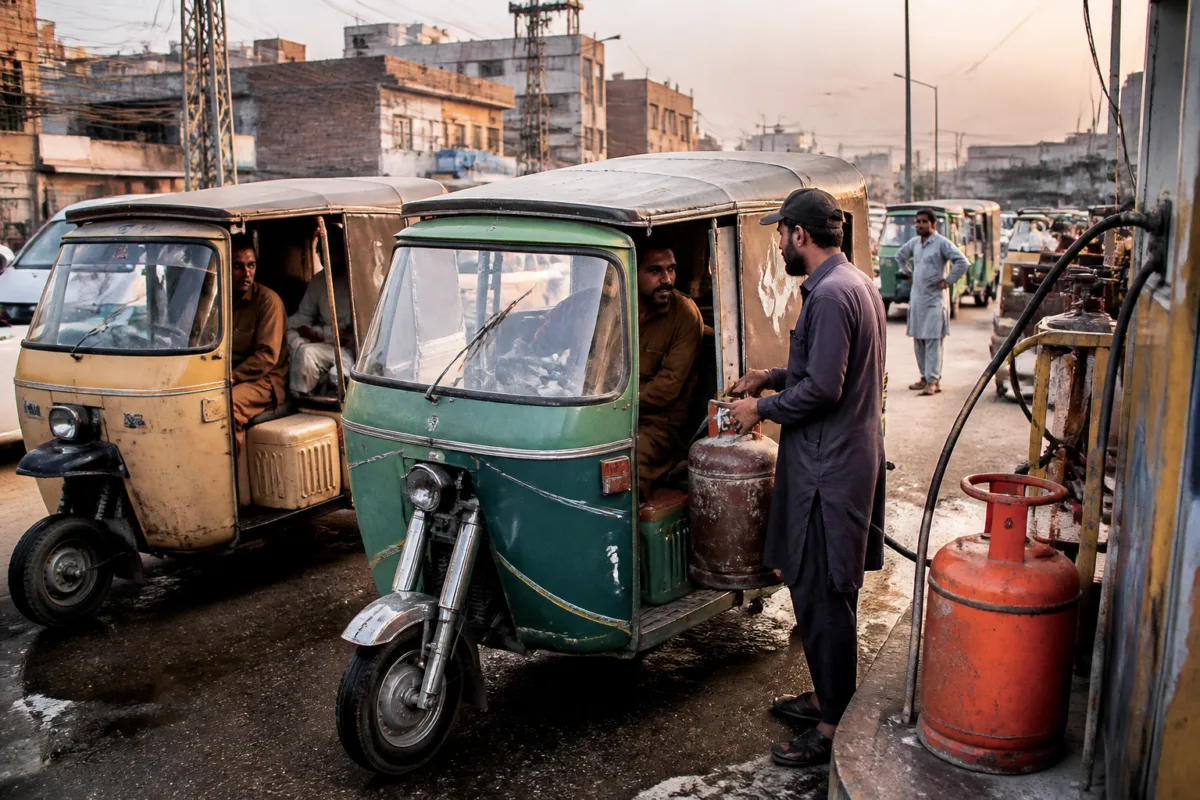
The Pakistan LPG crisis is no longer confined to fuel markets. In Lahore, where large numbers of three-wheelers reportedly run on liquefied petroleum gas, a sharp increase in cylinder prices is reaching drivers, passengers and households through the city’s everyday transport system. The immediate trigger is a reported interruption in supplies from Iran after two border crossings were closed, but the consequences reveal a deeper dependence on an energy source used simultaneously for mobility and cooking.
According to the report published by Aaj Tak Business, traders said LPG prices had been rising since 17 October after the border closures disrupted imports. A 12-kilogram cylinder reportedly rose 56% to 7,000 Pakistani rupees, while LPG in the open market reached about 583 Pakistani rupees per kilogram. The Pakistan LPG Association said approximately 7,000 metric tonnes of LPG had previously arrived from Iran each day, and that this supply had stopped.
The figures describe a supply shock, but the urban impact is shaped by how Lahore’s transport economy is organised. Many drivers use LPG-powered three-wheelers to earn daily income, while passengers rely on those vehicles for relatively affordable short-distance travel. When the cost of operating the vehicle rises but passenger fares do not adjust at the same pace, the pressure is transferred to the driver’s income, the passenger’s travel choices or both.
That pressure is visible in the account of Rashid Ali, a 33-year-old Lahore rickshaw driver quoted in the report. Ali said he had been driving a motorised three-wheeler for 13 years, beginning work at 6 am and sometimes continuing until midnight. He previously earned as much as $6.50, or about 1,800 Pakistani rupees, on a long working day. With the rise in LPG prices, he said his income had fallen to about $3, leaving his family to reduce food consumption.
Ali’s account also shows why a fuel crisis cannot be understood only through the price displayed at a cylinder outlet. The cost of LPG affects the number of trips a driver can afford to undertake, the income left after fuel expenses and the fare that passengers are willing or able to pay. Ali said that a journey costing 200 or 250 rupees to operate might still attract only 80, 100 or at most 150 rupees from passengers. The gap leaves drivers with limited room to recover higher operating costs.
## Lahore’s transport system absorbs the shock
The Avami Rickshaw Union’s chairman, Majid Ghauri, described LPG as the “fuel of the poor”, according to the report. The union has 43,000 auto-rickshaws, he said, and around 70% of them, along with approximately 8,000 Qingqi three-wheelers, run on LPG. These figures were presented as an account from the union rather than as an independently verified citywide vehicle census, but they indicate the scale of the exposure within Lahore’s informal and semi-formal transport network.
The importance of three-wheelers lies in their position between private travel and larger public transport. They can provide short trips, flexible routes and connections where passengers may not have a convenient alternative. The supplied report does not establish how many other modes are available on affected routes or whether authorities have introduced replacement services. It does, however, document the immediate bargaining problem created by the fuel shock.
One passenger, Mohammad Ramzan, told Reuters, as cited by Aaj Tak Business, that a driver demanded 500 rupees for a ride across the city. Ramzan offered half that amount, after which the driver refused to make the trip. The exchange illustrates a breakdown in the informal fare system: drivers face higher costs, while passengers continue to negotiate around incomes that have not necessarily increased.
For drivers, the vehicle is both a workplace and an income-generating asset. For passengers, it is a service whose price is negotiated trip by trip. That arrangement can function when fuel costs are relatively stable. It becomes unstable when the input price rises sharply and there is no clearly described mechanism for revising fares, supporting operators or protecting passengers from sudden increases.
## The household and mobility connection
The most significant feature of the crisis is the overlap between transport fuel and household energy. The report states that the same LPG supply disruption is affecting drivers who operate vehicles using a fuel also used for cooking. This means the shock can appear twice in the same household: first through higher expenditure required to keep the vehicle working, and again through the cost of preparing food.
Ali’s statement that his family has reduced its food consumption provides a direct example of that transmission. It also shows that the effect of rising fuel prices is not limited to mobility or inflation statistics. When a driver’s earnings fall after fuel expenditure, the household may cut consumption rather than pass the full increase on to passengers. The consequences therefore extend beyond the road to nutrition and basic household security, although the supplied report does not provide wider data on how many families have made similar reductions.
Passengers face a related trade-off. If drivers raise fares to reflect costs, low-income riders may reduce trips, negotiate harder or refuse journeys. If fares remain unchanged, drivers may work longer hours, reduce the number of trips or stop operating routes that no longer cover their costs. The report provides individual examples of this tension but does not establish its overall effect on ridership, traffic patterns or access to employment across Lahore.
This is why the phrase “fuel of the poor” has institutional significance. It identifies LPG not simply as a commodity but as a component of the city’s affordability structure. A fuel used by lower-income transport operators can keep short-distance travel within reach for passengers. A sudden shortage can therefore affect both sides of the urban transaction at once.
## A supply interruption with national consequences
The reported disruption began at the border, but its effects are being felt inside cities. LPG tankers and trucks carrying other goods were reportedly stranded after the Iran border crossings closed. The supply chain problem then moved through import availability, wholesale pricing, vehicle operating costs and passenger fares. Each stage links an international or border-level disruption to a daily urban decision.
Aaj Tak Business described the episode as the latest and largest energy shock since what it referred to as the beginning of the US-Iran war in February. That description is part of the supplied report’s account and is not independently assessed here. The report also states that petrol and high-speed diesel prices had already risen 40% because of the conflict. The immediate LPG shortage therefore appears in the article as part of a broader period of energy-price pressure rather than an isolated cylinder-market event.
The report further states that Pakistan’s inflation rate reached 9.6% in October and that the central bank raised interest rates to 12%, citing energy and wheat prices. These figures provide national economic context, but they do not by themselves measure the effect on Lahore’s transport users. Their relevance is that households and small operators are confronting the LPG increase alongside other rising costs, while borrowing conditions and general prices are also under pressure.
For urban residents, national energy policy is experienced through the cost of a ride, the number of trips a driver can complete and the amount of money left for food. This conversion from macroeconomic shock to street-level affordability is especially rapid where transport operators have limited financial reserves and fares are negotiated informally.
## The unresolved governance question
The supplied material identifies the reported supply disruption and documents its effects, but it does not describe a government response, a temporary import arrangement, an official fare revision or targeted assistance for affected drivers and passengers. That absence is important because the crisis sits across several administrative responsibilities: border and import management, energy supply, transport regulation, consumer protection and social welfare.
The report also does not establish whether the border closures are temporary, how much LPG is available through domestic production or alternative imports, or whether the 7,000-metric-tonne estimate represents Pakistan’s entire Iranian supply or only the association’s assessment. These unanswered questions matter for understanding whether the price increase is a short-term disruption or a longer supply constraint.
What is established in the supplied evidence is narrower but significant. Iran-linked LPG flows were reported to have stopped after border crossings closed. The price of a 12-kilogram cylinder reportedly reached 7,000 Pakistani rupees. Lahore drivers and passengers described a widening gap between operating costs and affordable fares. An industry representative linked a substantial share of local three-wheelers to LPG, while one driver said his income had fallen by roughly half and his family had reduced food consumption.
The Pakistan LPG crisis therefore exposes a structural vulnerability in Lahore’s urban economy: a transport system serving lower-income residents depends on a fuel supply that can be disrupted beyond the city’s control, while the operators who absorb the shock have little room to increase fares. Until the authorities clarify the supply outlook and any response for transport workers and households, the full duration and reach of the crisis remain uncertain.

