


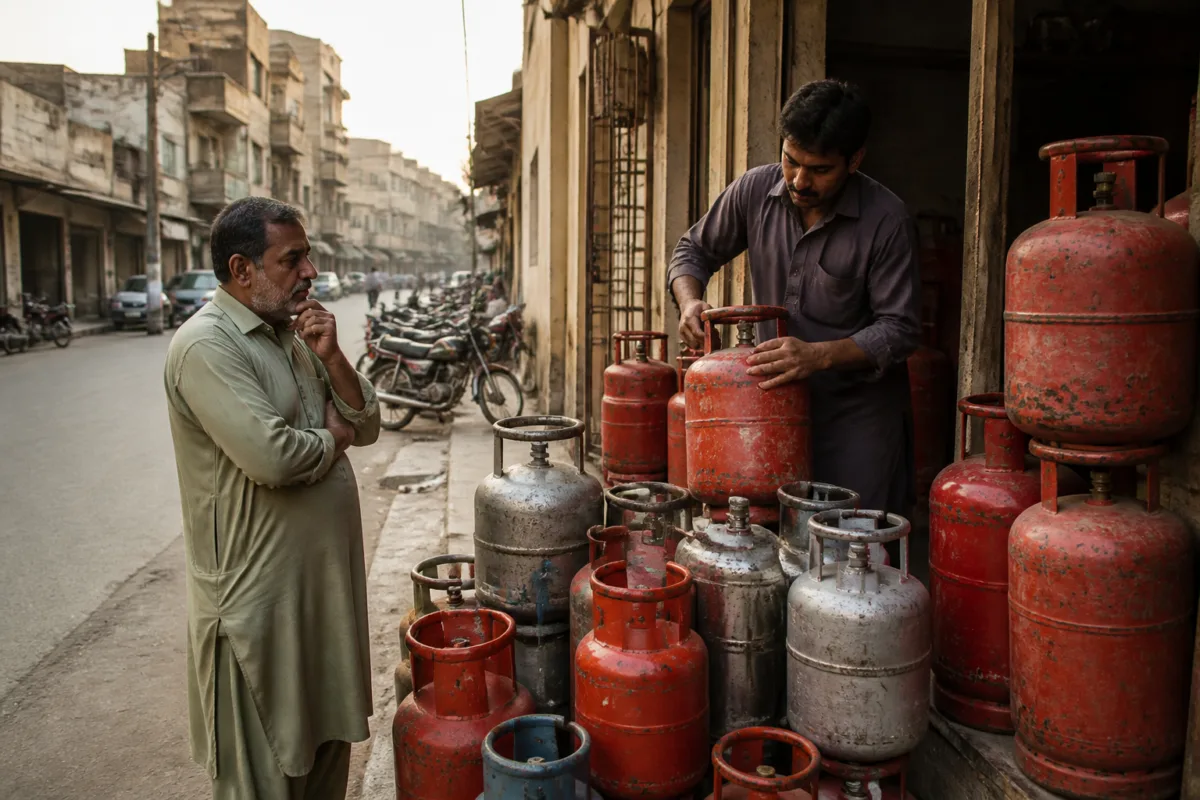
Pakistan’s LPG price hike in Karachi has pushed the fuel to 550 Pakistani rupees per kilogram, according to a report cited by Aaj Tak Business from The Express Tribune. The increase of 50 rupees within 24 hours is not only a household-cost story. It also reveals how quickly urban energy access can become unstable when a city depends on a disrupted supply route and when official prices diverge sharply from what consumers are asked to pay in local markets.
The reported increase comes as Pakistan faces a shortage of liquefied petroleum gas, or LPG, in the wake of difficulties in receiving consignments from Iran. The report said Pakistan closed its border with Iran on 17 October, bringing LPG imports to a halt. It attributed the supply disruption to sources and said the shortage had allowed local gas marketing companies to charge higher prices.
For Karachi, the immediate effect is being felt through household budgets. The reported market price of 550 rupees per kilogram is described as nearly double the government rate. The report also said LPG cylinder prices had risen from between 4,500 and 8,200 Pakistani rupees in recent days, although it did not provide a separate cylinder size or a detailed official price schedule for those figures. This gap between regulated or announced rates and market prices is central to understanding the crisis.
LPG is not used by all households in the same way. But the report specifically noted that homes without piped natural gas have few alternatives when LPG becomes more expensive. For such households, the increase is not simply a discretionary expense that can be postponed. Cooking fuel has to be purchased, even when incomes do not rise alongside energy prices. This makes supply disruption a question of access as well as inflation.
The reported crisis also shows why city-level energy vulnerability cannot be measured only by the availability of formal infrastructure. A household may technically have access to an energy market while remaining highly exposed to price shocks if it lacks a piped connection, has limited storage capacity or must buy cylinders at short intervals. In that situation, the reliability of transport, imports, wholesale distribution and local retail oversight becomes part of everyday urban infrastructure.
The supply problem appears to have moved quickly through the market. LPG sellers told the publication that marketing companies were supplying gas at very high prices, making it difficult for them to continue operating. Several vendors reportedly said their sales had fallen by as much as 50 per cent after the latest increase because customers had reduced purchases in response to higher costs.
That fall in sales does not necessarily mean that demand for cooking fuel has disappeared. The report said consumers who do not have piped natural gas have no practical alternative to buying LPG. The more immediate possibility is that some households are purchasing less, delaying refills or trying to reduce consumption while remaining dependent on the fuel. The supplied report does not establish which coping strategies households are using, but it does identify the structural constraint: the absence of an affordable substitute for many consumers.
The Karachi episode also illustrates the difference between an official price and an effective price. A government rate can provide a benchmark, but it does not guarantee that consumers will find the product at that price if supply is insufficient. When the market price rises to nearly twice the official level, the practical reach of the stated rate becomes an important governance question. It raises the need to distinguish between a formal price announcement, the price charged by suppliers and the price actually paid by households.
The reported link to the Iran border is therefore significant. A border closure can affect more than cross-border trade. If a city’s fuel market relies on inflows that are interrupted, the impact can appear in wholesale availability, retail pricing and household consumption within a short period. In this case, the report said consignments from Iran had not reached Karachi’s markets, creating a supply shortage. It did not provide the volume of LPG normally received through that route or identify how much of Karachi’s consumption depends on it, so the scale of that dependency remains unestablished in the supplied material.
The article also placed the disruption within wider geopolitical tension, referring to an escalation involving the United States and Iran. That context may explain why supply routes have become more difficult, but the evidence supplied for this story is more specific about the immediate mechanism: a border closure, interrupted LPG imports and reduced availability in Karachi. The price impact can be assessed through those reported developments without assuming that every aspect of the broader geopolitical situation has the same direct effect on the city’s fuel market.
The urban consequences extend beyond kitchens. The report warned that higher fuel costs could raise transportation expenses and increase the prices of tandoor products and bakery goods. These effects were presented as a concern rather than as measured price changes, and the supplied material does not include data showing how much costs have already risen in those sectors. Even so, the channels identified are important. LPG can function as both a household fuel and an input into small businesses, food preparation and local distribution. A price shock can therefore move through neighbourhood economies rather than remaining confined to cylinder buyers.
This is where the issue becomes a governance problem. The report said market experts were calling for strict monitoring and enforcement, arguing that suppliers and marketing companies could continue benefiting from shortages if rules were not implemented effectively. The article did not identify the specific agencies responsible for enforcement, disclose the number of inspections or record any penalties. It therefore cannot establish whether regulatory action has failed in legal or administrative terms. It does, however, show a market in which consumers, retailers and suppliers appear to be experiencing the same disruption differently.
Retailers face higher procurement costs and falling sales. Consumers face prices that are reported to be far above the government rate. Marketing companies are accused, through the report’s attributed account, of charging higher prices for supply. The supplied material does not include their response, so those claims should remain attributed rather than treated as independently established findings. The absence of a documented response from the companies is itself a limitation on what can be concluded about responsibility for the price increase.
The price difference also exposes the importance of transparency in urban fuel markets. Consumers need to know whether a price reflects a genuine increase in procurement and transport costs, a temporary shortage, local market power or a combination of factors. Without information on supply volumes, official allocations, wholesale prices and enforcement actions, it is difficult to separate unavoidable cost pressure from price escalation enabled by scarcity.
For Karachi residents, the immediate policy question is whether supply can be restored and whether retail prices can be brought closer to official levels. The report said the government had not provided a relief plan, but it did not cite a formal government statement or specify a publicly announced intervention. It also did not establish a timeline for the resumption of Iranian LPG consignments. These gaps matter because temporary disruption and prolonged scarcity require different administrative responses.
The reported 50 per cent fall in vendor sales offers one indicator of the market’s stress, but it is not a complete measure of public impact. It does not show how many households have reduced consumption, shifted to other fuels or gone without adequate cooking energy. Nor does the material establish whether the price increase is uniform across Karachi or concentrated in particular localities. More detailed official and market data would be needed to determine the geographic and social distribution of the burden.
What the evidence does establish is a chain of vulnerability. Karachi’s LPG users have faced a sharp reported price increase after supply from Iran was disrupted. Homes without piped natural gas have limited alternatives. Retailers say sales have dropped as costs rise. The reported market price is far above the government rate, while the government’s stated response remains unclear in the supplied material. Together, these facts show how an external supply interruption can become an urban affordability crisis when households depend on a fuel sold through a fragmented market.
The developments that require monitoring are clear: whether LPG consignments resume, whether the border restrictions affecting supply change, whether authorities publish or enforce a workable price framework, and whether retailers and consumers receive relief. Until those questions are answered with official data and documented action, Karachi’s LPG market will remain a test of whether energy regulation can protect households when the supply chain breaks.

