


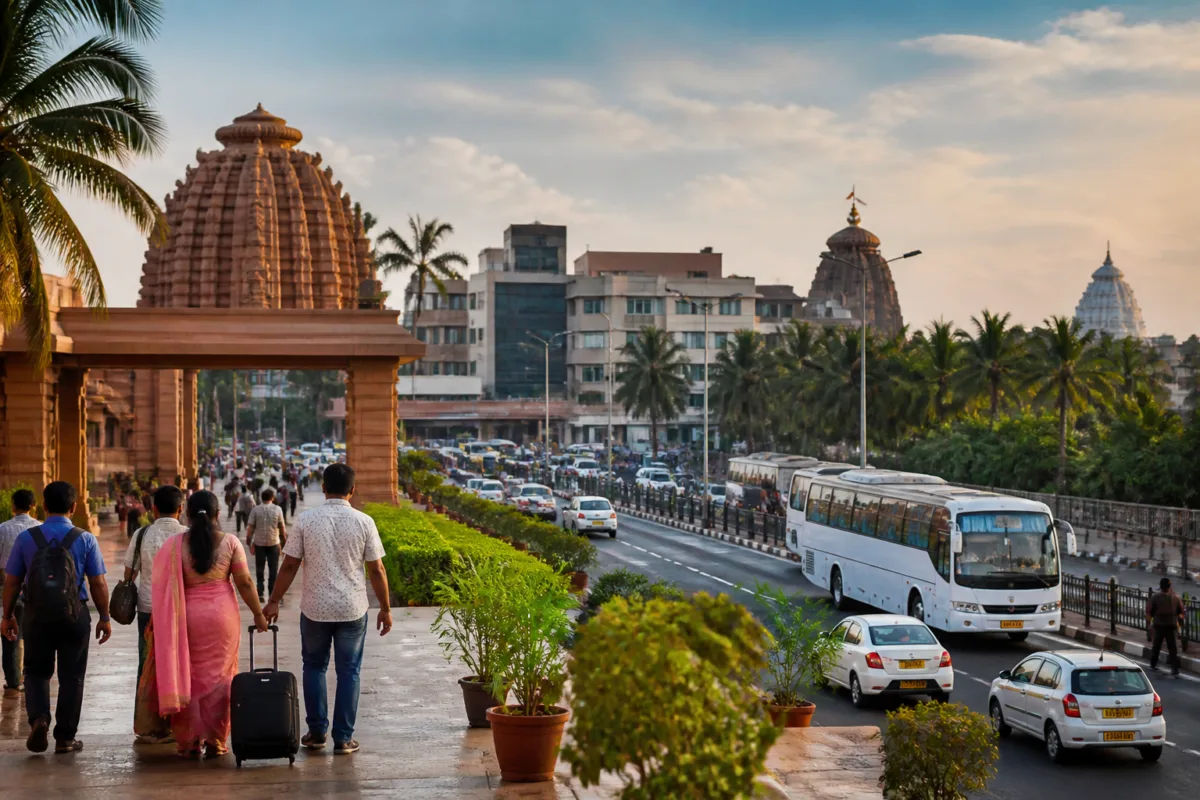
Odisha’s proposal to become a “21-night tourism destination” is less a slogan about longer holidays than a test of whether the state can connect its pilgrimage centres, beaches, forests, heritage sites and smaller destinations into one functioning visitor economy. The proposal, presented at the 7th Odisha Tourism Conclave in Bhubaneswar, puts connectivity, accommodation, skills and destination management at the centre of the state’s tourism strategy.
J K Mohanty, chairman of the Hotel and Restaurant Association of Odisha, urged the state to move beyond short-duration pilgrim visits by developing seven-, 14- and 21-night itineraries. The suggested circuits would combine spirituality, heritage, wildlife, beaches, culture, cuisine, wellness and adventure. The proposal was made in the presence of Deputy Chief Minister Pravati Parida, Chief Secretary Anu Garg and other participants, according to the Times of India report on the conclave.
The central planning challenge is not simply to identify more attractions. It is to make them operate as a connected system. A visitor may be able to reach Bhubaneswar, Puri or Konark, but a longer itinerary also depends on reliable links to destinations such as Chilika, Bhitarkanika, Similipal, Satkosia, Debrigarh, Hirakud, Koraput and Deomali. It requires accommodation at different price points, trained guides, visitor information, multilingual signage and dependable local transport. Without those supporting systems, a list of destinations remains a tourism circuit only on paper.
The Bhubaneswar-Puri-Konark Golden Triangle would remain the backbone of the proposed model. Its importance reflects the way tourism infrastructure tends to develop around established anchors. These three locations already provide a recognisable base for visitors, while the wider plan seeks to use that base to distribute travel towards other parts of the state. The proposal therefore combines a concentrated entry point with a more dispersed destination network.
That shift has direct implications for urban infrastructure. Bhubaneswar would function not only as the state capital but also as a gateway for air passengers, conference delegates and visitors beginning or ending longer journeys. Puri and Konark would continue to carry pressure associated with pilgrimage and heritage tourism. Other destinations would need sufficient road access, accommodation, sanitation, visitor management and emergency services to support higher footfall without reducing the quality of the visitor experience.
The available figures show the scale of the gap that the proposal is intended to address. Mohanty cited Ministry of Tourism data showing 428.55 crore domestic tourist visits and 2.53 crore foreign tourist visits across India in 2025. Odisha, by comparison, received 1.28 crore domestic visitors and 62,115 foreign visitors, according to the figures cited at the conclave. The comparison does not by itself explain why visitors choose one destination over another, but it establishes the contrast between India’s overall tourism volume and Odisha’s relatively small share of international arrivals.
The foreign visitor figure is particularly relevant to the proposed 21-night model because longer, multi-destination itineraries usually depend on more than a single landmark. Odisha’s tourism offer, as described at the conclave, is geographically varied. Its ability to convert that variety into longer stays would depend on whether visitors can understand the routes, book accommodation across destinations, access reliable transport and obtain services in locations beyond the best-known pilgrimage and heritage sites.
The domestic market presents a different but equally important planning question. A large number of domestic visitors does not necessarily mean long stays or high local spending. Short pilgrim visits may generate intense demand at particular locations and times without distributing economic activity across the wider state. The proposed seven-, 14- and 21-night itineraries are intended to change that pattern by encouraging visitors to combine different experiences and spend more time within Odisha.
For cities, the issue is how tourism demand is received and managed. Longer stays may improve hotel occupancy and visitor spending, as Mohanty argued, but they also require a larger and better-trained workforce. The association estimates that the state’s target of adding about 15,000 hotel rooms could generate demand for nearly 45,000 skilled hospitality workers. That estimate was presented at the conclave and is not an independent assessment in the supplied report, but it points to a basic implementation constraint: rooms cannot become productive tourism infrastructure without people to operate them.
Mohanty called for an expansion of hotel management institutes, stronger industry-academia partnerships and a 70% fee subsidy for students pursuing hospitality education. These proposals connect tourism policy to education and employment policy. They also indicate that the proposed hotel expansion cannot be treated only as a real estate or construction target. The state would need to align the timing and location of new rooms with workforce availability, training capacity and actual visitor demand.
This is where the institutional design of the proposal becomes important. Mohanty sought a government-industry task force to prepare a five-year action plan focused on investment, connectivity, destination development and global promotion. Such a body, if created, would have to coordinate responsibilities that currently sit across different administrative and commercial interests. Tourism promotion, airport connectivity, roads, accommodation, training, heritage management and local visitor facilities do not belong to a single operational function.
The proposal also highlights a distinction between connectivity in the broad sense and connectivity that visitors can actually use. Mohanty identified connectivity as one of Odisha’s biggest constraints and sought stronger domestic air links from Bhubaneswar, including restoration of discontinued flights to Jaipur, Indore, Goa and Kochi. He also called for direct international flights to Singapore, Bangkok, Kuala Lumpur and Dubai. These are demands for improved network access, but air links alone cannot solve the last-mile and inter-destination problems that a 21-night circuit would create.
A longer itinerary requires dependable movement after arrival. The report records calls for reliable transport, trained guides, multilingual signage and better visitor facilities. These are relatively ordinary components of tourism infrastructure, but their absence can make a geographically rich state difficult to navigate. For smaller destinations, visitor infrastructure also determines whether increased demand can be absorbed without placing disproportionate pressure on local services and environments.
The proposed circuits include wildlife and ecological destinations such as Chilika, Bhitarkanika, Similipal and Satkosia, alongside beaches, heritage locations and urban gateways. The supplied report does not provide carrying-capacity assessments, conservation plans or visitor limits for these places. That information would be necessary to evaluate how a significant increase in stays could be managed. For now, the proposal establishes the ambition and the infrastructure requests, but not the operational safeguards or implementation sequence.
The same limitation applies to the plan to add about 15,000 hotel rooms. The report does not specify where those rooms would be located, what categories of accommodation they would represent, how they would be financed or which destinations would receive priority. Those details matter because a statewide room target could produce very different outcomes depending on whether investment is concentrated in Bhubaneswar and Puri or distributed across emerging circuits.
Odisha’s tourism debate is therefore also a debate about regional urbanisation. Hotels, transport operators, guides, restaurants and visitor services can create employment beyond the main cities, but only if destinations are connected to markets and equipped with basic infrastructure. At the same time, gateway cities may face increased demand for airport capacity, road access, public services and accommodation. The economic benefits of longer stays will depend on how effectively the state distributes visitor flows rather than merely increasing arrivals at a few established locations.
The figures cited at the conclave make the case for a larger tourism strategy, but they do not yet demonstrate that the 21-night model is ready for implementation. The state has a proposed direction, a hotel-room target, a workforce estimate, connectivity requests and a suggested five-year government-industry plan. What remains to be established is the delivery framework linking these elements: which agency leads, which destinations are prioritised, how investment is sequenced, how skills are funded and how visitor pressure is monitored.
The next phase will determine whether “21-night tourism destination” becomes a coordinated infrastructure programme or remains a promotional idea. The evidence supplied so far confirms a gap between Odisha’s tourism potential and its recorded domestic and foreign visitor numbers, as well as a set of industry demands aimed at closing it. The proposed task force and five-year action plan, if taken forward, will be the milestones to watch for a clearer answer on how the state intends to build the connectivity and capacity required for longer stays.

