


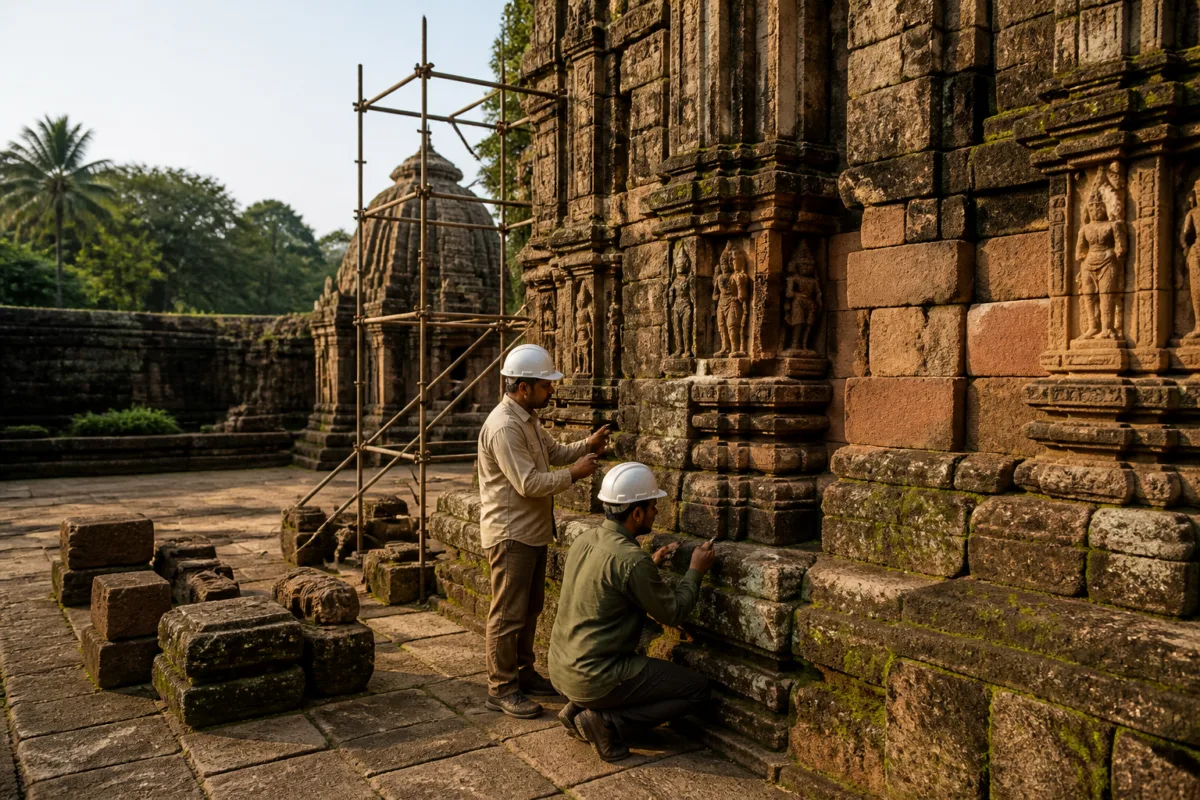
More than 3,000 temples and monuments of archaeological significance in Odisha face conservation and maintenance concerns, according to figures placed before the state Assembly, while only 295 properties have been formally taken up for protection by the state and central governments.
The figures were provided by Odisha Minister for Odia Language, Literature and Culture Suryabanshi Suraj in response to a question from legislator Kumari Sanjali Murmu on measures and grants for protecting the state’s temples and monuments.
The minister said 213 ancient heritage properties had been declared under state protection and 82 had been declared centrally protected monuments. Together, these account for 295 protected properties out of the more than 3,000 temples and monuments identified in the response as having archaeological significance.
The Assembly response also pointed to a gap between the availability of conservation funds and their utilisation. The report said that grants provided for heritage conservation over the past five years had not been fully spent, even as the funds available were described as insufficient for the protection needs of the monuments.
For 2021-22, an allocation of Rs 10.0849 crore was reported, of which Rs 9.7235355 crore was spent. In 2022-23, Rs 13 crore was allocated and Rs 12.8796143 crore was spent. The reported allocation for 2023-24 was Rs 17 crore, with expenditure of Rs 16.8532269 crore.
For 2024-25, the report said that none of the Rs 15 crore provided had been spent. In 2025-26, an allocation of Rs 15.90 crore was reported, against which expenditure stood at Rs 11.5464281 crore.
The minister’s response further stated that Rs 7 crore had been allocated during the current financial year for protected heritage properties, while Rs 13 crore had been distributed for both protected and unprotected heritage properties. The report does not provide a site-wise breakdown of these allocations or explain the reasons for the unspent amounts.
The figures indicate two linked administrative challenges. First, formal protection covers only a small share of the wider pool of archaeologically significant temples and monuments identified by the state. Second, even the funds allocated for conservation are not consistently converted into completed maintenance or protection work.
For heritage assets, delayed spending can affect structural repairs, documentation, site management and preventive conservation. However, the Assembly response, as reported, does not specify which monuments are in the most urgent condition, how projects are selected, or whether unspent funds resulted from tendering delays, land or ownership issues, technical clearances, limited implementation capacity or other factors.
Researchers and historians have previously expressed concern over the deterioration of ancient heritage properties due to inadequate maintenance, the report said. The Assembly figures now place that concern alongside a measurable gap in the coverage and utilisation of public conservation support.
A fuller assessment would require property-level information on the 295 protected sites, the condition of the remaining monuments, annual project completion rates and the reasons behind the unspent grants. Without those details, the reported allocations show the scale of the funding challenge but do not by themselves establish the condition of every monument in Odisha.

