


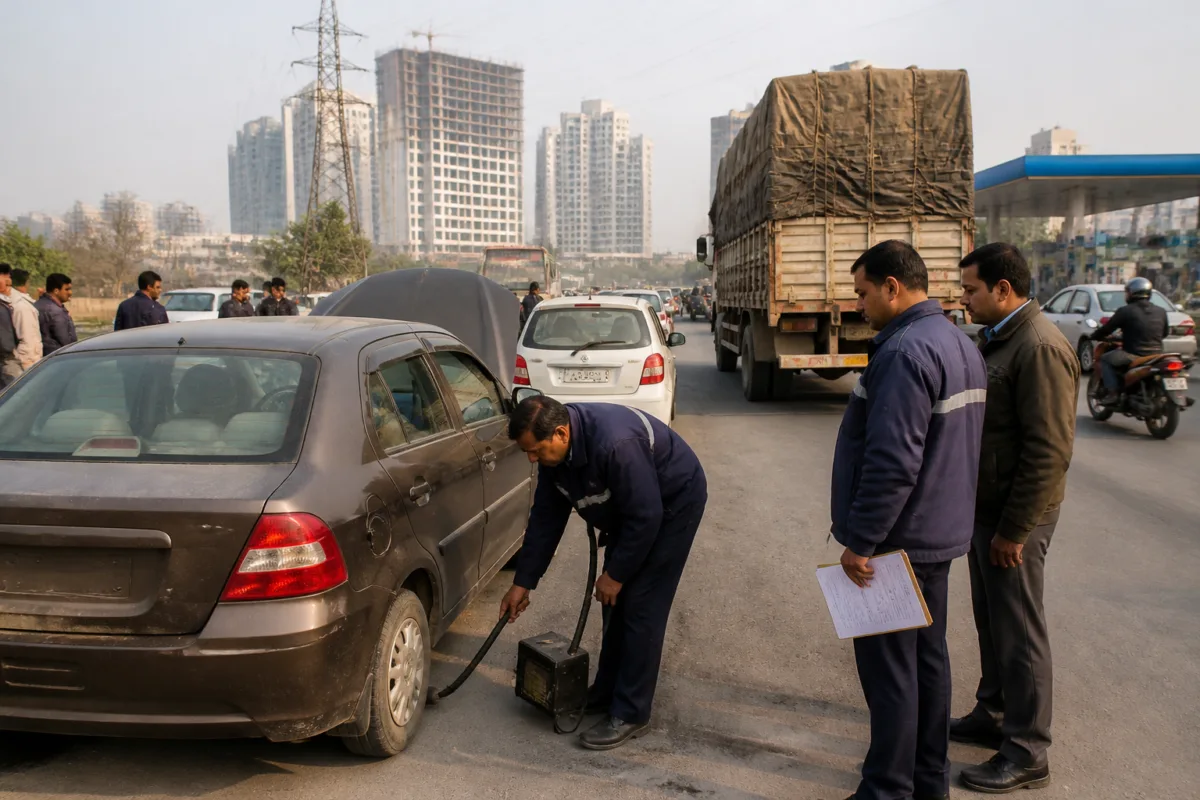
Noida’s vehicle pollution crackdown produced a sharp rise in enforcement during October, but the figures also reveal a wider administrative challenge: issuing penalties is not the same as collecting them. The transport department acted against 5,059 vehicles between April and October, imposed fines worth ₹1,069.20 lakh and recovered ₹555.30 lakh, according to a report by Navbharat Times – Noida citing transport department data.
The enforcement activity is linked to the Graded Response Action Plan, or GRAP, which brings stricter measures when air pollution worsens. The report says action remained relatively routine from April to September but intensified in October. During that month alone, 541 vehicles were issued challans and ₹52.93 lakh was collected in fines.
That monthly figure is important because it shows how seasonal pollution-control enforcement can change the operating pattern of a city’s transport administration. The department’s campaign did not focus on one type of violation. It covered vehicles without valid pollution-under-control certificates, overloaded vehicles, older vehicles restricted under pollution-control rules and vehicles carrying construction material in the open.
The largest October category was older petrol vehicles. The transport department reportedly acted against 266 petrol vehicles that were 15 years old and seized all of them immediately. Six diesel vehicles that were 10 years old were also stopped. The report describes these actions as part of the GRAP-linked campaign against vehicles that are not permitted to operate on the roads under the applicable restrictions.
The second major category involved vehicles without pollution-under-control certificates. In October, 142 such vehicles were penalised, generating ₹14.30 lakh in fines. The department also acted against 116 overloaded vehicles that were described as contributing to road dust and pollution, recovering ₹38.56 lakh from them. Eleven vehicles carrying construction material in the open were penalised as well.
Across the April-October period, the department recorded action against 2,794 vehicles without pollution certificates, 1,357 overloaded vehicles and 756 old petrol vehicles. These figures account for 4,907 of the 5,059 vehicles covered by the overall enforcement total. The report does not provide a complete category-wise breakdown for the remaining 152 vehicles, although it separately mentions action against vehicles carrying construction material in the open.
The data points to two distinct enforcement problems. The first is direct emissions from vehicles that do not meet pollution-control requirements. The second is the contribution of transport operations to the urban environment through dust, overloading and uncovered construction material. In this sense, the campaign extends beyond the question of whether an individual vehicle has a valid certificate. It also covers how goods and construction materials move through the city.
This matters for Noida because the enforcement burden is distributed across several points in the urban system. Transport officials inspect vehicles on roads, petrol pumps interact with vehicle owners seeking fuel, and construction-related movement affects roads and surrounding neighbourhoods. Each point requires a different form of compliance. A pollution certificate depends on vehicle testing and renewal. Action against overloaded vehicles depends on roadside inspection. Preventing dust from construction material requires attention to how vehicles are loaded and covered before they enter the road network.
The department has also asked petrol pump operators and employees not to provide fuel to vehicles without valid pollution certificates and to inform officials when such vehicles arrive. This creates an additional monitoring layer outside the transport department itself. The report does not establish how many vehicles were identified through petrol pump reporting, how frequently pumps complied with the request or whether fuel denial was formally enforced. Those details remain important to judging whether the measure works as a routine compliance mechanism or mainly as an advisory instruction.
The gap between penalties imposed and money recovered is another significant administrative indicator. Between April and October, fines worth ₹1,069.20 lakh were imposed, while ₹555.30 lakh was recovered. The recovered amount was therefore slightly more than half of the amount imposed. The report does not explain whether the unrecovered balance reflects pending payment deadlines, disputed challans, court processes, vehicle owners who could not be traced or another administrative reason.
That distinction is central to understanding enforcement performance. A challan records the department’s action against an alleged violation, while recovery indicates that the financial consequence has actually been realised. Without information on the age and status of outstanding penalties, the figures cannot show whether the gap is temporary or systemic. They do, however, establish that the enforcement process had not converted all imposed penalties into collected revenue by the end of the reported period.
The October numbers also show that the intensity of enforcement changed as GRAP-related measures became more relevant. Of the 5,059 vehicles targeted during the seven-month period, 541 were acted against in October. The report does not provide monthly figures for April through September, so it is not possible to measure the exact rate of increase or determine whether October was an exceptional month compared with each earlier month. The available information supports only the broader conclusion that action became more visible and concentrated during October.
The institutional structure described in the report places the transport department at the centre of vehicle-related pollution enforcement. The department is responsible for roadside action, challans and seizures, while petrol stations are being asked to support identification of non-compliant vehicles. The ARTO enforcement officer named in the report, Dr Udit Narayan Pandey, said that action against restricted and non-compliant vehicles would continue and that petrol pump operators and staff had been asked to share information.
This arrangement also reveals a limitation in the available public data. The report provides totals for action, fines imposed and fines recovered, but it does not state how many enforcement teams were deployed, how many inspections were conducted, where violations were concentrated or how many vehicles returned to compliance after action. It also does not establish whether seized vehicles were scrapped, repaired, deregistered or otherwise removed from circulation.
For residents, the practical impact of the campaign depends on more than the number of challans. Vehicle owners without valid certificates face penalties and possible restrictions on fuel access. Owners of vehicles covered by age-based restrictions face seizure. Road users and neighbourhoods near construction routes may benefit if overloaded and uncovered vehicles are prevented from generating dust. But the supplied figures do not measure changes in ambient air quality, roadside dust levels or traffic emissions after enforcement.
The report therefore confirms the scale and scope of the transport department’s action, but not its environmental outcome. It shows that enforcement expanded during the GRAP period, that old and non-compliant vehicles were targeted, and that a substantial sum remained unrecovered compared with the amount imposed. It does not establish whether the campaign reduced pollution or whether the same violations declined after the action.
The next stage will depend on whether the department continues the drive beyond the October intensification and whether it publishes clearer information on recoveries, seizures, repeat violations and the status of vehicles taken off the road. The ARTO enforcement officer has said that the campaign will continue. That commitment is the immediate official next step, while the unresolved recovery gap remains the clearest administrative question in the available data.

