


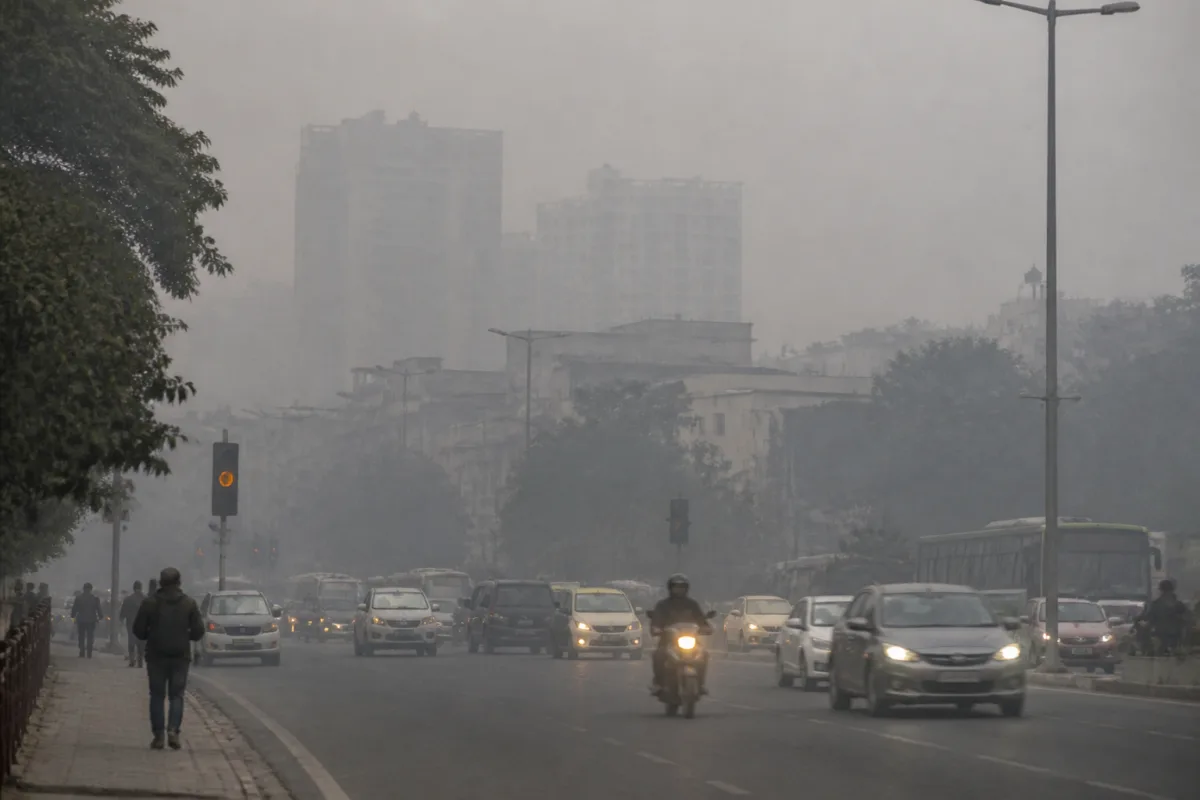
Delhi air pollution reached severe levels on Friday, with the Central Pollution Control Board recording an air quality index of 403 in the capital as dense smog reduced visibility across several parts of the National Capital Region. IQAir separately recorded Delhi’s AQI at 334 and ranked it as the world’s most polluted city at the time of its update, placing it ahead of Lahore.
The difference between the two readings reflects the separate measurement methods used by the Swiss air-quality platform and Indian authorities. The CPCB’s Sameer application showed Delhi’s AQI at 403 at 6.05 am, with the reading remaining at the same level at 8 am and 9 am. Under India’s air-quality classification, this falls in the severe category.
Of the 58 monitoring stations reporting data by 8 am, 33 recorded severe air quality, 24 reported the very poor category and one station recorded moderate air quality. The worst reading was recorded at IIT Delhi, where the AQI reached 488. Chandni Chowk recorded 479 and Delhi University’s North Campus recorded 478.
Other high readings included 456 at Burari Crossing and 451 each at ITO and Jawaharlal Nehru University. Among the stations in the severe category were Jahangirpuri at 430, Wazirpur at 427, Anand Vihar at 419, Rohini at 413, Terminal 3 of Indira Gandhi International Airport at 403 and Tikri Kalan at 402.
Earlier readings reported at 6.05 am showed an AQI of 487 at IIT Delhi, 476 at both North Campus and Chandni Chowk, 468 at Pusa and 461 at NSUT Jaffarpur. The dense haze lowered visibility in several locations and made movement on roads more difficult, according to the report.
Delhi’s air quality had last entered the severe category earlier this year on January 19, when the 24-hour average AQI stood at 410. The latest deterioration follows a period of persistently poor air quality in the Delhi-NCR region after Diwali.
The Commission for Air Quality Management had introduced Stage III of the Graded Response Action Plan in the National Capital Region on November 6 after assessing the possibility of further deterioration. The stage includes restrictions on several dust-generating construction and demolition activities, closure of stone-crushing and mining operations, and curbs on specified categories of vehicles.
Stage III also restricts the operation of BS-III petrol and BS-IV diesel light motor vehicles, or older vehicles, in Delhi and high-vehicle-density districts including Gurugram, Faridabad, Sonipat, Ghaziabad and Gautam Buddh Nagar. Certain BS-IV and older diesel goods vehicles are also barred from entering Delhi.
If Delhi’s 24-hour average AQI rises above 450 and enters the severe-plus category, the highest level of anti-pollution restrictions under GRAP, Stage IV, is triggered. The Safdarjung weather station recorded a minimum temperature of 16.2 degrees Celsius, which was 2.7 degrees above normal, as the city remained under heavy haze.

