


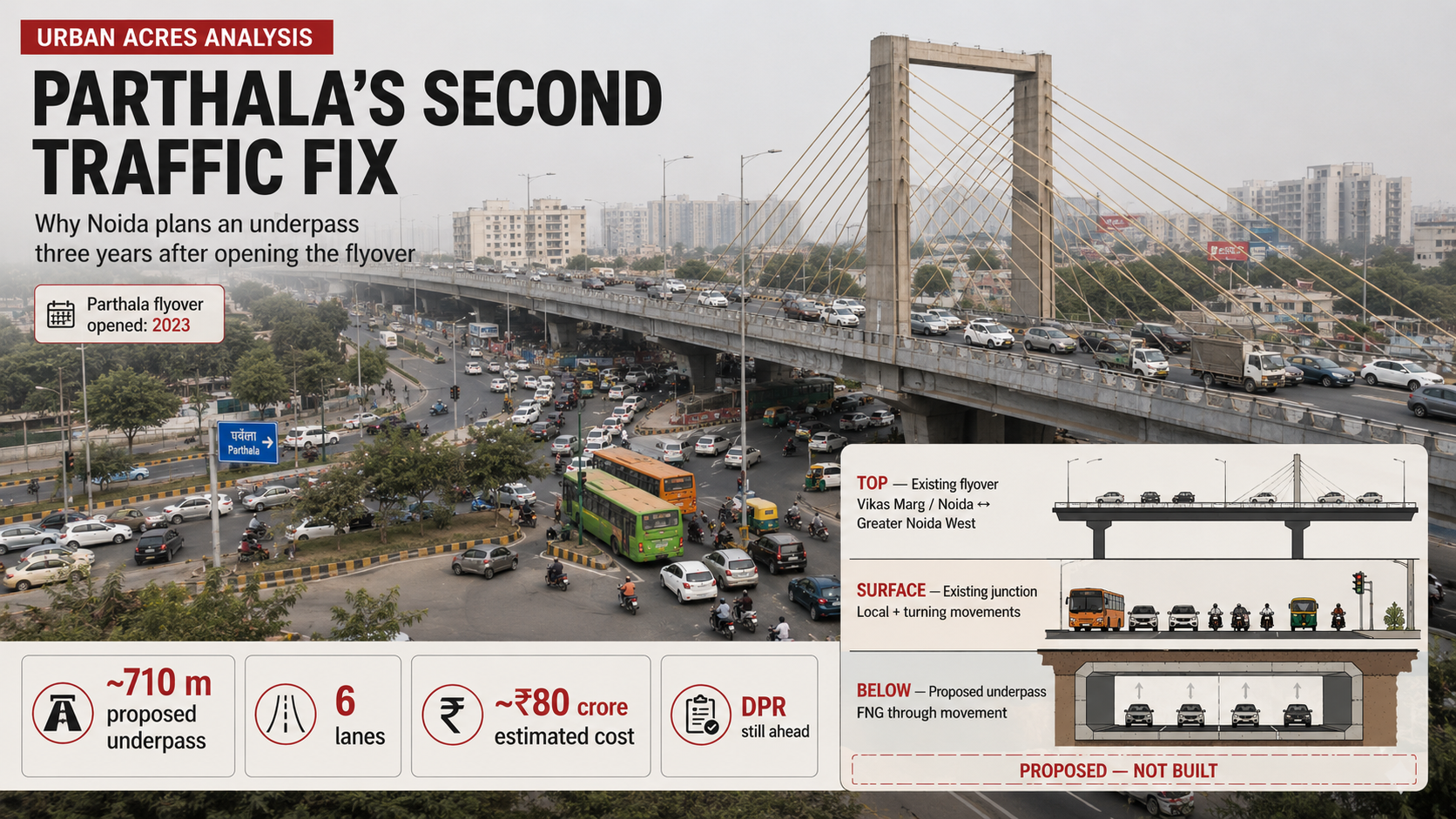
A proposed six-lane, 710-metre underpass would separate traffic on the FNG axis beneath Parthala Chowk. But DPR and tendering remain ahead, while the wider FNG corridor and adjoining junctions expose a larger network problem that a single structure cannot resolve.
NOIDA — Three years after opening a cable-stayed flyover over one of Noida’s busiest intersections, the Noida Authority is preparing another major grade-separated intervention at Parthala Chowk.
The Authority has advanced a plan for a six-lane underpass along the Faridabad–Noida–Ghaziabad, or FNG, alignment, where it crosses Vikas Marg. Current plans describe a structure approximately 710 metres long, carrying three lanes in each direction and costing an estimated ₹80 crore.
The engineering logic is relatively clear: the existing flyover carries the Noida–Greater Noida West movement over the junction, while the proposed underpass would take through-traffic on the intersecting FNG axis below it. Surface roads would continue to handle turning and local movements.
What is less certain is the stronger claim now surrounding the project—that it will effectively eliminate congestion at Parthala.
That outcome has not yet been demonstrated.
Approval is a milestone, not construction
The first distinction concerns project stage.
Multiple reports describe the Authority as having approved or decided to develop the underpass. However, one report quoting Noida Authority general manager A.K. Arora says a Detailed Project Report will now be prepared, followed by tendering. Another describes the current approval as in-principle.
That places the project well before contract award, mobilisation or excavation.
The frequently cited 18-month timeline should therefore be understood as an intended construction period, rather than a countdown that necessarily began with this week’s announcement.
There is, as yet, no publicly verified contractor, contract value or construction commencement date.
And the project itself is older than this week’s headlines
The underpass is also not a newly discovered solution.
A six-lane, 710-metre structure at Parthala was being reported in December 2024, then at an estimated ₹85.5 crore. That version was being developed for the FNG movement beneath the existing cable-stayed bridge.
By December 2025, another account described a four-lane version of the same 710-metre concept, with final design and DPR still to follow.
The six-lane version and ₹85.5-crore estimate resurfaced by March 2026.
The latest development therefore matters because the Authority appears to have moved the proposal forward and settled again on six lanes—not because an underpass has suddenly appeared for the first time.
There is also an unexplained financial change. The current estimate is approximately ₹80 crore, versus roughly ₹85.5 crore in earlier planning.
The difference may ultimately reflect changes in design, quantities or scope, but no document reviewed by Urban Acres establishes the reason. It should remain unreconciled until a DPR or sanctioned estimate is published.
Why Parthala still jams after a flyover
The need for another structure reveals a basic principle of intersection design: grade separation on one movement does not automatically separate every movement.
The Parthala flyover opened in June 2023 to provide a freer connection between Noida and rapidly urbanising Greater Noida West. It carries Vikas Marg traffic above the roundabout.
But the FNG alignment crosses beneath it at ground level. Vehicles travelling between the Chhijarsi side and Sorkha/Phase-II side still interact with surface traffic and turning movements at the junction.
By February 2026, the Authority was still attempting to reconfigure the roundabout, including dedicated U-turns and geometry changes. Reporting described continuing peak-hour queues, wrong-side movements and traffic feeding into downstream constraints.
The proposed underpass tackles this second axis by allowing FNG through-traffic to pass beneath the intersection.
In engineering terms, Parthala would become a multi-level junction: one primary movement above ground, another below it, and local distribution at surface level.
That could materially reduce conflict at the centre of the intersection.
It does not automatically remove the constraints beyond it.
The bottleneck can simply move
This is the most important public-interest test.
After the Parthala flyover opened, faster discharge from the junction contributed to increased pressure farther towards Gaur Chowk. Reporting on the Greater Noida West side identified narrow downstream sections, intersection conflicts, informal stopping and other capacity constraints.
This is a familiar network effect.
If an intersection can release 5,000 vehicles per hour but the road or junction receiving those vehicles can accommodate materially less, the queue does not vanish. Its location changes.
Parthala therefore cannot be evaluated only by asking whether vehicles stop beneath the flyover.
Noida and Greater Noida authorities need to measure the entire journey:
FNG approach → Parthala → Hindon crossing → Gaur/Kisan Chowk → Greater Noida West distribution network
and, in the other direction:
Parthala → Chhijarsi → NH-9 / Delhi-Meerut Expressway interface.
Urban Acres is not asserting that these links have specific quantified capacity deficiencies without a current traffic model. The point is that they must be included in one.
The FNG name creates another misconception
Descriptions of the underpass as part of the Faridabad–Noida–Ghaziabad corridor can imply a functioning regional expressway stretching continuously across the NCR.
That is not the current reality.
In July 2026, the wider FNG project was still reported as incomplete after decades of planning. Only 11.6 kilometres of the 23 kilometres under Noida’s jurisdiction were reported completed, while land, funding and coordination constraints continued across the wider scheme.
That matters because the traffic function of Parthala will change as more pieces of the FNG are completed.
An underpass sized for current traffic is not necessarily an underpass sized for the eventual corridor—and, conversely, current traffic projections based on full FNG operation may not materialise according to the original schedule.
The DPR therefore needs to disclose its traffic assumptions explicitly.
₹80 crore should buy a measurable mobility outcome
The public test for the project should not be whether 710 metres of concrete are completed.
It should be whether the completed junction performs better.
At minimum, Noida Authority should publish baseline and post-opening measurements for:
- peak-hour queue length on every approach;
- average intersection delay;
- corridor travel time;
- traffic volume by movement;
- crash and conflict data;
- wrong-side driving;
- pedestrian crossing conditions;
- drainage failures and closure hours;
- downstream travel time towards Gaur Chowk and Chhijarsi.
A project intended to address a traffic bottleneck should be judged against traffic outcomes.
Construction itself will become the next mobility problem
An underpass beneath an operating junction and existing flyover is not merely an excavation exercise.
The reported diaphragm-wall construction method is intended to protect surrounding ground and infrastructure during excavation.
But the public-facing challenge will be maintaining movement during construction.
Parthala’s previous flyover construction required diversions and produced significant local disruption. Residents reported blocked approaches, confusing movements and traffic entering residential service lanes during that work.
The DPR and tender should therefore make the construction traffic-management plan a disclosed project deliverable—not an afterthought once barricades appear.
Drainage must be treated as operational infrastructure
Two sump-and-pumping arrangements have been reported as part of the proposed design.
That is significant because an urban underpass is only as reliable as its stormwater system.
The appropriate lifecycle question is not simply whether pumps are installed. It is:
inlet → sump → pump → power supply → backup power → discharge point → maintenance → monsoon response
Noida Authority should disclose pump capacity, design rainfall assumptions, backup power arrangements and the agency responsible for long-term maintenance once the DPR is complete.
The real test comes after opening
There is a credible engineering rationale for separating FNG through-traffic from Parthala’s surface intersection.
But that is different from claiming the project will make traffic disappear.
Parthala’s own history demonstrates why.
The 2023 flyover solved an important movement. The junction still required further redesign. Now another major structure is proposed for the crossing movement.
The lesson is not necessarily that the flyover failed. It is that urban traffic operates as a network.
The best measure of the ₹80-crore underpass will therefore be neither its lane count nor its completion ceremony.
It will be whether residents can move through Parthala—and through the roads immediately beyond it—with shorter, safer and more predictable journeys.
