


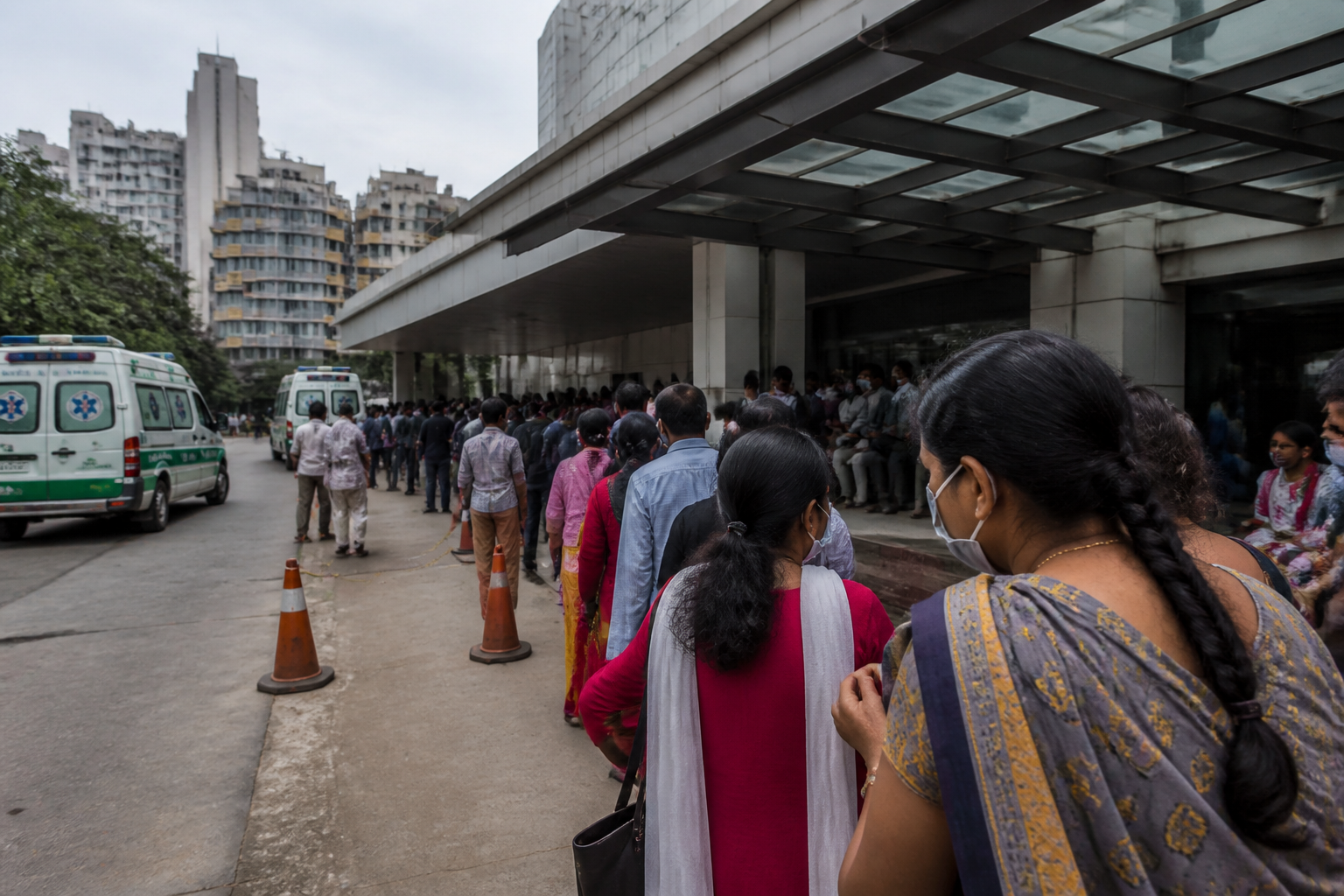
The overcrowding at Bengaluru’s National Institute of Mental Health and Neurosciences is not simply a problem of insufficient beds or slow outpatient services. It is a sign of how India’s specialised public healthcare system is being asked to compensate for weaknesses across the wider network of district hospitals, medical colleges and secondary-care centres.
Dr YC Janardhan Reddy, who took charge as Nimhans’ interim director on September 1, said in an interview with The Times of India that strengthening healthcare at the periphery was essential to reducing pressure on the institute. Patients reportedly begin queuing for outpatient services as early as 4am, while concerns have also been raised about ventilator availability in casualty.
Reddy’s central argument is that Nimhans cannot solve the problem through expansion alone. The institute receives patients from across the country for conditions ranging from relatively simple complaints to the most severe neurological and mental-health emergencies. A tertiary institution designed to handle highly specialised cases is therefore functioning as a default point of access for a much wider patient population.
That creates a capacity problem that is difficult to solve within the boundaries of one campus. Reddy said that even if another Nimhans campus were opened next door and 50 additional intensive-care units were created, those facilities could be filled on the same day. The observation points to a demand system in which new capacity attracts patients because the surrounding levels of care are not strong enough to absorb them.
The pressure is also linked to affordability. According to Reddy, some patients initially seek care at corporate hospitals during emergencies, but after realising within two days that they cannot afford treatment, attempt to shift to Nimhans. The movement is understandable from a household’s perspective, but it transfers financial and clinical pressure to a public tertiary institution whose resources remain limited.
This is the institutional gap behind the queues. When secondary-care centres lack adequate infrastructure or competent personnel, patients and families have an incentive to bypass them, even when their medical needs do not require the highest level of specialised care. The result is a concentrated burden at a national institute, longer waits for outpatient consultations and greater difficulty in ensuring critical-care availability.
The interview does not provide a capacity audit of Bengaluru’s district hospitals or medical colleges, nor does it quantify how many Nimhans patients could be treated elsewhere. But it establishes the direction of the problem: expanding the apex institution without improving the facilities below it may reproduce the same overcrowding at a larger scale.
The proposed response is therefore less about building a single larger hospital and more about creating a functioning referral network. District hospitals and medical colleges would need reliable infrastructure and skilled staff so that patients can receive appropriate care closer to home. The source material does not specify a funding model, staffing plan or implementation timetable for such an expansion, but the director’s comments make clear that the burden cannot be addressed by Nimhans alone.
Nimhans is still pursuing physical expansion. Its north Bengaluru campus, planned as a polytrauma centre, is expected to become operational soon, with outpatient services possibly beginning in a couple of months. A new outpatient department on the main campus is also expected to begin operations in the coming months. These projects could add access points, but they do not remove the need to distinguish between tertiary referrals and cases that can be handled at secondary-care facilities.
The larger Nimhans 2.0 proposal introduces another layer to the institutional picture. The initiative was announced in the Union Budget, but the government has not yet decided where the new centre will be established. Reddy said Nimhans had provided inputs for its development and that the proposed centre was not intended to be an extension of the existing campus, although it would follow the same overarching model.
That distinction matters. A new national-level institution could expand specialised capacity, education and research, but its location and operating design will influence whether it decentralises care or creates another major national destination. The available information does not establish the proposed site, scale, funding structure or service mix. Those decisions will determine whether Nimhans 2.0 complements the existing system or adds another heavily centralised node.
Technology is being discussed alongside expansion, but the interview presents a more cautious picture than the current enthusiasm around artificial intelligence might suggest. Reddy said AI applications in mental health had not yet reached a translational stage where they could be used routinely in clinical practice. Much of the work remains at the research level, including efforts to understand biological correlates of illness and the development of applications for cognitive training, self-help and depression-related support.
Digital programmes such as Tele-MANAS are already part of the broader technology landscape, while internet-based cognitive behavioural therapies may support people with mild to moderate illness. Some programmes operate without therapist intervention, while others include periodic professional inputs. Reddy stressed that such tools would need to be indigenous because mental illness and its cultural context vary across populations.
This qualification is important for a healthcare system facing both high demand and uneven access. Digital tools may help extend basic support or guide patients towards appropriate services, but they cannot automatically replace trained clinicians, emergency facilities or referral institutions. Reddy said AI was likely to remain complementary to the human component of medicine and noted that its performance depended on the data used to train it.
The institute’s technology agenda also reveals the complexity of building digital mental-health systems. Clinical expertise must work alongside artificial intelligence, machine learning, deep learning and cybersecurity capabilities. Reddy said medical institutions and technology institutions needed closer collaboration, noting that Nimhans already had partnerships with a couple of IITs. Such cooperation could support research and digital applications, but the interview does not establish that these collaborations have already changed routine patient care.
The evidence therefore points to three connected pressures. The first is demand concentration at a premier public institution. The second is the affordability-driven movement of patients between private and public hospitals. The third is the mismatch between expectations from AI and the present state of clinical deployment. Physical expansion, financial access and digital innovation are being discussed together, but each addresses a different part of the healthcare system.
For Bengaluru, the immediate urban question is whether specialised healthcare can be made accessible without requiring every serious or uncertain case to travel to one institution. Long queues are the visible outcome. The less visible issue is the design of the referral chain: which facilities handle first contact, which hospitals provide secondary care, when patients move to tertiary centres and how that movement is financed.
Nimhans’ upcoming north Bengaluru campus and new outpatient department are the next operational milestones. The government’s decision on the location of Nimhans 2.0 is the larger institutional milestone. The effectiveness of both will depend not only on the additional buildings created, but also on whether district hospitals and medical colleges are strengthened enough to prevent the existing concentration of demand from simply being reproduced elsewhere.
