


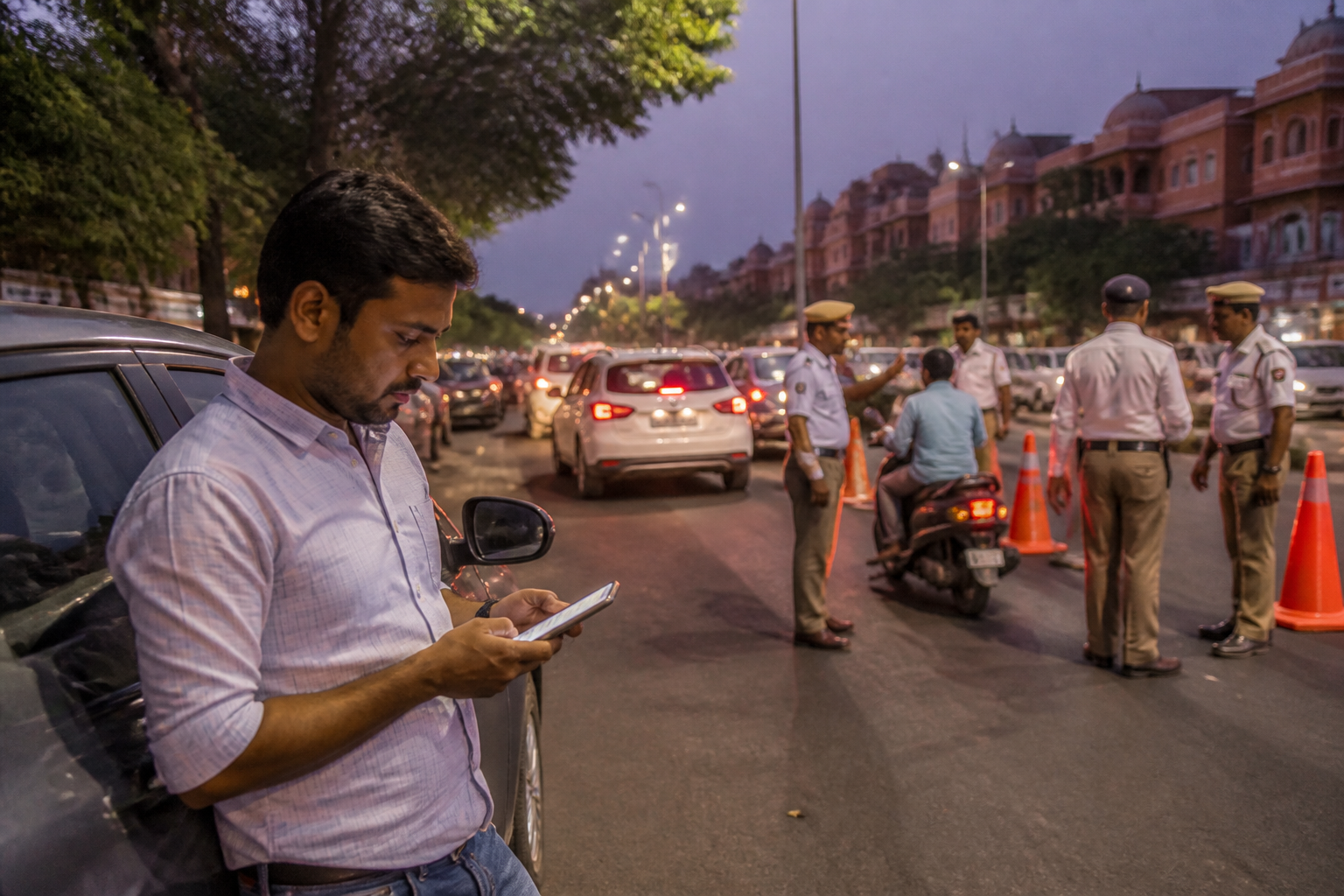
The Jaipur e-challan dispute has brought two linked questions into focus: who is authorised to issue a traffic notice, and what can a motorist do when a digitally generated challan is believed to be wrong. The issue emerged after a Secretariat employee complained about a mobile e-challan issued following an interaction with a traffic constable, prompting the traffic department to restate both the authority of enforcement personnel and the procedure for challenging an incorrect notice.
According to the report, the employee alleged that he was stopped at around 10 pm on September 25 and issued a challan by a constable identified as Kishan Singh. He questioned the constable’s authority, after which he alleged that an altercation took place and traffic personnel took him away. The complainant further alleged that he was assaulted and suffered an injury to a finger. He submitted a complaint to an assistant commissioner of police seeking action against the personnel involved.
The allegations in the complaint are not established as findings in the supplied report. Their significance for the traffic system lies in the institutional question they have raised: whether the official who initiates or issues a notice has the required authority, and how that authority can be tested after the vehicle owner receives an electronic record of the alleged violation.
ACP Traffic East-II Mukesh Choudhary said only police personnel of the rank of head constable and above are authorised to issue traffic challans. That clarification places the dispute within a defined chain of administrative responsibility. It also means that a challan is not only a record of an alleged traffic violation; it is an official action that must be issued through the authority prescribed by the department.
For motorists, the distinction matters because a digitally delivered notice can appear final even when the underlying circumstances are disputed. The department’s stated process provides a formal route for contesting such notices. Where a challan has been generated through the Integrated Traffic Management System, or ITMS, the vehicle owner can use the ‘Raise Grievance’ facility on the ITMS Challan portal.
The process begins with locating the notice through the vehicle number or notice number. The motorist can then submit details of the objection and upload supporting evidence, including a picture of the vehicle. The grievance is examined by the department. If the challan is found to have been issued incorrectly, it is cancelled. If the department finds it valid, the notice remains in force.
This procedure separates the act of issuing a challan from the act of reviewing a challenge to it. The first stage records the alleged violation. The second allows the vehicle owner to present evidence and requires the department to examine whether the notice should stand. That distinction is central to the functioning of a digital enforcement system: automation or electronic delivery does not remove the need for administrative review when the recipient disputes the record.
The Jaipur case also shows why questions of rank and process become more important as enforcement moves onto digital platforms. A notice that reaches a vehicle owner electronically may be generated within an information system, but the system still depends on officials who record, initiate or authenticate enforcement action. The department’s statement that only head constables and above may issue challans therefore addresses the human authority behind the digital notice.
At the same time, the supplied report does not establish whether the disputed challan was ultimately cancelled or upheld. It also does not state what conclusion, if any, was reached on the complainant’s allegations of an altercation or assault. Those matters remain separate from the general grievance mechanism described by the traffic department. A motorist’s ability to challenge a challan does not, by itself, determine whether conduct during the roadside interaction was proper.
The distinction is important for accountability. There are at least two questions in a dispute of this kind. The first is whether the traffic notice was legally and procedurally issued. The second is whether the interaction between enforcement personnel and the motorist complied with the department’s expectations. The ITMS grievance route addresses the first question by allowing evidence to be submitted against the notice. The complaint to the ACP addresses the second by seeking action concerning the conduct of personnel.
The department’s explanation gives motorists a specific administrative pathway instead of leaving the challenge dependent on an informal exchange with the officer who issued the notice. The use of a vehicle number or notice number creates an identifiable entry point for the dispute, while the option to upload a vehicle picture allows the claimant to attach material evidence. The final decision, according to the ACP, is based on departmental examination of the grievance.
However, the available account does not describe the time taken to decide a grievance, the documents required in different types of cases, or whether the applicant receives a detailed reason when a challan is upheld. It also does not specify how a motorist can pursue the matter if dissatisfied with the departmental decision. These details are not established in the supplied material and cannot be assumed from the existence of the portal.
That gap points to the difference between having a digital grievance facility and having a fully transparent dispute-resolution system. The report confirms that the ITMS Challan portal provides a ‘Raise Grievance’ option and that the department examines submissions. It does not provide evidence on the portal’s disposal timelines, communication standards or appeal structure. For citizens, those operational details determine how usable the process is in practice.
The case therefore places institutional design alongside individual responsibility. Motorists who believe a notice is incorrect have been advised to access the challan using the vehicle or notice number, provide details and submit supporting evidence. The department, in turn, has stated that it will assess the complaint and either cancel an incorrectly issued challan or keep a valid one in force. This arrangement depends on both sides being able to identify the record, present evidence and receive a decision through an accountable process.
The immediate controversy also raises a narrower but consequential question about public communication. If motorists do not know which ranks are authorised to issue challans or how to contest an error, a notice can become a source of confusion before it becomes a matter of adjudication. The ACP’s clarification addresses both points by identifying the authorised rank and directing vehicle owners to the official grievance facility.
The supplied report does not show whether the alleged officer was authorised under the stated rank requirement, nor does it record the department’s final response to the individual complaint. That is the unresolved factual core of the case. What is established is the department’s position on authorised personnel and its description of the ITMS review process.
For Jaipur’s traffic administration, the issue is consequently less about whether every digitally issued notice should be accepted or rejected than about whether the system makes authority and correction visible to citizens. The department has stated that a challan can be cancelled when an examination finds it was issued incorrectly. The complaint has now brought attention to the need for motorists to know how that examination begins and what evidence they can submit.
The next developments to monitor are the outcome of the employee’s complaint, the status of the disputed challan and any further departmental clarification on grievance disposal. Until those steps are recorded, the case confirms the available challenge mechanism but does not establish the final findings on the individual incident.
