


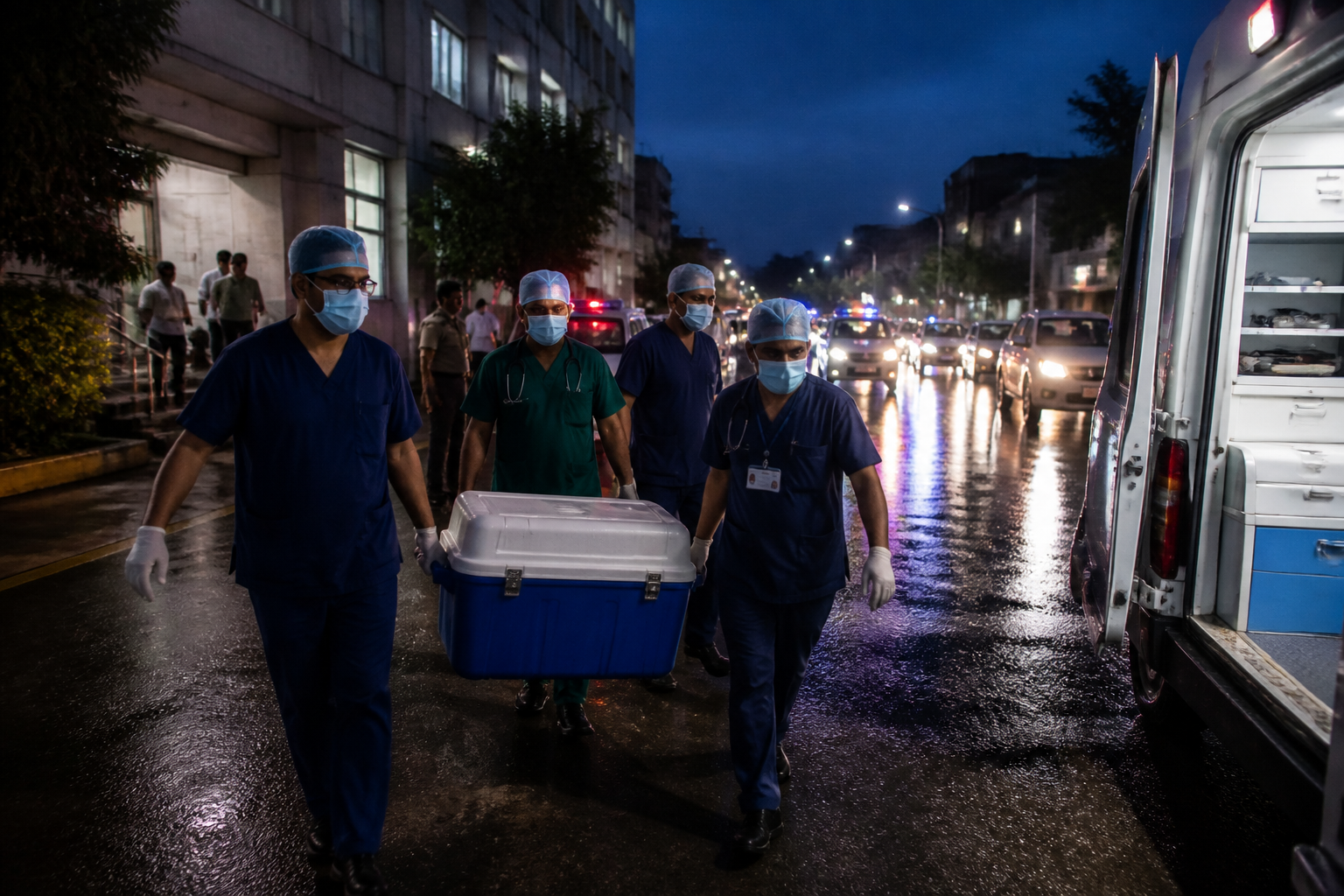
A nine-year-old boy from a farming family in Solapur became an organ donor after being declared brain-dead following a road accident, enabling a three-year-old Russian child receiving treatment in Chennai to undergo a heart transplant. The case shows that organ donation is not only a medical decision made inside a hospital. It also depends on a tightly timed regional system linking families, doctors, transplant coordinators, airports and road authorities.
The donation was reported on World Heart Day, September 29, after the child’s parents agreed to donate his heart, liver and both kidneys. The organs were allocated to four recipients: the heart went to the Russian child in Chennai, the liver to a patient in Pune, and the two kidneys to two other patients in Pune. The donation therefore connected patients and institutions across Solapur, Pune and Chennai rather than serving only the city where the donor was treated.
That geography is central to understanding what happened. The boy was injured while crossing a road in front of his home and was admitted to Chandan Neurosciences Hospital in Solapur. Despite treatment under Dr Prasanna Kasegaonkar, the medical team declared him brain-dead. The decision by his parents to donate his organs then set in motion a series of medical and logistical processes, each with a narrow window for completion.
The heart faced a particular allocation challenge. According to the report, a suitable recipient with the same blood group was not available in Solapur. Without a recipient in the city, the heart risked going unused. The Pune division’s transplant coordinator, Aarti Gokhale, issued an international alert about the heart’s availability. That alert eventually matched the organ with a three-year-old Russian child being treated at MGM Hospital in Chennai.
The episode illustrates how transplant capacity is shaped by geography. A donated organ may be clinically suitable for a patient, but that match has little practical value unless the organ can reach the recipient within the required time. In this case, the absence of an appropriate recipient in Solapur did not end the process. Instead, the search expanded beyond the city and ultimately across national boundaries to a child already receiving treatment in Chennai.
The heart’s movement also depended on aviation. The Chennai medical team travelled to Solapur by charter aircraft to collect the organ. Dr Pallavi Mehta, head of the intensive care unit at Chandan Neurosciences, said the usable life of a heart for transplantation is generally around four to six hours. That time limit made the journey a coordinated emergency rather than a routine transfer between hospitals.
The weather created an additional complication. After take-off, the aircraft had to return to the runway because of adverse conditions, costing valuable time. The medical team nevertheless completed the required procedures rapidly and transported the heart to Chennai, according to Dr Mehta. A green corridor was arranged between Solapur and Chennai for the road portion of the journey.
A green corridor is often described simply as a traffic-management measure, but this case shows its wider institutional role. It required the organ’s movement to be treated as a time-critical public responsibility involving more than the donor and recipient hospitals. The corridor had value because it connected the medical process to the city’s transport network, allowing the heart to move through roads with reduced delay after reaching the relevant transit point.
The success of the transfer therefore rested on several linked decisions. The donor family had to consent during an intensely difficult moment. Doctors had to identify the child’s condition and manage the donation process. A transplant coordinator had to search for a compatible recipient beyond Solapur. A Chennai hospital had to organise a medical team and aircraft. Authorities had to facilitate the green corridor. Each step addressed a different constraint, but the outcome depended on all of them working within the same limited time.
The case also highlights the difference between physical proximity and functional access. Solapur did not have a suitable recipient for the heart, but it was the place where the organ became available. Chennai had the recipient but not the donor. Pune received the liver and kidneys. The transplant network worked by connecting these locations, turning a regional medical event into a multi-city operation.
That network is not visible to most road users. A green corridor may appear to be an isolated traffic intervention, yet its effectiveness depends on prior medical coordination, route planning and the ability of multiple institutions to act quickly. The road is only one part of the system. If the recipient search is delayed, if the aircraft cannot be arranged, or if the hospital procedures take too long, traffic clearance alone cannot save the transfer.
The case also places hospitals outside the largest metropolitan centres within the national transplant geography. Chandan Neurosciences Hospital in Solapur was the site where the donor was treated, the organs were retrieved and the heart began its journey. The receiving child was in Chennai, while other organs were allocated to Pune. The report does not establish the broader distribution of transplant facilities across these cities, but this single case demonstrates the importance of coordination between institutions with different roles and locations.
The medical and transport systems were also exposed to uncertainty. The aircraft’s return because of adverse weather introduced a delay that could not be resolved merely by better traffic management. The response depended on the medical team completing the remaining procedures quickly and continuing the transfer. This is a reminder that time-critical urban services operate across several infrastructures at once: hospitals, communications, aviation and roads.
The people named in the report reflect that division of responsibility. Dr Prasanna Kasegaonkar supervised the donor’s treatment. Aarti Gokhale coordinated the Pune division’s effort to find an international recipient. Dr Pallavi Mehta explained the time constraints and the effect of the weather disruption. Doctors Viresh Nashtे, Santosh Gujरे and Sharad Jadhav, transplant coordinator Dr Sandeep Patil and the hospital team were also credited with important roles. Their combined work shows that a transplant is not the product of a single intervention, but of a chain of specialised tasks.
The allocation of four organs from one donor also shows why consent decisions have consequences beyond one recipient. The family’s choice allowed the heart, liver and kidneys to be directed to patients in three locations. The source report identifies the recipients by location and, in the case of the heart recipient, nationality and age, but does not provide further medical details. What is established is that the donation extended the possibility of treatment to four patients.
There is also a governance question embedded in the episode: who coordinates when a city cannot use a medically suitable organ? In this case, the Pune division’s transplant coordination mechanism issued an international alert rather than treating the lack of a local recipient as the end of the process. The report does not describe the full rules or institutional structure behind that alert, but it makes clear that coordination was necessary to connect supply and need across jurisdictions.
The transport response similarly depended on cooperation between public and private actors. The hospitals and medical teams handled clinical decisions and organ retrieval. The charter aircraft provided the inter-city link. The green corridor addressed the road journey. The report does not identify every authority involved in arranging the corridor, so the precise administrative chain cannot be established from the supplied material. It does, however, confirm that the corridor was arranged for the Solapur-to-Chennai transfer.
This is why the story belongs to the urban infrastructure conversation even though its immediate subject is organ donation. Cities are not only places where hospitals and patients are located. They are systems through which people, medical teams and life-saving materials must move. In time-sensitive healthcare, the quality of those connections can affect whether specialist capacity is usable at all.
The case should not be read as evidence that every organ transfer will succeed under similar conditions. The report records one successful operation and identifies the obstacles encountered, including the absence of a matching recipient in Solapur and the aircraft’s return because of weather. It does not provide comparative data on other transfers, average travel times, failure rates or the availability of transplant infrastructure across Maharashtra and Tamil Nadu. Those questions remain outside the evidence supplied here.
What the episode does establish is more specific and important: a family’s decision in Solapur set off a coordinated process that reached a child in Chennai, while three other patients in Pune received organs from the same donor. The heart’s journey required a recipient search, a charter flight, rapid hospital procedures and a green corridor, all within a four-to-six-hour window described by the treating hospital’s intensive care chief.
The next stage for public understanding is to look beyond the emotional power of the donation and recognise the institutional chain that made it possible. The reported outcome depended on consent, clinical certification, matching, coordination and transport working together. In this case, that chain converted an organ that might otherwise have been lost locally into a transplant for a child hundreds of kilometres away.
