


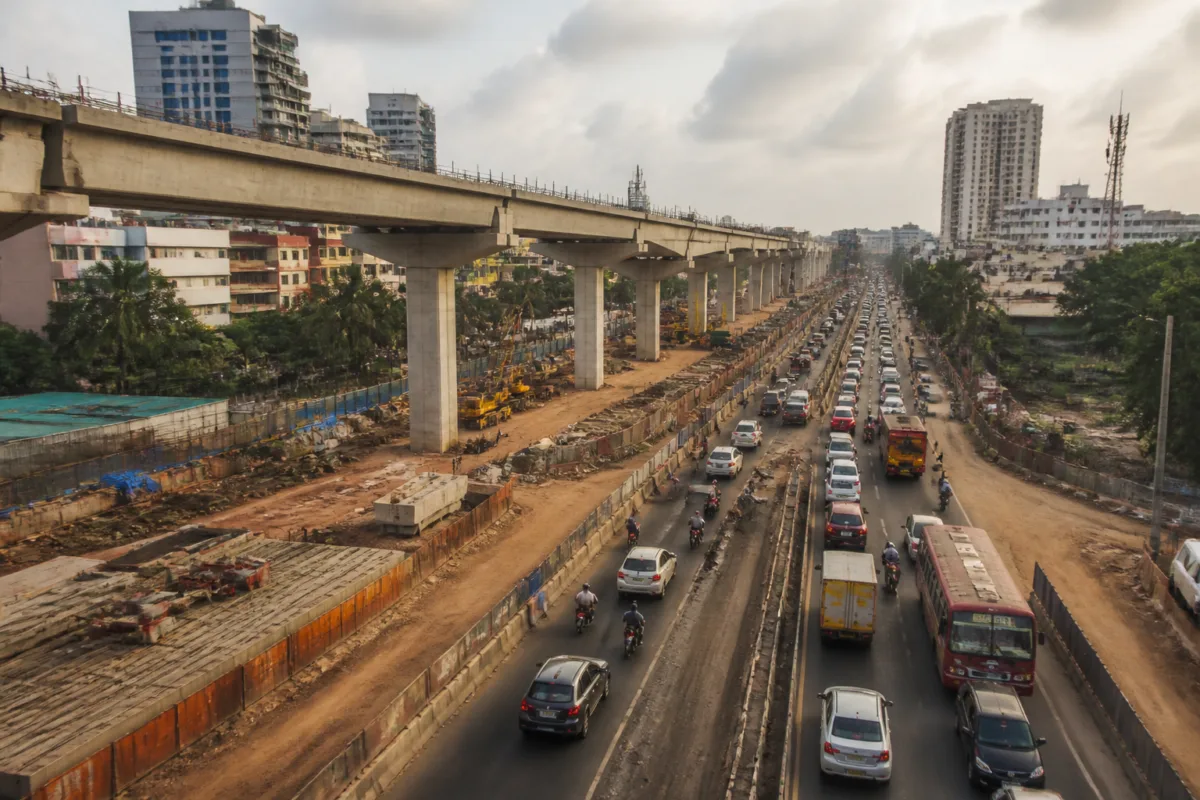
The latest construction strategy on Kochi’s NH66 Edappally–Moothakunnam corridor shows how a highway project can be 75% complete and still remain deeply exposed to delays. The National Highways Authority of India (NHAI) has established three casting yards to prefabricate concrete structures, but the 26.06-km six-laning project has also acquired additional works, faced material shortages and seen its completion deadline move from April 2025 to May 2027.
The project’s central challenge is no longer simply building a wider highway. It is coordinating a large construction system around an already busy urban corridor while maintaining traffic movement, adding local connections and securing the raw materials needed to keep work physically progressing. The decision to manufacture structural components away from their final locations is therefore both a construction intervention and a response to the operational constraints of working inside a functioning city.
The six-laning work began on October 25, 2022, and is being executed by Oriental Structural Engineers. NHAI has set up specialised casting yards at locations including the FACT site and Hazhi camp. Prefabricated concrete elements made at these facilities are then assembled at the project site. According to an official quoted by the Times of India, 220 of an additional 1,100 piles and 200 of an additional 1,000 girders had already been prefabricated.
Prefabrication changes where time is spent. Instead of carrying out all structural work at locations where traffic, utilities and existing road conditions may restrict construction activity, components can be produced in dedicated facilities and transported for assembly. The project official said this method could save considerable time. However, the available information does not establish how much time the method will save across the entire corridor, nor does it indicate whether the May 2027 target has been formally revised following the latest construction changes.
The project’s revised scope is significant because it links highway capacity with local urban circulation. NHAI now plans 18 additional structures, along with 4.9 km of additional pillars and 5.9 km of new service roads. These additions are intended to improve local connectivity and address traffic bottlenecks rather than merely add capacity to the main carriageway.
That distinction matters in a corridor such as Edappally–Moothakunnam. A highway can be widened while nearby junctions, service roads and crossing points continue to obstruct movement. The revised plan indicates that project authorities have identified the interfaces between the national highway and the surrounding urban road network as a major part of the traffic problem. It also means that the project’s original scope was not the final measure of what would be required to manage traffic through the area.
The most visible example is Edappally Junction, one of the corridor’s principal pressure points. Two flyover-cum-underpasses are being built on either side of the existing Edappally flyover. Their opening is now expected in May 2027 after the flyovers were extended by an additional 90 metres each. The structures, originally planned at 650 metres, will now be 740 metres long, with three additional structural spans on each side. Each flyover will have a width of 50 metres.
One of the extended flyovers is near the Lulu Office entrance to the north, while the other is near Oberon Mall to the south. The stated purpose of the extension is to move vehicles farther away from the existing Edappally flyover and improve decongestion. An underpass is also being constructed near the southern flyover to enable pedestrians and small vehicles to move between Marottichuvadu Market and the MAJ Hospital side of Edappally.
These details show why urban highway projects cannot be assessed only by measuring the length of the main road widened. The performance of the corridor depends on how vehicles enter and leave the highway, how local roads connect to it, and whether pedestrians and smaller vehicles have safe and practical crossing routes. The additional structures and service roads are therefore central to the project’s urban function, even though they may also extend construction activity and defer the completion of some components.
The project has made progress on several major structures. All primary bridge structures, including seven major bridges and eight minor bridges, have been completed. The parallel Varapuzha bridge, built using the balanced cantilever technique, is operational. Work on the three-lane Edappally railway overbridge and the surrounding service roads is in its final phase, with an opening planned for December.
At the same time, construction progress remains tied to the availability of quarry material and soil. The project requires approximately 900,000 tonnes of high-grade crushed stone and granite. A month-long ban on interstate quarry transport imposed by Tamil Nadu was reported to have threatened physical work. NHAI has applied for extraction rights at a government quarry in Thrissur and requested local sourcing approvals from Chalakudy.
The material issue illustrates the administrative geography behind major infrastructure projects. The work is located in Kochi, but its construction inputs may depend on permissions, transport rules and extraction arrangements across multiple parts of Kerala and neighbouring states. A highway authority may control the project schedule, yet the schedule remains vulnerable to decisions taken by quarry operators, state agencies, local administrations and transport authorities.
Soil availability has created a related constraint. A shortfall in red soil was partly addressed through an arrangement with Cochin Port Trust to use dredged soil from a shipping channel. NHAI has also sought state government permission to use soil from the Kottappuram irrigation channel. The source material does not establish whether these permissions have been granted or how much of the requirement they would meet.
This is an important distinction in evaluating construction progress. The project is reported to be 75% complete, but the remaining 25% cannot be understood as a uniform final stage. It includes additional piles, girders, flyover extensions, service roads, an underpass and construction activity dependent on materials that are not yet fully secured. Physical completion percentages can therefore coexist with substantial uncertainty over the sequencing and delivery of individual components.
The project’s revised deadline also reflects this complexity. It was originally scheduled for completion by April 2025, but persistent bottlenecks pushed the target to May 2027. The new deadline is connected not only to delays in execution but also to the decision to expand the scope at Edappally and elsewhere along the corridor. The available report does not specify the original contract value, the revised cost, the number of land parcels affected or the precise causes of each earlier delay.
For commuters, the immediate issue is whether construction can continue without creating additional congestion on a corridor that is already carrying significant traffic. NHAI’s decision to use casting yards is explicitly intended to accelerate the work and prevent traffic congestion caused by highway construction. The December opening planned for the railway overbridge and service roads is the next stated milestone, while the extended flyover-cum-underpass works are expected to be completed in May 2027.
The larger urban question is whether the project can deliver a highway that functions as part of Kochi’s local street network rather than as an isolated high-capacity corridor. The revised scope suggests that the answer depends on more than lane count. It depends on bridges, service roads, junction design, pedestrian movement, small-vehicle access and the availability of construction materials.
The evidence confirms that NHAI is using prefabrication to address time pressure while simultaneously enlarging the project’s traffic-management components. It also shows that construction progress remains vulnerable to supply and approval bottlenecks beyond the immediate work site. The December railway overbridge opening, the progress of the additional piles and girders, decisions on quarry and soil sourcing, and the May 2027 target for the extended Edappally structures are the milestones that will show whether the revised delivery strategy can convert reported progress into a functioning corridor.

