


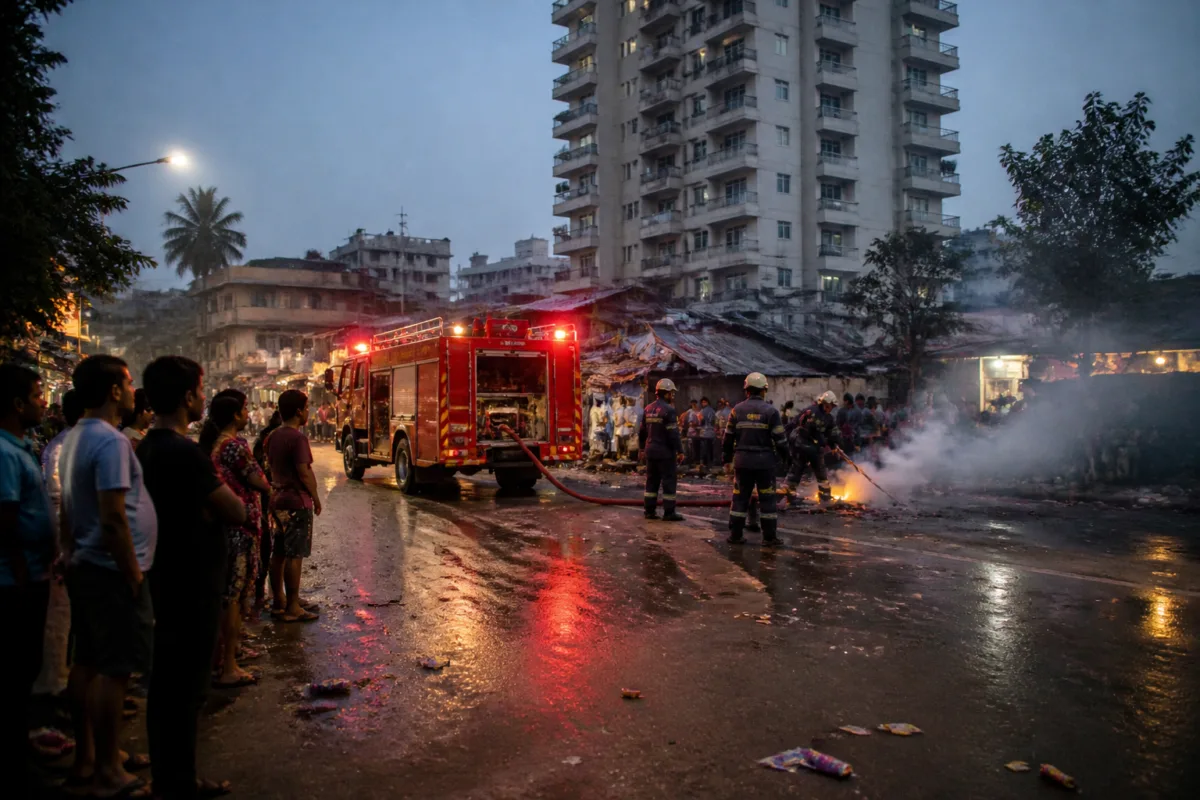
Navi Mumbai’s Diwali fire data points to a recurring urban safety problem rather than a series of isolated emergencies. The fire departments of the Navi Mumbai Municipal Corporation (NMMC) and the City and Industrial Development Corporation (CIDCO) recorded 198 fire calls between November 8 and 14, of which 155 were attributed to firecrackers, according to officials cited by the Free Press Journal. The incidents affected residential buildings, hutments, shops, markets, warehouses, vehicles and open areas containing tarpaulin, garbage and dry grass.
The figures matter because they show how a short period of concentrated festive activity can place simultaneous pressure on a city’s emergency-response system. They also reveal that fire risk in Navi Mumbai is shaped by the interaction of behaviour, building density, combustible material and the physical form of neighbourhoods. A rocket entering a residential building and burning fireworks landing on hutment roofs are not only questions of individual caution. They are also examples of how quickly a spark can move from a public street into buildings, informal settlements and mixed-use areas.
The reported numbers are divided between two agencies. NMMC recorded 101 fire calls during the period, while CIDCO recorded 97. NMMC Fire Officer Purushottam Jadhav said approximately 75% of the corporation’s calls were linked to firecrackers, with the remaining 25% attributed to electrical short circuits. CIDCO Chief Fire Officer Vijay Rane said 79 of its 97 calls were related to firecrackers. Taken together, the two departments attributed nearly four-fifths of the reported calls to fireworks.
That distribution makes the episode different from a conventional fire season driven mainly by electrical faults, industrial activity or one major incident. The calls were spread across several types of urban settings and were generated during a limited festival period. The pattern suggests that the emergency challenge was not simply the scale of any individual blaze, but the number of incidents arriving across the network at the same time.
Under NMMC, November 9 and 10 recorded the highest daily totals, with 27 calls on each day. The department received 23 calls on November 8, followed by 12 on November 11, six on November 12, one on November 13 and five on November 14. More than 45 major fire incidents were reported within the NMMC jurisdiction. Officials said firefighters brought the major fires under control and that no loss of life was reported in the corporation’s area.
The station-level figures offer another layer of information. Vashi recorded the highest number of calls among the five NMMC fire-station jurisdictions, with 39 incidents during the period. Nerul recorded 18, Airoli 17, Koparkhairane 16 and CBD Belapur 11. The concentration in Vashi does not, by itself, establish a single cause. However, it identifies where the response system experienced the greatest reported demand and where future prevention and preparedness efforts may require closer attention.
The incidents described in the report also demonstrate why fire safety cannot be assessed only by looking at formal buildings. Residential towers, shops, markets, warehouses, vehicles and hutments each present different access and suppression challenges. A rocket entering a building creates a risk inside a developed structure, while a burning firework landing on a hutment roof can ignite materials that may spread fire quickly. Tarpaulin sheets, accumulated garbage and dry grass create additional combustible surfaces in open or semi-open areas.
These locations are often connected. A neighbourhood may contain high-rise buildings near informal settlements, commercial activity, parked vehicles, waste accumulation and construction-related spaces. During a period when fireworks are being used across streets and housing areas, the boundaries between these environments do not prevent ignition. The fire risk therefore becomes an urban-interface problem: the same event can affect formal housing, informal housing and public or commercial spaces within a short distance.
The report places this risk against Navi Mumbai’s continuing growth in high-rise construction. In response, NMMC has strengthened its firefighting infrastructure with specialised equipment and vehicles. Its fleet includes a 68-metre turntable ladder, a 60-metre tower monitor, five water browser vehicles, one mini water tender, five rescue tenders, five quick-response vehicles and five fire motorcycles. These assets indicate an effort to address both firefighting and rescue requirements in a city where buildings are becoming taller and emergencies may occur above the reach of conventional equipment.
Equipment, however, is only one part of the emergency system. The location and distribution of stations, the ability to reach an incident through local roads, the availability of water, the condition of access routes and the speed with which a call is received and acted upon all influence outcomes. The supplied report does not provide response-time data, details of equipment deployment at individual incidents or information on whether any call experienced a delayed response. Those gaps limit what can be concluded about operational performance beyond the stated fact that major NMMC fires were controlled without reported loss of life.
NMMC operates fire stations in Belapur, Nerul, Vashi, Koparkhairane and Airoli. CIDCO operates stations in Kharghar, Ulwe and Dronagiri. The two agencies’ combined figures show that fire protection in Navi Mumbai involves more than one institutional authority. That arrangement reflects the city’s administrative and development history, but it also makes coordination important. Incidents can occur in areas with different land-owning, planning or service responsibilities, while residents experience the urban area as one connected city.
CIDCO’s 97 calls were recorded across its fire-station jurisdictions, including Kharghar, Ulwe and Dronagiri. The report does not provide a station-wise breakdown for CIDCO comparable to the NMMC figures. It also does not state whether the 198 calls include duplicate dispatches, false alarms or only incidents requiring fire-service intervention. These details would be necessary to compare the agencies’ workloads more precisely. The available figures are nevertheless sufficient to establish the scale of demand reported by both departments during the seven-day period.
The authorities had also undertaken preventive communication before Diwali. NMMC’s fire department distributed safety pamphlets and prepared an awareness video on precautions and activities to avoid while bursting firecrackers. Such measures are intended to reduce unsafe behaviour before an incident occurs. The reported outcome shows the difficulty of relying on awareness alone: despite the campaign, 155 calls across the two jurisdictions were still attributed to firecrackers.
That does not prove that the awareness campaign was ineffective. The report does not measure how many residents received the material, understood it or changed their behaviour. Nor does it identify the specific practices associated with each call. What the data does show is that communication campaigns operate within a broader system of enforcement, neighbourhood design, building management and emergency readiness. Safety advice can ask residents to use fireworks responsibly, but it cannot by itself remove dry grass, clear waste, prevent fireworks from entering buildings or guarantee access for fire vehicles.
The pattern also raises a question about the management of predictable peak demand. Diwali is a recurring festival, and the reported concentration of calls on November 8, 9 and 10 indicates that emergency services face a foreseeable surge rather than an unexpected shock. The supplied material does not state whether additional crews, temporary posts, patrols or pre-positioned vehicles were deployed during the peak period. It does show that the departments had to manage multiple calls across several station jurisdictions and that NMMC had a range of specialised vehicles available.
For a rapidly developing city, the relationship between new construction and fire preparedness is central. Taller buildings require equipment capable of reaching higher floors, while denser neighbourhoods can make access more difficult. At the same time, informal settlements, shops, markets and storage spaces may contain combustible materials and have different levels of formal fire protection. The report’s list of affected sites makes clear that the city’s fire-safety challenge is not confined to high-rise towers, even though high-rise growth has driven investment in advanced equipment.
The institutional responsibilities are similarly distributed. NMMC is responsible for its five listed fire-station jurisdictions, while CIDCO operates stations in Kharghar, Ulwe and Dronagiri. Fire officers from both organisations provided the figures cited in the report. The available account does not describe a joint command structure, shared incident database or common public reporting format. Without those details, it is not possible to assess how the two systems coordinate during simultaneous emergencies. But the separate counts underline the importance of consistent data when a metropolitan area is served by multiple agencies.
The most important evidence in this episode is therefore not only the total of 198 calls. It is the combination of frequency, cause, location and institutional coverage. Firecracker-related incidents made up the majority of calls. They occurred across formal and informal urban spaces. Vashi recorded the highest NMMC total. More than 45 major incidents were reported under NMMC, yet no loss of life was reported in that jurisdiction. The departments also had specialised vehicles and had conducted advance awareness activities.
Together, these facts show a system that was able to respond to a heavy, time-bound workload, but they do not establish that the underlying risk has been reduced. Firefighters controlling a blaze is the final stage of the safety chain. Earlier stages include safe public behaviour, building-level prevention, removal of combustible material, clear access routes, effective communication and coordination between agencies. The report provides evidence about some of these elements, but not enough to measure the performance of the entire chain.
Navi Mumbai’s Diwali fire calls should therefore be read as an annual stress test for urban safety. The figures confirm that festive fireworks generated a substantial share of emergency demand across NMMC and CIDCO areas. They also show why fire planning must account for the full urban fabric, from high-rise buildings to hutments, shops, vehicles, markets and open spaces. What remains unclear is how response times varied, how many incidents required specialised equipment and whether the agencies will publish a fuller post-festival assessment. Those are the next facts needed to determine whether the city’s emergency capacity is keeping pace with its changing built environment.

