


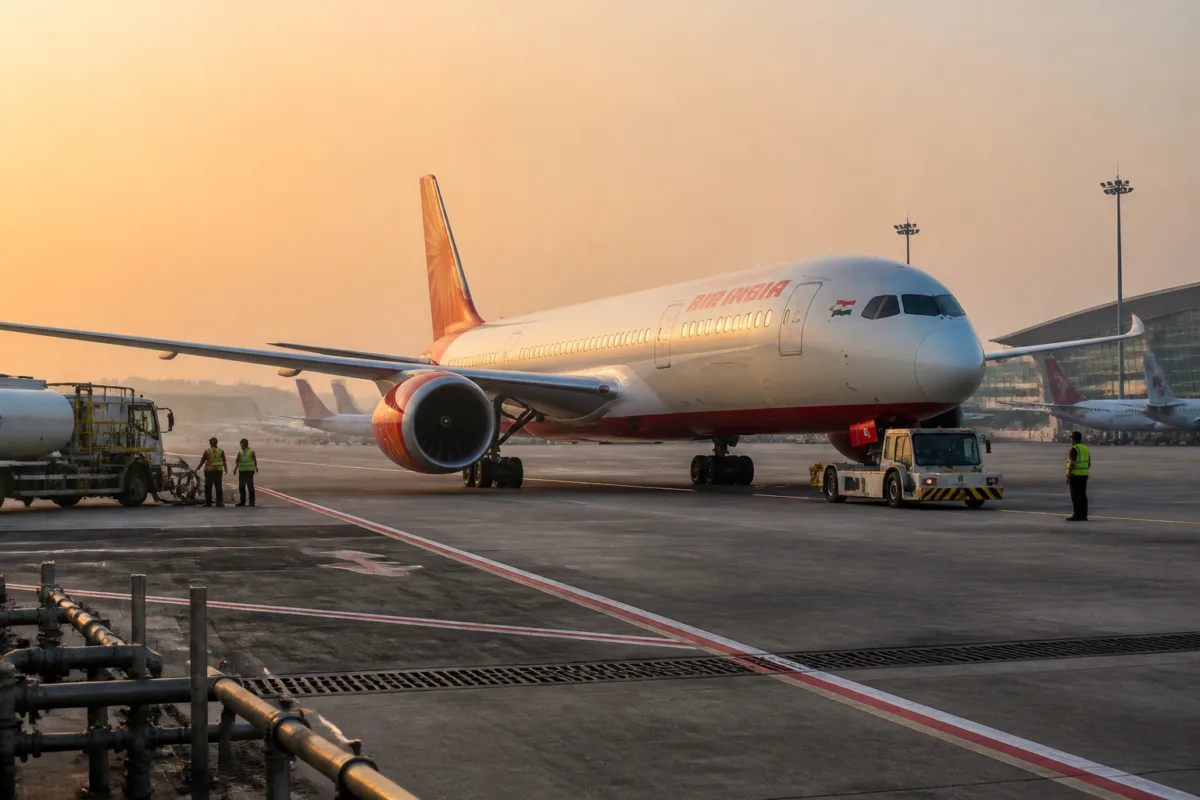
Air India and Airbus have signed an agreement to study the feasibility of developing India’s first voluntary corporate sustainable aviation fuel programme, a framework that could allow businesses to support SAF use on selected routes and account for emissions linked to air travel.
The proposed programme would be open to companies seeking to reduce the lifecycle emissions associated with business travel. The feasibility study will examine voluntary procurement and use of SAF on selected Air India routes, along with a mechanism through which corporate customers could participate.
Under the framework being evaluated, Air India could sell or transfer associated Scope 3 sustainable aviation fuel certificates, or SAFc, to eligible corporate customers. These certificates are intended to help participating organisations track their contribution to emissions reductions linked to aviation.
The agreement was signed at the second India Sustainable Aviation Fuel Summit organised by the Federation of Indian Chambers of Commerce and Industry. The initiative remains at the feasibility-study stage. If implemented, the companies said it would become India’s first voluntary corporate SAF programme.
The proposed system would assess emissions reductions by comparing the lifecycle carbon footprint of SAF with that of conventional jet fuel. The companies said the assessment would use globally recognised standards, with verified emissions savings enabling participating organisations to monitor and report progress towards aviation’s net-zero carbon ambition for 2050.
“Through this collaboration with Airbus, we are exploring a credible mechanism that enables corporates to support SAF adoption and reduce the emissions associated with business travel,” Tewolde Gebremariam, chief executive officer and managing director of Air India, said in a statement.
He said expanding demand for SAF would be essential to scaling production and building a sustainable aviation ecosystem in India. The proposed programme is therefore being examined not only as a customer-facing emissions mechanism, but also as a way to create demand for SAF within the aviation sector.
Airbus India and South Asia president and managing director Jürgen Westermeier described the collaboration as a step towards accelerating SAF adoption in the region. “Decarbonising aviation demands collective, industry-wide action, and we welcome other corporates to join the programme,” he said.
The study will also examine how the framework could be scaled across industry sectors and support the development of a domestic SAF ecosystem. The supplied announcement does not specify the routes that could initially use SAF, the volume of fuel involved, the programme’s proposed launch date, or the pricing and trading arrangements for the certificates. Those details would need to emerge from the feasibility study and any subsequent implementation decision.

