


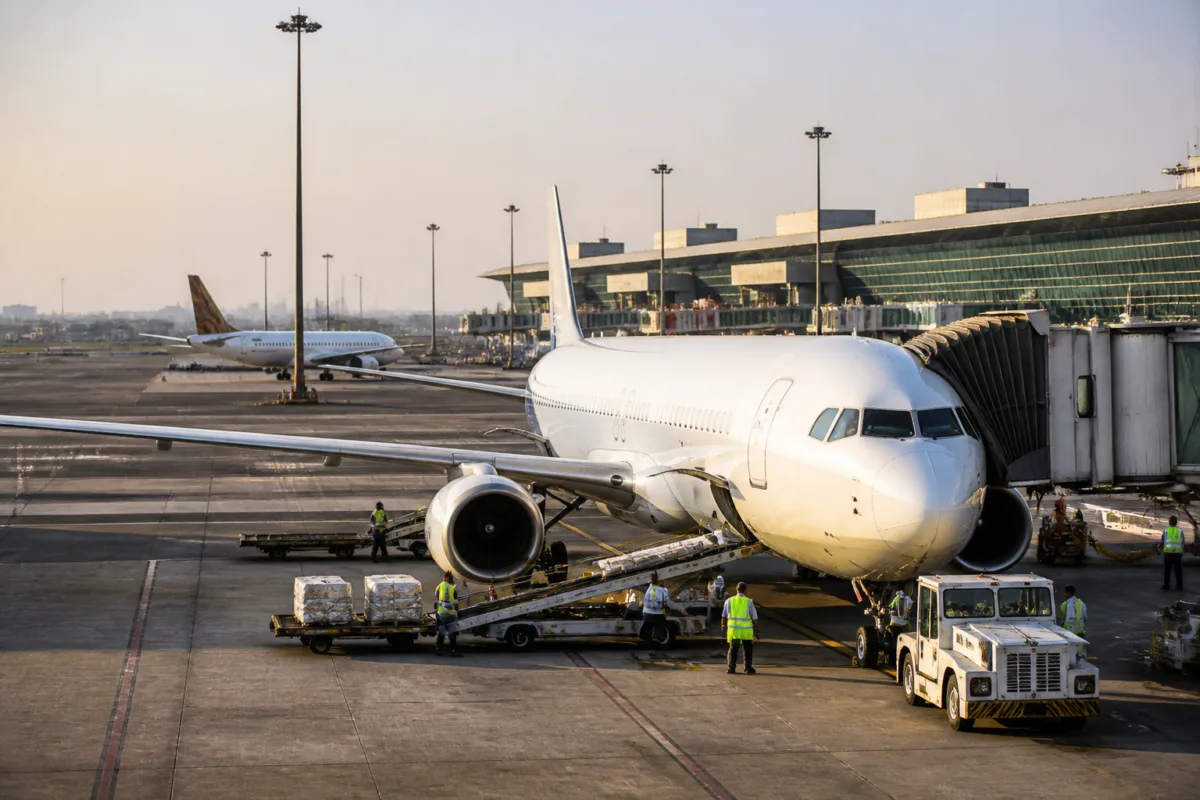
India’s aircraft orders are rising because the country’s airlines are expanding faster than manufacturers can deliver new planes. Commerce and Industry Minister Piyush Goyal has said Indian carriers have already ordered more than 1,200 aircraft, yet the country may need more than 2,000 to meet its aviation requirements. The gap reveals a central constraint in India’s civil aviation expansion: demand is growing, but fleet availability remains tied to long global manufacturing and delivery cycles.
Goyal made the remarks during a two-day visit to Egypt, where he also discussed the need for more air connectivity between India and Egypt. He said India was ready to order another 1,000 civil aircraft and that the government was engaging established manufacturers such as Airbus and Boeing to accelerate deliveries against existing orders.
The statement is significant not simply because of the size of the proposed order. It brings into focus the relationship between aircraft availability, airline network expansion and international connectivity. Airlines can announce or plan new routes only when they have access to aircraft, crews, maintenance capacity and the operational systems required to support them. In the situation described by the minister, aircraft supply is becoming a limiting factor before demand itself has weakened.
## India’s aircraft orders and the delivery bottleneck
The reported numbers show two separate stages of the aviation pipeline. More than 1,200 aircraft have already been ordered by Indian airlines, while another 1,000 could be ordered to address the country’s stated requirement for more than 2,000 aircraft. An order, however, is not the same as an aircraft entering commercial service. The report notes that there can be a considerable gap between placing an order and receiving delivery.
That distinction matters for passengers and cities. An airline may have strong demand for a route but remain unable to add flights if the aircraft assigned to that expansion has not yet been delivered. The result is that the physical growth of the fleet becomes a determining factor in how quickly domestic and international connectivity can improve.
The report identifies IndiGo and Air India as the principal Indian carriers that have placed large orders with Airbus and Boeing. Their purchases are intended to support both domestic and international routes. Together, those orders represent a long-term expansion strategy, but the delivery schedule determines when the strategy becomes visible to passengers through additional services.
For India’s urban system, this creates a time lag between economic demand and transport capacity. A growing number of air travellers can increase pressure on airlines to add capacity, while manufacturers must manage production and delivery commitments across global markets. Goyal’s request for faster deliveries indicates that the government sees this time lag as a national connectivity concern rather than only a commercial matter for individual airlines.
## Why Egypt is part of the capacity question
The discussion on India-Egypt connectivity illustrates how aircraft availability affects international links. Goyal said additional flights between the two countries would require more aircraft and that the arrival of new planes could create scope for expanded services to Egypt. At present, EgyptAir operates direct flights between India and Egypt, according to the report.
This example shows that international connectivity depends on more than bilateral interest or passenger demand. It also depends on whether carriers have aircraft available for a route and whether those aircraft can be deployed without weakening existing networks. New international services compete with domestic expansion for the same fleet resources, particularly when airlines are already attempting to serve a large and growing home market.
The report does not establish a specific timeline for additional India-Egypt flights. It does, however, connect the possibility of expansion directly to future aircraft deliveries. That makes the delivery pipeline an important operational variable for route development.
For passengers, the immediate effect of limited fleet availability is fewer opportunities for airlines to add frequency, open new destinations or provide alternatives on existing routes. The report does not provide fare data or route-by-route capacity figures, so it cannot establish how the aircraft shortage has affected ticket prices or passenger experience. It does establish that airlines consider aircraft availability a challenge to launching new flights and expanding their networks.
## The manufacturing ambition behind the orders
India’s aviation strategy, as described in the report, is not limited to purchasing aircraft from overseas manufacturers. The government is also seeking to expand aircraft manufacturing, component production and related services within the country. That creates a second layer to the aircraft-order story: India is simultaneously a major buyer of aircraft and an emerging participant in the aerospace supply chain.
Airbus has two final assembly lines in India, one for military transport aircraft and another for helicopters. The report also states that Boeing and Airbus together purchase about $2 billion worth of components and services from India each year. These activities indicate that India already has a role in the global aerospace production network, although the supplied material does not quantify the share of domestic production in commercial passenger aircraft.
The report further notes that Brazil’s Embraer has entered into a strategic partnership with the Adani Group to explore the possibility of manufacturing regional aircraft in India. The reference to regional aircraft is relevant to the country’s connectivity ambitions because such planes are associated with shorter routes and smaller markets. However, the report does not confirm that regional aircraft production has begun or provide an implementation schedule for the partnership.
This distinction between existing activity and future possibility is important. Airbus’s final assembly facilities, the component and services purchases by Airbus and Boeing, and the Embraer-Adani partnership represent different levels of industrial participation. They should not be treated as evidence that India is already capable of producing the full range of commercial aircraft required by its airlines.
## From fleet expansion to an aviation industrial base
India’s large aircraft orders can therefore be read in two ways. In the short term, they are an attempt to secure capacity for airlines facing rising passenger demand. In the longer term, they form part of a broader effort to build an aviation ecosystem that includes assembly, components, maintenance and related services.
The two objectives are connected but not interchangeable. Faster deliveries from Airbus and Boeing could help airlines add flights sooner, but they would not by themselves create domestic aircraft manufacturing capability. Conversely, expanding component production and exploring regional aircraft assembly could strengthen the industrial base, but those steps would not immediately solve a shortage caused by delayed deliveries of passenger aircraft.
The policy challenge is therefore one of sequencing. Airlines need aircraft now and over the next several years, while industrial capabilities develop over a longer period. The government’s engagement with manufacturers addresses the near-term supply problem. Its support for domestic manufacturing and the aerospace supply chain addresses the longer-term question of how much value and capability can be retained within India.
The report provides no details on the financing structure of the proposed 1,000-aircraft order, the identity of the prospective buyers, delivery slots, airport capacity or the number of aircraft currently in service. Those omissions limit what can be concluded about the precise scale of the shortage. The available evidence supports a narrower conclusion: Indian airlines have placed substantial orders, officials believe the national requirement is larger, and delivery delays are obstructing faster network expansion.
## What the aircraft gap reveals about urban connectivity
Air travel is often discussed as an airline or airport issue, but fleet availability influences the wider geography of economic and social connection. Domestic aircraft support links between major cities and smaller urban markets, while international flights connect Indian cities to business, tourism and diaspora networks abroad. When airlines cannot obtain aircraft quickly, those links expand more slowly even if demand exists.
The aviation system also shows how infrastructure growth depends on multiple institutions. Airlines determine fleet purchases and network plans. Manufacturers control production and delivery schedules. The central government can facilitate industrial policy and engage with manufacturers. Airports and aviation authorities must support the operations created by additional aircraft. The source report focuses mainly on the first three elements, and does not provide evidence on airport-side constraints.
That institutional chain is why the proposed additional orders matter beyond their headline value. A larger fleet can create the possibility of more flights, but actual connectivity will depend on when aircraft arrive and how airlines deploy them. It will also depend on whether domestic manufacturing and component capabilities grow alongside the passenger market.
India’s aircraft requirement, as described by the minister, is thus both a transport demand signal and an industrial policy test. The country is trying to expand its role as a major aviation market while also increasing its participation in the production systems that supply that market. The immediate evidence confirms a substantial order pipeline and a recognised delivery challenge. It does not yet establish when the additional 1,000 aircraft will be ordered, when they would be delivered or how many new routes they would create.
The next milestones to watch are the delivery schedules for existing Airbus and Boeing orders, any formal announcement of additional purchases, developments in the Embraer-Adani regional aircraft partnership and the expansion of India’s component and aerospace services base. Those developments will show whether the country can convert strong passenger demand and large aircraft orders into actual increases in urban and international connectivity.

