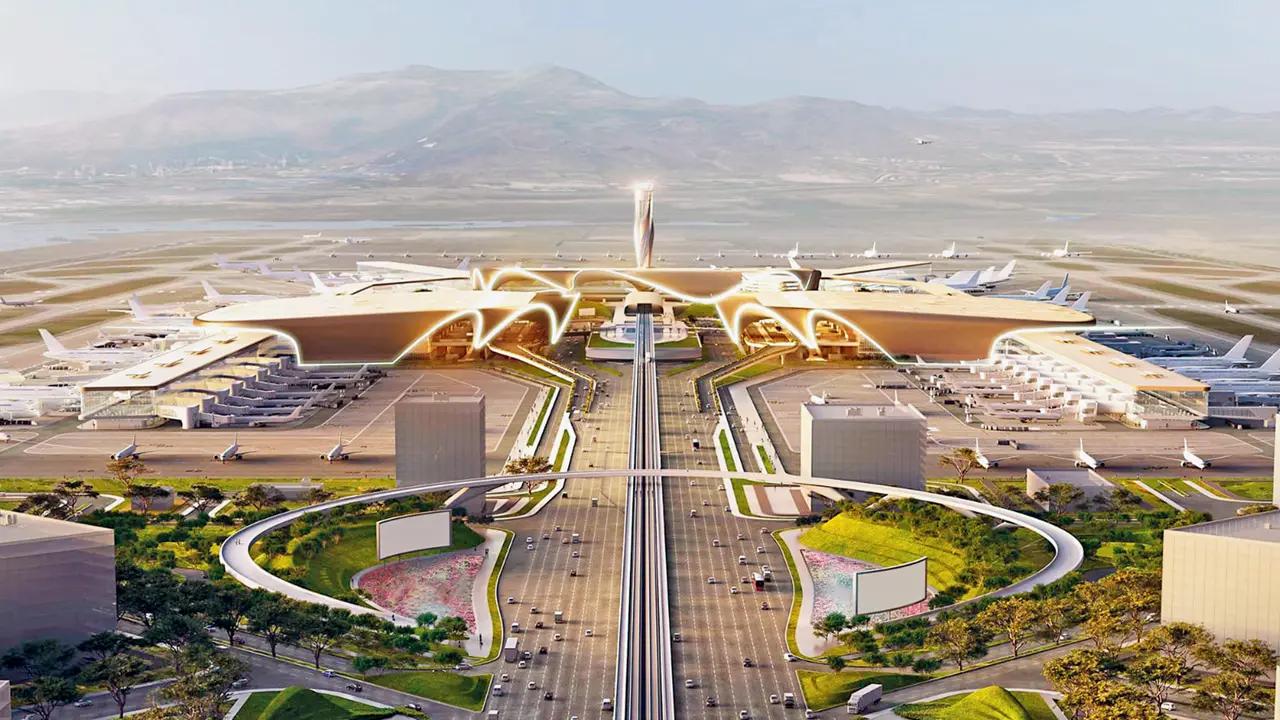
A long-term capacity review at Navi Mumbai’s upcoming international airport has triggered a fresh round of infrastructure planning, with authorities initiating a detailed study to assess the feasibility of adding a third runway. The move reflects growing concerns around future air traffic demand in the Mumbai Metropolitan Region (MMR), where aviation capacity is expected to come under increasing pressure over the next two decades.
The City and Industrial Development Corporation (CIDCO), which is spearheading the development of the Navi Mumbai International Airport, has commissioned a joint consultancy team to undertake a techno-commercial evaluation. The study is expected to be completed within six months and will examine whether additional runway infrastructure is necessary to sustain projected growth. Officials familiar with the planning process indicate that the assessment will go beyond engineering feasibility. It will also evaluate operational efficiency, financial viability, and environmental implications—factors that are becoming central to infrastructure decision-making in high-density urban regions. Given the ecological sensitivity of large-scale airport projects, the findings could shape how future expansions balance capacity with sustainability.
The Navi Mumbai airport is being positioned as a critical component of a dual-airport system alongside Mumbai’s existing aviation hub. Designed as a greenfield development, the facility is planned to handle up to 90 million passengers annually in its ultimate phase, along with significant cargo volumes. However, projections suggest that combined passenger demand across the MMR could exceed 150 million passengers per annum by 2040, with further growth anticipated in subsequent decades. Urban planners note that such projections raise complex questions about land use, environmental impact, and multimodal connectivity. Expanding runway capacity may improve operational throughput, but it also requires careful integration with surrounding transport networks, including metro corridors, road infrastructure, and regional rail systems. Without this alignment, capacity gains risk being offset by congestion on the ground.
The proposed feasibility study comes at a time when policymakers are also exploring the development of an additional airport in the wider region. This multi-airport strategy is increasingly seen as essential for megacities where aviation demand is closely tied to economic growth, logistics networks, and global connectivity. Experts suggest that decisions emerging from the Navi Mumbai Airport third runway study will likely influence broader infrastructure planning across western India. As cities compete to attract investment and improve mobility, aviation infrastructure is being viewed not just as a transport utility but as a key economic enabler.
For residents and businesses, the implications are significant. While enhanced airport capacity can improve connectivity and reduce congestion, it also brings challenges related to environmental stress, noise pollution, and land development pressures. The outcome of the study will therefore be closely watched as a test of how India’s urban infrastructure evolves in a climate-conscious and citizen-focused direction.
Navi Mumbai Airport Taps RITES Creative JV For Third Runway Study