


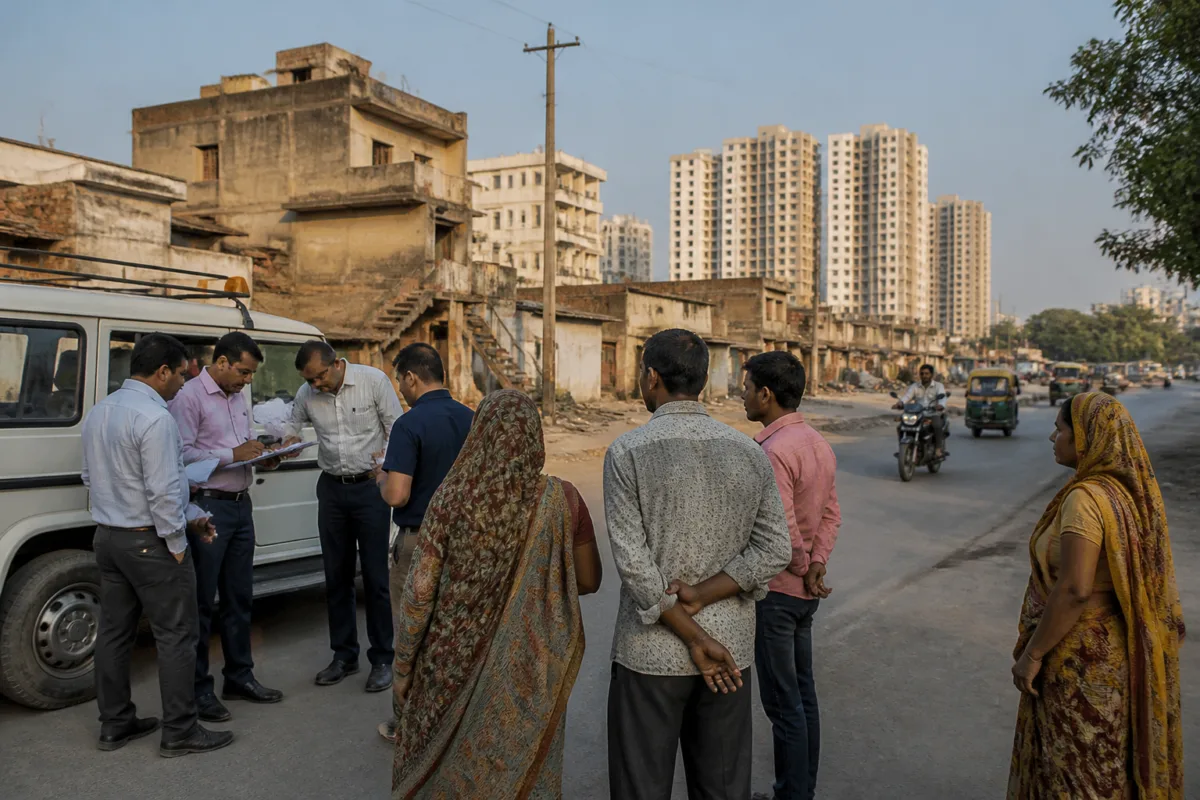
The Surat Municipal Corporation Standing Committee has reaffirmed that it will not provide homes matching the demands of 28 families affected by the demolition of houses in Nasir Nagar, keeping the dispute over their rehabilitation unresolved.
Civic officials told the committee that the families had already been offered accommodation under existing housing schemes but had refused the options proposed by the corporation. Officials also maintained that there were no guidelines allowing the civic body to provide homes to families whose houses had been constructed illegally on a public road.
The committee’s decision followed a review of a proposal outlining the corporation’s rehabilitation efforts and the circumstances surrounding the failed allotment process. The review was conducted after the families objected to the proposed allotments and the method used to distribute them.
The Surat Municipal Corporation had offered homes at different locations under the Jawaharlal Nehru National Urban Renewal Mission Basic Services to the Urban Poor scheme, or JnNURM-BSUP. It had initiated the allotment process through a draw on August 27. The process could not be completed after the affected families opposed the draw and the proposed housing locations.
The Standing Committee has now decided that the civic body should continue with its existing legal position. This means the corporation will not alter its approach to the 28 families on the basis of their stated housing demands, according to the report reviewed by the committee.
The dispute highlights the administrative difficulty involved when demolition, public-road clearance and rehabilitation overlap. While the civic body has cited the legal status of the demolished structures and the absence of guidelines for providing alternative homes in such cases, the affected families have rejected the accommodation offered through the existing scheme. The disagreement has therefore prevented the allotment process from reaching completion.
The case also shows how the design of a rehabilitation scheme can affect implementation beyond the availability of housing units. The corporation’s proposal involved homes at various locations and an allotment through a draw, while the families objected both to the process and to the proposed allotments. With the committee maintaining its position, any further movement will depend on the corporation’s next administrative or legal step and on whether the families accept the offered housing options.
The Standing Committee’s resolution does not indicate that a fresh allotment has been scheduled or that new housing locations have been approved. For now, the existing offers under the JnNURM-BSUP scheme remain the basis of the corporation’s rehabilitation response, while the objections raised by the families continue to keep the process stalled.

