


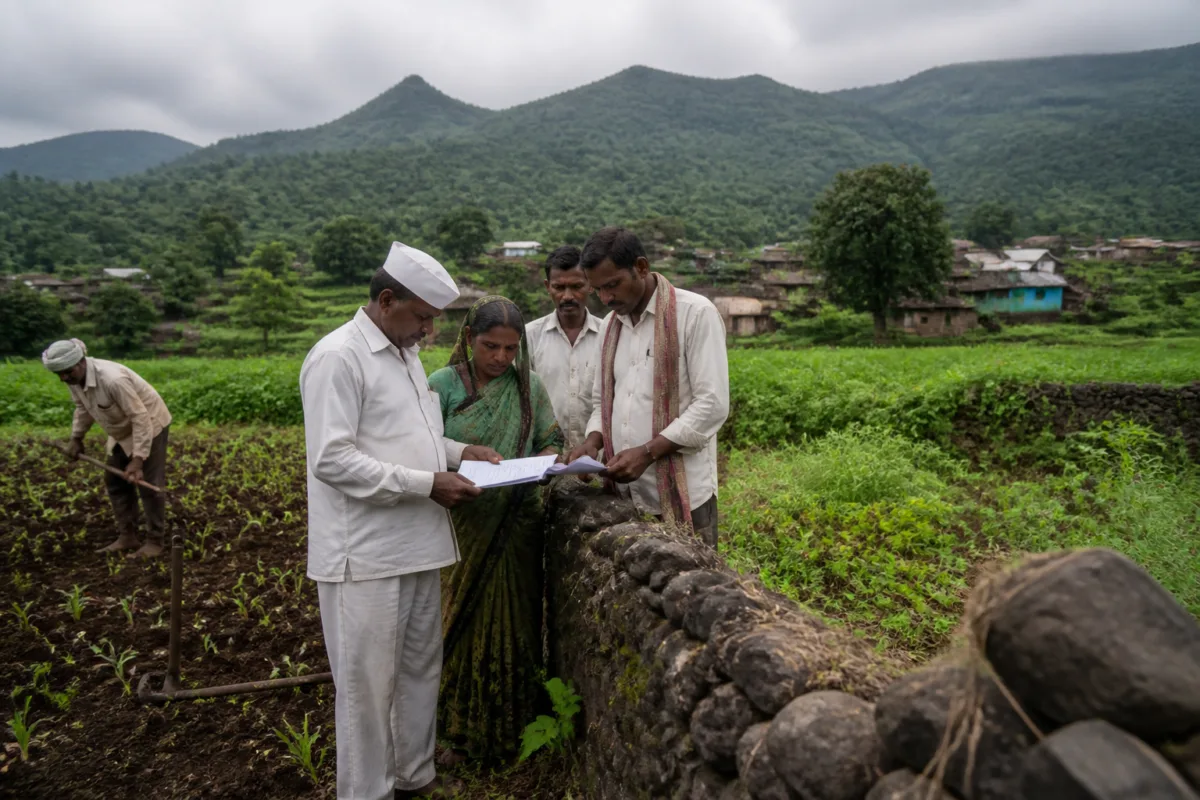
Nashik land rights have become the centre of a dispute in Trimbakeshwar and Igatpuri talukas, where hundreds of tribal farmers say official revenue records have marked their ancestral agricultural plots as Reserved Forest and removed their legal status as landholders. The farmers continue to possess and cultivate the land, but entries in their 7/12 extracts reportedly list the state government as the primary owner.
The issue has been reported in villages including Chorpada, Mulwad, Valan, Karanjpada and Sawarpada in Trimbakeshwar, as well as several villages in Igatpuri. According to the farmers, the entries were made under Section 3 of the Maharashtra Private Forests Act. They said they were not given prior notice before the ownership details in the revenue records were changed.
The disputed entries have created a gap between physical possession and official recognition. Although the affected families continue to farm the plots, the revenue records no longer identify them as agricultural landholders. This has reportedly prevented them from obtaining land documents needed for government schemes, agricultural loans and disaster compensation.
Rajesh Madhe, a farmer from Trimbakeshwar, said the entries were originally intended to preserve green cover on land near designated forest blocks. However, he alleged that revenue officials routinely marked active private farmland as government forest land. He said the changes had directly affected farmers’ access to official documents and financial support.
The problem has also acquired significance because both Trimbakeshwar and Igatpuri are included among Maharashtra’s drought-hit talukas. Trimbakeshwar-Igatpuri MLA Hiraman Khoskar raised the issue with Nashik district collector Ayush Prasad, arguing that farmers in the affected areas were unable to receive assistance available to other farmers because of the entries on their 7/12 extracts.
“While the farmers across the state are getting govt help, the farmers here are unable to get it thanks to the stamp on the 7/12 extract,” Khoskar said. He added that many of the affected residents had no livelihood option other than farming, even though their land did not belong to them on paper.
The dispute highlights the administrative consequences of land classification in rural areas adjoining forest blocks. A change in a revenue record can affect more than the description of a parcel: it can determine whether a cultivator is recognised by banks, welfare departments and disaster-relief systems. In this case, farmers say the records have not altered their possession or cultivation, but have weakened their ability to prove their legal relationship with the land.
Collector Prasad said the matter was a state government subject and that the district administration had decided to take it up with the government. The report does not specify how many land parcels have been affected, when the disputed entries were made, or whether a formal review or correction process has begun. The next step is expected to involve the state government examining the revenue records and the farmers’ claims.

