


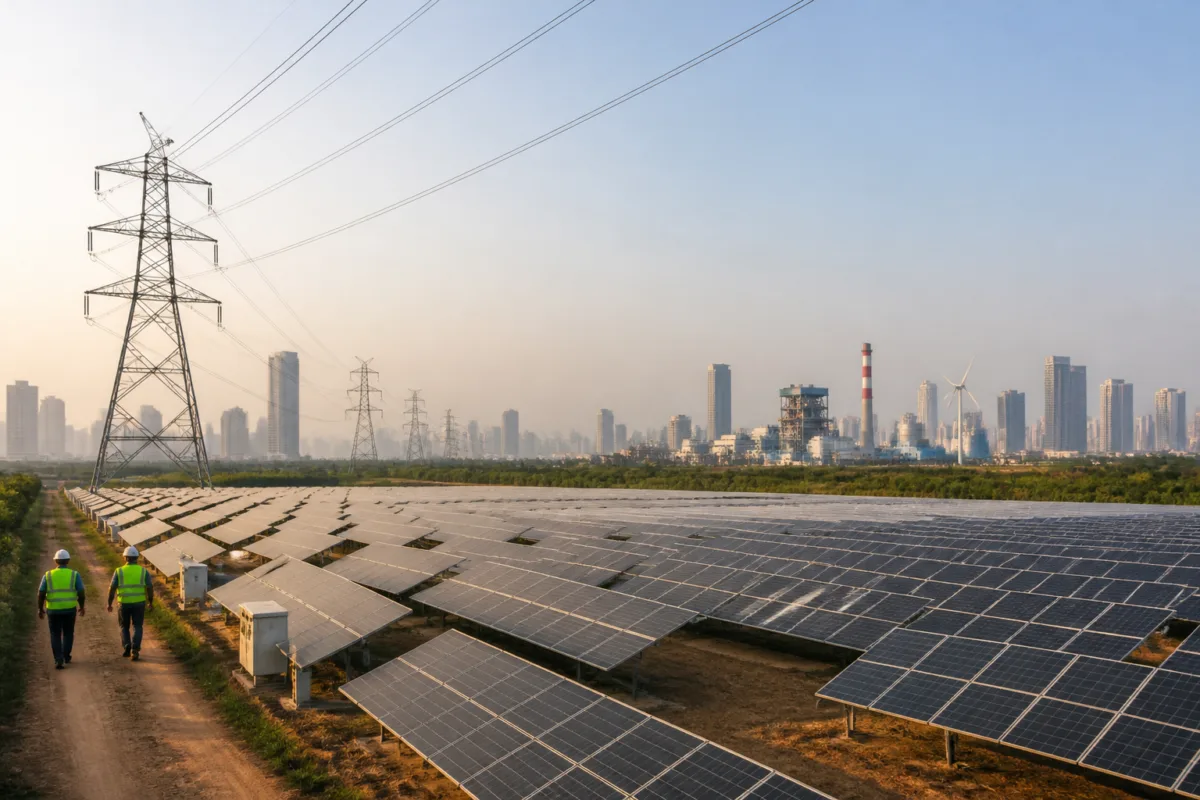
The International Energy Agency’s assessment that India’s renewable energy capacity could grow more than 20% faster between 2026 and 2030 is not simply a manufacturing story. It is a test of whether the country’s electricity infrastructure, distribution utilities, land systems and project approvals can expand at the same speed as its clean-energy ambitions.
The opportunity is already visible in India’s solar manufacturing and biofuel sectors. But the IEA report, as cited by the Times of India, also makes clear that adding generation capacity is only one part of the transition. Transmission networks must carry power from producing regions to demand centres, storage must manage variable renewable generation, and electricity distribution companies must become financially and operationally capable of absorbing a changing power system.
That combination makes the renewable-energy challenge an urban infrastructure issue. Cities depend on reliable electricity for housing, transport, water supply, sewage treatment, digital services, commercial activity and public institutions. A larger clean-energy system can support lower-carbon urban growth, but only if the networks connecting generation to consumers are developed alongside the projects themselves.
The IEA’s central projection is conditional. India could accelerate renewable capacity deployment by more than 20% during 2026-30 if infrastructure bottlenecks are addressed and market reforms are implemented. The qualification matters because renewable projects can be built faster than the supporting systems needed to evacuate and manage their output. Delays in transmission, land acquisition, permitting and project execution can therefore turn a generation target into an underused or delayed asset.
The report’s emphasis on grid infrastructure reflects the technical difficulty of integrating increasing volumes of variable renewable energy. Solar and wind generation do not follow demand patterns automatically. The electricity system therefore needs stronger forecasting, more flexible dispatch and greater storage capacity. It also needs demand-side flexibility, allowing consumption to respond more effectively to the availability and cost of power.
These requirements place the grid at the centre of India’s next renewable phase. Solar PV manufacturing capacity reached around 225 GW in September 2026 and is projected to increase further by 2030, according to the report cited in the source article. Yet manufacturing capacity does not itself guarantee that projects will be commissioned, connected or used efficiently. The physical network and the institutions operating it determine how much of that capacity can translate into reliable electricity.
The policy architecture has already tried to address part of the supply chain. Production-linked incentive schemes and domestic sourcing requirements for solar photovoltaic modules have helped expand clean-energy manufacturing and reduce dependence on overseas supply. The next challenge is moving into upstream segments of the solar chain, where global dependence on imports from China exceeds 95%, the report said.
This shift from module assembly towards upstream manufacturing has an infrastructure and industrial-planning dimension. It requires investment, land, power, logistics, skilled labour and dependable access to inputs. It also links renewable-energy policy to the wider geography of industrial development. Manufacturing hubs need transport connections and utilities, while new generation projects need transmission corridors and approvals that may cross multiple jurisdictions.
The same policy-to-infrastructure relationship appears in biofuels. India increased biofuel production sixfold between 2020 and 2025, with liquid biofuel consumption reaching around 11 billion litres in 2025. Consumption is projected to rise to 16 billion litres by 2030. The growth suggests that India’s energy transition is not limited to electricity generation or urban rooftop solar; it also includes fuels for transport, aviation and gas substitution.
Sustainable aviation fuel is expected to create a new demand category. Blending targets for international flights are scheduled to begin at 1% in 2027 and rise to 5% by 2030. The targets will require supply chains capable of collecting, processing and certifying suitable feedstocks. The source material does not establish the scale of infrastructure already available for this market, but it identifies feedstock systems and sustainability standards as necessary conditions for expansion.
Compressed biogas offers another example of how the energy transition intersects with municipal systems. The report describes it as a domestic alternative to imported natural gas and estimates that India’s sustainable feedstock potential could support up to 75 billion cubic metres of gas equivalent annually. That figure is close to the country’s current natural-gas demand. If developed, such a system would depend on reliable feedstock collection, processing facilities, transport links and clear sustainability rules.
For cities, the potential connection is particularly important because organic waste, wastewater and agricultural residues are distributed across different administrative and economic systems. The supplied report does not specify a municipal deployment model, but its focus on feedstock supply chains indicates that production cannot be scaled through energy policy alone. Waste management, local government capacity, land availability and commercial offtake would all influence whether the potential becomes operational capacity.
The economic case for developing domestic gas alternatives is strengthened by India’s projected import dependence. Natural-gas import dependence is expected to rise from 52% in 2024 to around 71% by 2030. That projection places biogas within a broader energy-security debate. It also shows why the renewable transition includes more than replacing fossil-fuel generation with solar and wind: it involves reducing exposure to imported fuels across multiple parts of the economy.
However, the report’s emphasis on sustainability standards is a reminder that not all low-carbon supply is automatically sustainable. Feedstock expansion can create environmental and land-use pressures if it is poorly governed. The supplied material does not provide a detailed assessment of those risks, but it identifies adherence to sustainability standards as a requirement. That makes monitoring and verification part of the infrastructure of the transition, rather than an administrative afterthought.
The financial condition of power distribution companies is another decisive institutional issue. DISCOMs sit between generation and consumers and influence payment security, tariff collection, procurement and the reliability of electricity supply. The IEA report identified strengthening their finances as critical to India’s next phase of renewable expansion. Without financially stable distribution utilities, new generation and grid investments can face payment delays, contractual uncertainty and weaker implementation capacity.
This is also where the renewable-energy agenda meets the everyday experience of urban residents. A city may have access to new clean-energy capacity on paper, but households and businesses experience the system through supply reliability, tariffs, outages and service quality. The transition will therefore be judged not only by installed capacity or manufacturing output, but by whether electricity reaches consumers consistently and affordably.
Land acquisition and permitting add another layer of complexity. Renewable projects, transmission lines, storage facilities and manufacturing plants require land across different administrative jurisdictions. Delays can arise from incomplete approvals, competing land uses, environmental requirements or coordination failures between agencies. The source report identifies these delays but does not quantify their contribution to project timelines. That missing detail is important because the projected 20% acceleration depends partly on resolving precisely these execution constraints.
The evidence available in the report points to a transition moving from targets to systems. India has policy support for domestic manufacturing, rapidly expanding biofuel production and large potential for compressed biogas. At the same time, the country must build transmission, storage, forecasting, flexible demand, feedstock networks and financially stronger distribution utilities. Each element belongs to a different institutional domain, making coordination as important as investment.
The larger urban question is whether India can align energy infrastructure with the speed of urbanisation and industrial growth. Renewable capacity can reduce the carbon intensity of cities and improve energy security, but only when generation, networks, utilities, land administration and end-use demand are planned together. The IEA assessment confirms the scale of the opportunity, while its conditions identify where implementation could fail.
What happens next will depend on whether reforms translate into faster project execution, stronger transmission and storage capacity, improved power-system management and more reliable distribution companies. The report also leaves important questions open, including how India will build sustainable feedstock supply chains and verify the environmental performance of emerging bioenergy systems. Those implementation details, rather than capacity targets alone, will determine whether India’s renewable-energy growth becomes a durable urban and economic transition.

