


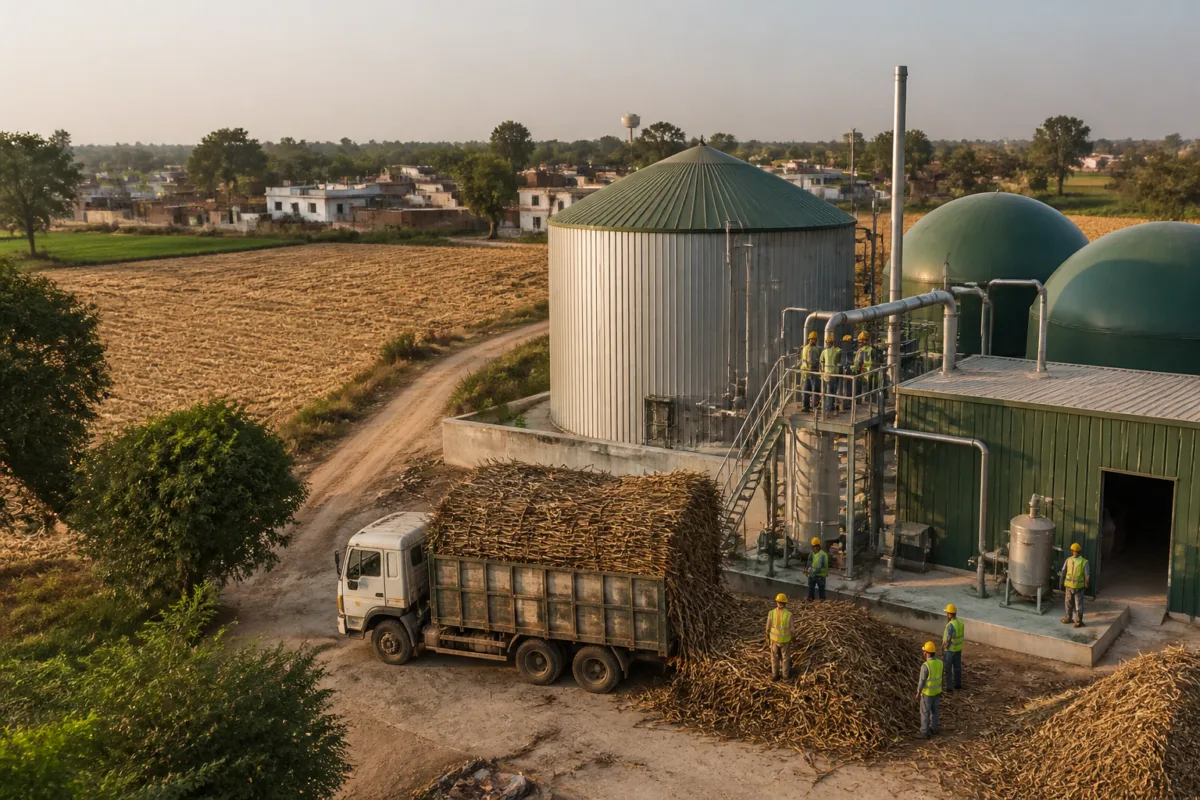
Reliance Industries plans to invest another ₹15,000 crore to establish nearly 100 compressed biogas (CBG) plants across India by 2030, according to Economic Times, expanding a network that the company says already includes 45 plants across 10 states. The plants currently produce around 350 tonnes of biogas a day, the report said.
The expansion would place Reliance among the largest companies attempting to build capacity in India’s still-developing CBG sector. The company’s Bio Energy Business CFO, Vikas Rathi, announced the latest investment, which is equivalent to about $1.6 billion, according to the report.
The proposed plants are part of a wider Reliance strategy to establish more than 500 CBG plants by 2030 and develop integrated CBG hubs with annual capacity of one million tonnes over the next five years, the company’s FY26 annual report said. Reliance also reported that it accounts for more than 30% of India’s CBG production, supplies green fuel to over 40,000 vehicles daily and has engaged more than 80,000 farmers through its bioenergy operations.
For India’s cities and energy networks, the significance of the investment lies beyond the construction of individual plants. CBG facilities can process agricultural residue, cattle dung, municipal waste and other biomass into a renewable gaseous fuel. The fuel can be supplied to transport users, smaller industries and city gas distribution networks, while the process also produces organic manure.
However, the gap between announced projects and operational facilities shows the difficulty of scaling the sector. Government data cited by Economic Times showed that 1,929 CBG plants had been registered by August 2026, but only 217 had been commissioned and 357 were under construction. The figures indicate that registration and investment announcements have not automatically translated into functioning infrastructure.
CBG plants require a regular supply of agricultural residue or other organic waste. That material is distributed across villages, varies by season and has competing uses. Developers must organise collection, storage and transport while managing moisture and ensuring that feedstock reaches plants at commercially viable costs.
The report said Reliance’s existing plants are operating below capacity, highlighting that construction is only one part of the business challenge. Plant utilisation, reliable feedstock and the sale of byproducts will determine whether the proposed network can operate efficiently and generate sustainable returns.
Government support is intended to improve those economics. The Sustainable Alternative Towards Affordable Transportation initiative, launched by the Ministry of Petroleum and Natural Gas in October 2018, encouraged private companies to establish CBG plants and provided a framework for oil and gas companies to purchase the fuel. Indian Oil, BPCL, HPCL, GAIL and IGL invite entrepreneurs to supply CBG for marketing, with long-term offtake arrangements intended to provide greater revenue visibility.
Other measures have sought to support the wider project ecosystem. Organic manure from CBG plants was recognised as fermented organic manure under the Fertiliser Control Order, while CBG projects were brought within the Reserve Bank’s priority-sector lending framework. Banks including SBI have also developed dedicated loan products, according to the report.
The government’s newer GOBARdhan scheme is designed to address some of the remaining gaps. Approved in August 2026 with an outlay of ₹23,731 crore, the scheme will run from FY27 to FY36 and aims to increase domestic CBG production nearly ten-fold to around 5 million standard cubic metres a day.
The scheme offers eligible greenfield CBG projects capital assistance of up to ₹2 crore per tonne per day of installed capacity. It also supports feedstock aggregation, organic manure processing and pipeline connectivity. Assistance can cover up to 80% of eligible expenditure on pipelines connecting CBG clusters to trunk pipelines, and up to 50% for standalone plants connecting to city gas networks, the report said. A credit guarantee mechanism is intended to improve access to institutional finance.
GOBARdhan also introduces procurement obligations for city gas distribution companies. These companies will have to meet CBG procurement obligations of 3% in FY27, 4% in FY28 and 5% from FY29 onwards in the CNG transport and domestic PNG segments. An administered price of ₹2,110 per MMBtu is intended to provide producers with greater revenue visibility.
These measures could make it easier for large developers to finance and operate plants, but they do not remove the need for reliable local supply chains. Feedstock aggregation will require coordination with farmers and rural communities, while pipeline connectivity will determine whether plants can access nearby gas markets without high transport costs. The viability of organic manure sales will also affect the overall economics of each facility.
Reliance’s bioenergy plans form part of a broader shift in its energy portfolio. At Jamnagar, the company is developing the 5,000-acre Dhirubhai Ambani Green Energy Giga Complex around solar manufacturing, battery storage, fuel cells, green hydrogen and power electronics. Reliance has set a target of enabling 100 GW of renewable energy by 2030 and achieving net-zero carbon emissions by 2035, according to the report.
CBG serves a different function from solar power, batteries and green hydrogen. It is a renewable gaseous fuel that can potentially use existing city gas distribution infrastructure, while its feedstock is sourced domestically. That gives it a possible role in reducing, at the margin, India’s dependence on imported gas.
India wants natural gas to account for 15% of its energy mix by 2030, compared with around 6% currently, the report said. It also noted that India imported 11.2 million tonnes of liquefied natural gas from Qatar in FY25 and that disruption risks around Qatar and the Strait of Hormuz had highlighted the vulnerability of imported energy supplies.
CBG cannot replace imported liquefied natural gas for India’s industrial and power sectors at the scale required. It can, however, provide a distributed domestic source of gaseous fuel for transport, city gas networks and smaller industrial users if plants receive adequate feedstock and operate close to capacity.
The main test for Reliance will therefore be operational rather than promotional. The number of plants announced and the capital committed will matter less than the volume of gas produced, plant utilisation, the reliability of biomass logistics and the ability to sell both CBG and organic manure. The company’s expansion will also test whether government support can convert a large pipeline of registered projects into a functioning waste-to-gas industry.

