


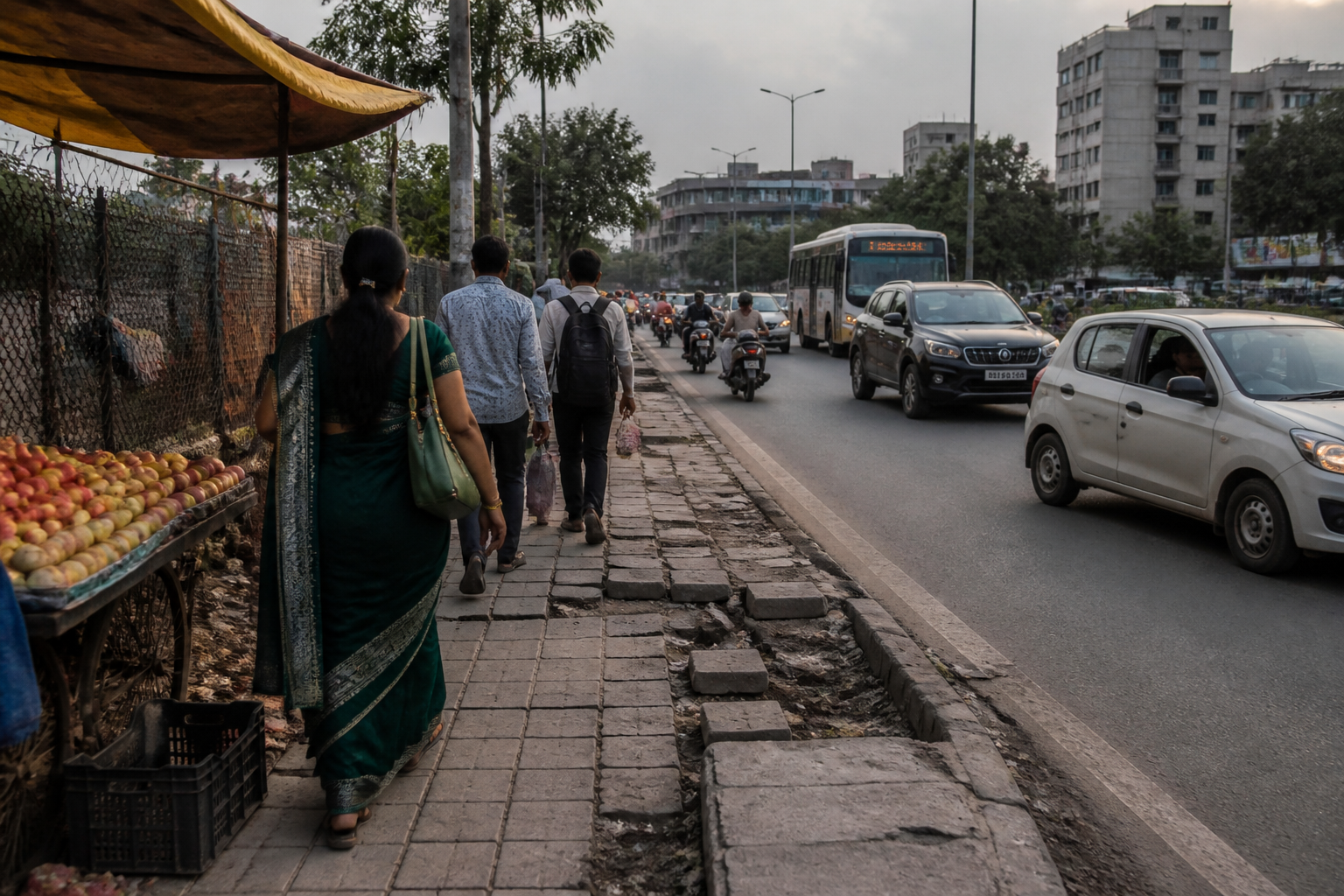
Nashik’s month-long Footpath First drive is being presented as an enforcement campaign, but the city’s own mobility findings point to a problem that extends well beyond encroachments. The Nashik Municipal Corporation has begun clearing occupied footpaths across its six divisional offices, while a draft Comprehensive Mobility Plan prepared by Maha Metro indicates that pedestrian infrastructure is missing or inadequate across much of the city’s major road network.
The campaign, which will continue throughout October, is intended to make footpaths safer and more accessible. The civic body’s encroachment department has already removed obstructions in parts of the Satpur and Panchavati divisions. Deputy commissioner for encroachment Suvarna Dakhane said the drive would continue across Nashik and cover all divisions.
That focus on public access is important because the draft mobility plan describes a structural shortfall rather than a single enforcement failure. Nashik has a road network of around 2,400 km, but footpaths are available along only about 35% of major roads, according to the report. More significantly, only 7% of roads have footpaths that meet prescribed pedestrian standards.
The figures change the meaning of a footpath-clearance drive. Where a footpath exists but is blocked by vendors or other encroachments, enforcement may restore a public facility that is already in place. But where there is no footpath, or where the existing one is damaged, too narrow or poorly maintained, removing an obstruction cannot by itself create a continuous pedestrian route. The distinction matters for how the campaign is assessed and for what citizens can expect after the month ends.
The draft Comprehensive Mobility Plan identifies several conditions that currently limit the use of Nashik’s footpaths. Some are occupied by encroachments, while others are poorly maintained, damaged or too narrow for regular movement. The result, the report notes, is that pedestrians are often forced to walk on carriageways alongside moving vehicles.
This makes walkability a question of both access and safety. A person walking on the carriageway is exposed to moving traffic even when that person is not violating any rule. The available information does not quantify pedestrian crashes or identify the roads with the highest risk, but it establishes the basic relationship between inadequate footpath provision and unsafe pedestrian movement.
The NMC’s stated objective is to reclaim public spaces for pedestrians. A senior civic official said every citizen has the right to walk safely and that the corporation’s priority was to ensure footpaths remained accessible and in good condition. The official also said action would be taken wherever encroachments were found.
That institutional response contains two separate responsibilities. The first is enforcement against occupation of pedestrian space. The second is maintaining and providing the physical infrastructure that makes walking possible. The source material confirms that the current campaign is being led by the encroachment department, while the mobility plan documents a broader infrastructure deficit. It does not establish whether the drive is accompanied by a citywide footpath construction, repair or redesign programme.
This gap between enforcement and infrastructure is central to Nashik’s walkability challenge. A clear footpath is useful only if it is continuous, sufficiently wide and maintained. The mobility plan’s finding that just 7% of roads have footpaths meeting prescribed pedestrian standards suggests that the issue is not merely whether a path is occupied on a particular day. It is also whether the city’s road design and maintenance systems consistently provide a usable pedestrian edge.
The campaign’s coverage across all six NMC divisional offices gives it a citywide administrative scope. It also creates an opportunity for the corporation to establish whether the same problem appears in different forms across Nashik. In Satpur and Panchavati, the initial action has focused on removing obstructions. The supplied information does not provide a division-wise assessment of footpath availability, the number of encroachments removed, the locations covered or the standards used to determine whether a footpath is pedestrian-friendly.
Those details are significant because a citywide drive can produce different outcomes depending on the local condition of the road. In one location, enforcement may reopen a functioning footpath. In another, pedestrians may continue to walk on the carriageway because the path is broken, narrow or absent. Treating both locations as the same encroachment problem would obscure the infrastructure question raised by the mobility plan.
The draft plan was prepared by Maha Metro, but the immediate implementation responsibility described in the report rests with the NMC’s encroachment department. This places the campaign within a wider administrative chain involving mobility planning, civic enforcement, road design and maintenance. The available material does not specify how these responsibilities are coordinated or whether the draft plan’s findings have been converted into a funded implementation programme.
That uncertainty does not diminish the importance of the October drive. It clarifies what the campaign can and cannot demonstrate. It can show whether the civic body is able to reclaim pedestrian space and sustain access in the areas it covers. It cannot, on the available evidence, resolve the larger shortage of footpaths across the road network. The 35% availability figure and the 7% compliance figure indicate that the city’s walkability deficit is substantially larger than the area currently addressed through encroachment action.
For residents, the practical test will be whether walking routes become safer and more continuous, not simply whether a clearance operation has taken place. For the civic administration, the test will involve maintaining access after enforcement and addressing locations where the physical footpath is defective or missing. The official statements supplied for the campaign emphasise accessibility, safety and public ownership of footpaths; the draft mobility plan shows the scale of the work implied by those commitments.
Nashik’s Footpath First drive therefore sits at the intersection of public-space enforcement and basic transport infrastructure. The immediate action is clear: the NMC is clearing encroachments during October across all six divisions. The larger evidence is equally clear: most major roads reportedly do not have footpaths that meet prescribed standards, and pedestrians are being pushed onto carriageways. What remains to be established is whether the campaign will be followed by a coordinated programme to repair, widen or provide footpaths where enforcement alone cannot make them usable.
