


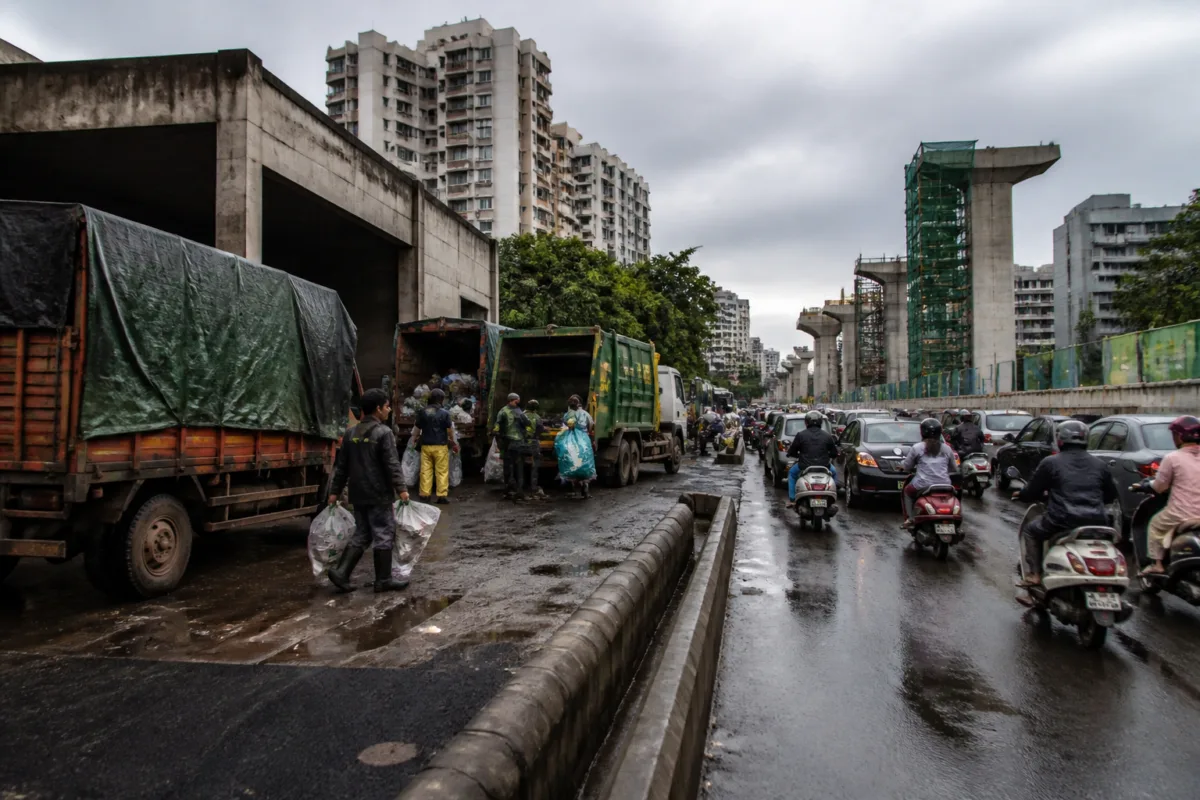
The Kothrud garbage depot has become a visible failure of Pune’s waste-management system, with residents reporting persistent odour, leachate on the road, traffic disruption and accidents around a facility that was supposed to make way for Maha Metro infrastructure. The continuing problem is not simply that one depot has not shifted. It is that the city has not yet created enough alternative capacity to move, segregate and process waste without transferring the burden to nearby streets and neighbourhoods.
The depot was established in the 1970s and was technically handed over by the Pune Municipal Corporation (PMC) to the Maharashtra Metro Rail Corporation Limited (Maha Metro) in 2019 for a maintenance yard and commercial building. Yet the handover did not result in the immediate removal of waste operations. PMC had arranged to shift waste management to another site in Bavdhan, but land acquisition hurdles meant that waste continued to be segregated at Kothrud, now on the ramp rather than inside the depot.
That interim arrangement has lasted for years. In the process, a site designed for an earlier urban context has remained part of the waste network even as the surrounding population and construction activity have increased. Residents cited by the report said the stench has worsened over time, while PMC officials acknowledged that the existing depot remains important to waste management across the area and cannot be closed without an alternative.
The Kothrud garbage depot therefore illustrates a basic infrastructure mismatch. Waste is generated continuously, but the spaces needed to collect, segregate, transfer and process it are difficult to secure in built-up areas. When a replacement site is delayed, the existing facility becomes overloaded. The resulting effects are experienced not only inside the depot but across the public road: overflowing leachate, parked garbage trucks, narrowed carriageways, traffic congestion and exposure to persistent odour.
For residents living near the depot, the consequences are tied to housing and livelihood decisions. Vilas Chavan, who has lived behind the depot for more than 30 years, said residents had been forced to become accustomed to the smell and also faced a drainage problem. Ameya Balkawade, who lives opposite the depot, said some residents had considered leaving but found that renting elsewhere would be expensive and selling property near the depot had become difficult because of the smell and dirt.
These accounts show how a waste facility can impose a cost on households beyond inconvenience. Residents cannot easily avoid the location once they own homes there, while the environmental condition around the property can affect both everyday living and the ability to sell. The report does not establish a quantified decline in property values, but the residents’ statements indicate that the depot has become part of the area’s housing problem.
The burden is also transferred to commuters. The report describes garbage trucks filled to capacity, waste and water dripping onto the road, and heavy vehicles reducing the available carriageway. Residents and commuters said the road becomes particularly dangerous during the monsoon, when rainwater mixes with waste to form leachate and makes the surface slippery.
Raksha Chowdhary, who travels between Bavdhan and Vanaz Metro station, said the odour was overpowering whether she travelled by two-wheeler, auto-rickshaw or car. Ashutosh Sathe, a Bavdhan resident, said dirty water leaking from garbage trucks made the road oily, smelly and slippery, and that he had seen two-wheelers slide and cause injuries. These accounts place the depot within a wider mobility system: a solid-waste facility is affecting the safety and reliability of a route used by local residents and commuters.
The problem has been intensified by concurrent construction. Work on the Vanaz-Chandni Chowk Metro extension has further narrowed the carriageway, according to the report. Large garbage trucks and cars are consequently getting stuck in traffic, while commuters face a combination of odour, dust, road-surface contamination and delays. The overlap is significant because transport infrastructure and waste infrastructure are competing for limited road space in a rapidly developing corridor.
The local geography has also changed. Residents linked the pressure on the depot to redevelopment in Kothrud and numerous projects coming up across Bavdhan. The report says waste is visible on main roads and bylanes in Kothrud, Bavdhan, Paud Road, Warje and neighbouring areas, while garbage vehicles remain stationed outside the depot. This suggests that the issue is not only a facility being used beyond its intended role; it is also a collection and transfer network struggling to absorb growth across several localities.
PMC’s response is centred on decentralisation. Santosh Varule, deputy commissioner of the civic body’s solid waste management department, said the corporation was identifying smaller spaces where lesser quantities of waste could be segregated before being transferred or processed. He said the Kothrud depot was important and that closing it would significantly affect waste management in the wider area.
Varule also said the Bavdhan alternative was not large enough because the quantity of waste generated in the collection areas had increased. According to him, there is currently no nearby depot to which vehicles can be sent on an urgent basis. PMC is attempting to reduce the load on Kothrud by moving collected waste in instalments, but sending waste directly to a processing site would increase vehicle operating costs substantially.
This explanation reveals the administrative trade-off behind the delay. Moving the depot is not only a question of identifying land. The replacement must be large enough, accessible to collection vehicles, connected to processing facilities and capable of handling waste generated across multiple neighbourhoods. It must also be secured in a context where redevelopment has increased demand for land and where waste facilities are likely to face opposition from nearby residents.
The cost issue is equally important. If waste is transported directly to processing sites, the number or distance of vehicle trips may rise. If waste is consolidated at an overloaded local depot, the financial saving in transport can be accompanied by higher social and operational costs: road congestion, leachate spills, odour, accident risks and deterioration in neighbourhood conditions. The available report does not provide a comparative cost assessment, but PMC’s explanation shows that the current arrangement is shaped partly by the expense of alternative logistics.
The proposed decentralised model could reduce that pressure if it is supported by adequate local facilities and monitoring. Manju Tadwalkar, director of environment solutions company Inora Biotech, said processing wet waste at the level of bulk generators such as housing societies and commercial hubs could prevent 50% to 60% of municipal waste from entering the transportation pipeline. In her assessment, this could reduce the number of heavy vehicles, carriageway blockages, leachate spillage and road-safety hazards.
Her suggestion is relevant to Kothrud and Bavdhan because the report identifies redevelopment and new projects as contributors to rising waste volumes. The bulk-generator approach would move part of the responsibility upstream, closer to the places where waste is produced. However, the source does not establish how many housing societies or commercial premises in these areas currently process wet waste, or whether PMC has the capacity to inspect and enforce such arrangements.
Tadwalkar also called for localised depot management, waste-planning provisions in redevelopment plans, on-ground inspections, microbial sprays to control odour, fixed time slots for collection trucks, sealed leachate trays and covered vehicle bodies. These measures address different points in the chain. Planning controls could create space for waste handling in new developments; inspections could test compliance; scheduled arrivals could reduce truck queues; and sealed vehicles could prevent waste and liquid from reaching the public road.
The broader policy question is whether waste management is being treated as a basic urban utility during redevelopment or as a residual activity to be accommodated after housing, commercial construction and transport projects are planned. Kothrud’s experience suggests that when the system lacks secure transfer capacity, the road becomes an unofficial extension of the depot. Waste is segregated on the ramp, vehicles wait outside, and liquid spills onto a carriageway already narrowed by other infrastructure work.
The immediate evidence confirms four linked pressures: the promised relocation has not occurred; the Bavdhan alternative is inadequate; waste generation in the surrounding collection areas has increased; and the existing depot is affecting residents, commuters and road operations. The report does not establish a final relocation date, a confirmed replacement site or a funded implementation schedule. Those are the milestones that will determine whether decentralisation moves beyond a stated objective.
Until alternative capacity is secured, Kothrud will remain a reminder that urban infrastructure does not end with the construction of a depot, metro line or road. The city must also maintain the systems that move waste through neighbourhoods without making public roads, homes and commuters absorb the consequences of delayed planning.

