


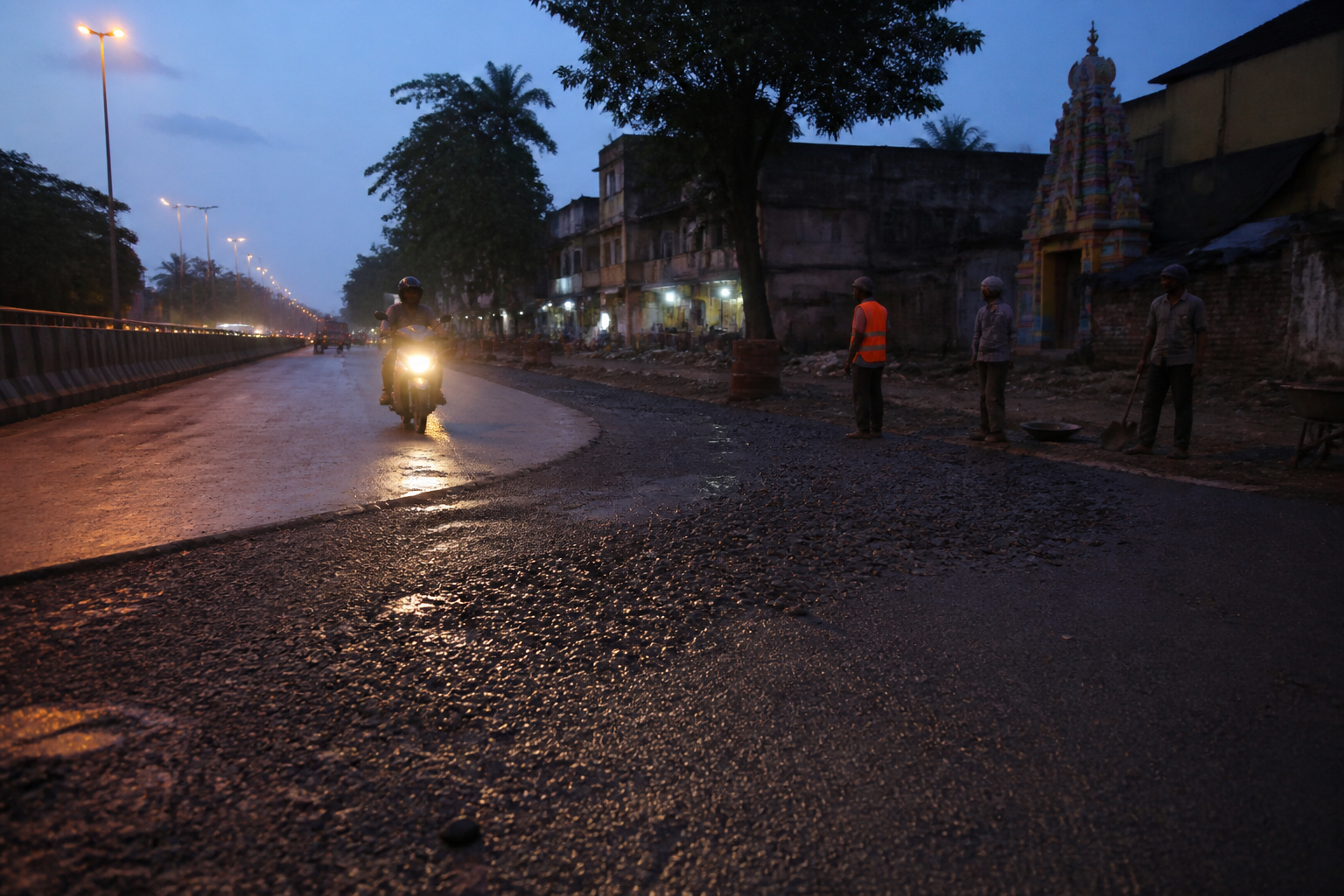
A mother and daughter were injured in Naigaon after their two-wheeler allegedly lost control on hot mastic laid during road repairs on Pali Road, according to a report by Loksatta. The incident has brought attention to a basic but consequential question in urban road management: how can repair work be carried out without turning an active public road into an immediate hazard for people using it?
The incident reportedly occurred around 5 a.m. on Saturday, September 19, near a dargah on Pali Road. Sonali Nazareth Mirchi was taking her 58-year-old mother, Sushila Mirchi, to a hospital for dialysis when they encountered the roadwork while travelling by two-wheeler from the Vasai Fort area towards Naigaon. Loksatta reported that the two-wheeler’s wheel burst after coming into contact with the hot mastic and that both women were injured.
The report attributes the accident to the absence of warning signs and barricades around the repair location. It also says that hot mastic had been poured for road restoration at the time. The affected road was therefore not simply a road with surface damage; it was an active work zone being used by residents, including people travelling before sunrise for essential medical care.
That distinction matters. Road repair is intended to restore mobility, but the work itself temporarily changes the conditions under which a road can be used. Freshly laid material, loose aggregate, uneven surfaces and construction equipment can create risks that are different from those posed by an ordinary pothole. If the public is not clearly warned or physically separated from the work area, the repair site becomes part of the road’s risk environment.
In this case, the timing and purpose of the journey underline the gap between municipal infrastructure schedules and the routines of residents. The mother and daughter were reportedly travelling for dialysis, a recurring medical requirement that cannot easily be postponed because a road is under repair. The report does not establish how many other people used the road at the time, but the incident shows that roadwork planning has to account for ordinary and essential movement at all hours, not only for traffic during conventional working periods.
The episode also sits within a wider road-repair push in Vasai-Virar. According to Loksatta, the Vasai-Virar Municipal Corporation had promised to complete road repairs before Ganeshotsav. Yet, with only a few days remaining before Anant Chaturdashi, much of the repair work was reportedly still incomplete. The report says that mastic and aggregate were continuing to be laid at several locations.
This creates two related administrative problems. The first is the condition of the road before repairs are completed. Residents continue to travel on damaged or partially treated surfaces. The second is the safety of the construction process itself. Even when a repair programme is necessary and time-bound, the public must be able to identify where work is taking place and what route is safe to use. The reported absence of barricades and warning boards points to a failure at that interface between project execution and public access.
The contractor’s role is central to the allegations raised by the affected women and local residents. They have reportedly demanded action against the contractor whom they hold responsible for negligence. However, the supplied report does not name the contractor, identify the work order, state the contract conditions, or record a response from the agency or contractor. Those details are important because responsibility for an unsafe work zone can only be assessed properly through the work package, supervision arrangements and records of the site inspection.
The same limitation applies to the municipal response. The report records the earlier assurance that repairs would be completed before the festival, but it does not provide a fresh statement from the Vasai-Virar Municipal Corporation about the accident, the safety arrangements at the site or any action against the contractor. It also does not state whether the work was stopped, whether the road was made safe after the incident or whether an inspection was ordered.
These missing details are not minor additions to the story. They determine whether the incident is treated as an isolated accident or as evidence of a wider failure in managing road repairs. A meaningful public record would need to establish who authorised the work, who supervised it, what safety measures were required, whether those measures were present and what happened after the accident was reported.
The choice of hot mastic also makes the worksite condition particularly relevant. The report states that hot mastic was poured for road restoration, but it does not provide technical details about the material, the temperature, the time required for the surface to become safe for traffic or the method used to keep vehicles away while the work was under way. Those operational facts would help establish how the two-wheeler reached the treated section and whether the site had been opened to traffic prematurely.
For residents, the immediate concern is not the terminology of the repair method but whether the road communicates its condition clearly. A warning board can alert a rider to slow down or choose another route. A barricade can prevent direct contact with a fresh surface. A properly managed diversion can reduce exposure altogether. The report’s central allegation is that none of these basic signals was provided at the location where the women were travelling.
The timing of the road programme adds another layer. The municipal promise to complete repairs before Ganeshotsav appears to have created a compressed implementation window, while the report says that substantial work remained close to Anant Chaturdashi. The supplied material does not establish whether the festival deadline caused rushed execution, and that conclusion cannot be drawn from the incident alone. It does, however, show the pressure created when public works are scheduled around a fixed civic milestone while residents continue to depend on the same roads.
This is also why the incident should not be reduced to a question of individual rider behaviour. The available report does not say that the women were speeding or ignored a visible warning. Instead, it specifically states that warning boards and barricades were absent. The condition and management of the worksite are therefore central to understanding what happened. Any official inquiry would need to examine the site layout, visibility, lighting, traffic movement and the steps taken to protect road users.
The public-interest significance extends beyond Pali Road because road repair is one of the most common forms of urban infrastructure work. Municipalities frequently have to maintain roads while keeping them open, particularly in dense settlements where alternative routes are limited. The Naigaon incident demonstrates the consequences when the construction phase is treated as a temporary inconvenience rather than as a period requiring its own safety controls.
At the same time, the evidence presently available has clear boundaries. Loksatta reports that the mother and daughter were injured, but the supplied material does not give details of their injuries, treatment or recovery. It does not identify the contractor or supervising officer, quantify the number of incomplete roads, provide the repair contract value or record whether other accidents occurred at similar sites. It also does not include a formal municipal or police statement.
The next step, therefore, is administrative clarity. The Vasai-Virar Municipal Corporation would need to explain the safety arrangements prescribed for road repairs, identify the agency responsible for the Pali Road work and state whether an inspection or action has followed the accident. The contractor’s response, the work order and any site assessment would help determine whether the reported absence of barricades and warning signs was a lapse in execution or part of a broader problem in supervision.
What the incident already confirms is that the success of a road-repair programme cannot be measured only by the number of roads treated or whether work is completed before a festival deadline. The safety of people using the road while that work is under way is part of the infrastructure outcome. Until the municipal corporation clarifies the action taken at Pali Road and the safeguards being applied at other active sites, the reported accident remains a warning about the gap between repairing a road and making the repair process safe.
