


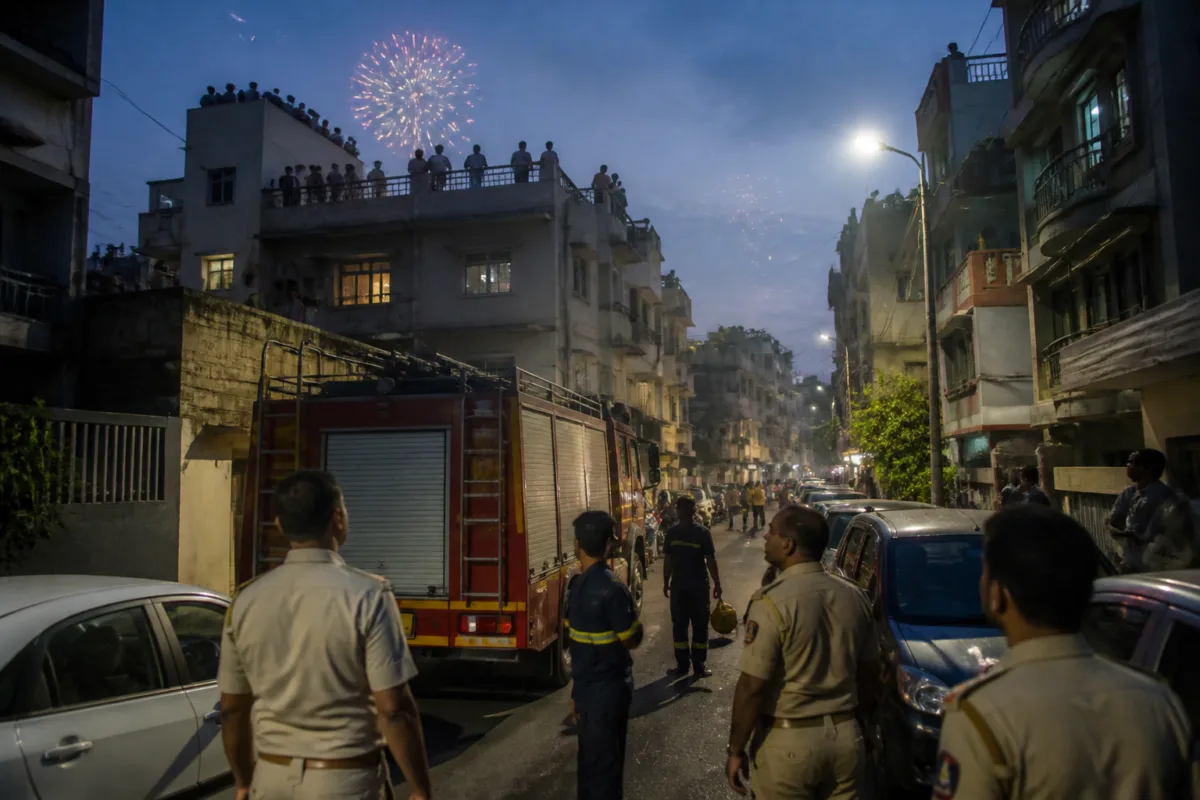
Nagpur’s aerial-fireworks ban was intended to reduce fire risks after a night that produced more than 42 fire incidents, but the order has exposed a deeper weakness in urban safety governance: the city acted against use after permitting a large retail network to operate and sell the products. The timing has left the Nagpur Municipal Corporation (NMC) with a difficult enforcement task and residents with limited clarity about how the restriction can work across a dense, largely private urban landscape.
The order, issued by municipal commissioner Vipin Itankar in his capacity as chairperson of the Urban Disaster Management Authority, came into force at 4 pm on November 9. It prohibits rockets, sky shots, aerial shells and similar flying fireworks on rooftops, terraces, balconies, narrow roads, slum areas, densely populated residential localities, marketplaces and parking areas. The measure followed more than 42 fire incidents reported in Nagpur within 24 hours during Lakshmi Pujan celebrations on November 8. Fire officials attributed 34 of those incidents to firecracker bursting.
The immediate public-safety rationale is therefore clear. Flying fireworks create risks in places where buildings, people, vehicles and combustible material are concentrated. The locations listed in the order are not isolated event grounds. They include residential terraces and balconies, narrow streets, informal settlements, commercial areas and parking spaces—urban settings in which a projectile can travel beyond the control of the person who lights it. The restriction attempts to address that risk by targeting the use of aerial fireworks in precisely the spaces where a fire or failed launch could affect several properties or households.
But the order also reveals the limits of regulating only the final act. Information obtained by the Times of India from the NMC’s general administration department indicates that the civic body had issued no-objection certificates for around 800 temporary firecracker shops in October. By the time the ban was announced after Diwali celebrations, traders had already sold large quantities of fireworks, according to the report. The result is an administrative mismatch: the city facilitated temporary retail operations before the festival and then sought to restrict the use of some products after the principal period of sale and consumption.
A senior civic official, quoted by the newspaper, said the administration should have considered stopping the manufacture or sale of the prohibited fireworks instead of expecting civic staff to identify every person bursting them. The observation points to a basic distinction in public administration. A sale or manufacturing restriction can be applied at identifiable points in the supply chain, while a use restriction must be monitored across thousands of homes, terraces, roads and commercial premises. The two approaches require different personnel, evidence and enforcement arrangements.
The NMC’s own staffing profile makes the challenge more visible. The civic body has around 4,000 permanent employees and approximately 4,000 temporary sanitary workers, according to information cited in the report. Most are already engaged in routine functions, including sanitation and solid waste management. Deploying staff across all 10 zones, especially during evening and late-night hours when fireworks are likely to be used, would be difficult because many employees are off duty and their existing responsibilities continue.
This is not simply a question of staff numbers. It is also a question of whether the responsible institution has the right operational role. Under the order, city police have been entrusted with taking legal action against violators. The NMC fire department, zonal offices and other civic agencies have been directed to support implementation by identifying violations and coordinating with police. That arrangement places detection, documentation and legal action across multiple agencies. Unless each part of the process is clearly defined, responsibility can become dispersed even when the order itself is specific.
The enforcement problem is particularly acute for violations occurring on private or semi-private property. Assistant municipal commissioners cited by the Times of India questioned how civic staff would identify a person launching a rocket or sky shot from a residential terrace, rooftop or balcony. The difficulty is not only seeing the firework. Officials would also need to establish where it was launched and identify the responsible person. In a dense neighbourhood, a projectile may be visible from several streets while the launch point remains concealed behind buildings or walls.
That creates an evidentiary problem for a rule that depends on pinpointing individual conduct. A city can restrict an activity in a public road or marketplace and deploy personnel at a defined location. It is harder to enforce the same restriction across dispersed residential premises without a coordinated system for complaints, rapid response, observation and police action. The report does not establish that such a system has been created for Nagpur’s order. It records instead that officials themselves regard implementation as a major challenge.
The timing of the ban also matters because urban regulation is experienced as a sequence, not as an isolated notification. Temporary shops require permissions; permissions create a regulated retail environment; sales distribute products across neighbourhoods; and enforcement then shifts to individual consumers. If the risk is known to arise from particular categories of fireworks, a decision made at the licensing or sale stage may be easier to administer than an order issued after distribution. The NMC official’s comment, as reported, reflects this supply-chain concern.
The existence of 800 temporary shop NOCs does not by itself establish that the permissions were unlawful or that each shop sold prohibited aerial fireworks. The supplied report does not provide the terms of the NOCs, the products covered by them or whether the permissions contained safety conditions. It does, however, establish that the city had authorised a large number of temporary retail outlets before imposing the use restriction. That sequence is central to understanding why enforcement became difficult after the festival.
The order’s geographic scope adds another layer of complexity. It covers rooftops, terraces, balconies, narrow roads, slum areas, densely populated residential localities, marketplaces and parking areas. These categories span different land uses, ownership patterns and administrative conditions. A marketplace may have traders’ associations or visible public access. A residential balcony is connected to a private dwelling. A slum area may have narrow access routes and high population density. A parking area may be managed by a private entity, a housing society or a local authority. Applying one prohibition across these settings requires more than a general announcement.
The report also identifies a further enforcement pressure during Panchami Diwali celebrations, when traders traditionally burst firecrackers on roads outside their establishments. Commercial areas could witness collective celebrations, requiring close coordination between police and NMC officials to prevent prohibited aerial fireworks. This shifts the enforcement task from isolated household behaviour to organised or semi-organised public activity. It may be more visible, but it can also involve larger crowds, commercial interests and competing claims over public space.
The institutional structure behind the order is significant. The municipal commissioner issued it as chairperson of the Urban Disaster Management Authority, while implementation involves the police, NMC’s fire department, zonal offices and other civic agencies. This shows how urban fire safety often cuts across conventional departmental boundaries. Fire prevention, public-order enforcement, licensing and municipal administration are connected, but they do not necessarily operate through one command chain. The effectiveness of the order therefore depends on coordination as much as on the legal wording of the ban.
The events reported in Nagpur also show how municipal capacity is consumed by emergencies after they occur. More than 42 fires in 24 hours, including 34 attributed by fire officials to firecracker bursting, can force an administration to respond quickly. Yet the subsequent enforcement of a preventive order requires personnel, surveillance, documentation and follow-through over multiple evenings. A city may have the legal power to prohibit an activity but still lack the operational capacity to monitor every location covered by the prohibition.
The supplied material does not establish whether the ban will be extended, whether any penalties have been imposed, or how many violations have been recorded. It also does not state whether the NMC plans to revise the process for granting temporary shop NOCs, restrict particular products at the point of sale, or create designated areas for permitted fireworks. Those are important unanswered questions because they determine whether the order is a one-time response to post-festival fires or part of a broader prevention framework.
What the evidence does establish is narrower but important. Nagpur recorded a serious cluster of fires during Diwali celebrations; fire officials attributed most of the reported incidents to firecracker bursting; the NMC issued a geographically broad ban on aerial fireworks after those incidents; and the city’s own officials questioned whether existing staff and enforcement arrangements could identify violators. At the same time, around 800 temporary shop NOCs had already been issued in October, creating the conditions for a large volume of fireworks to enter the market before the restriction took effect.
The larger urban question is whether safety regulation is being applied at the point where risk is created or only after harm has occurred. Nagpur’s order addresses the use of aerial fireworks in high-density areas, but the enforcement concerns raised by officials suggest that the city may find it easier to regulate permissions and supply than dispersed behaviour on private premises. The next test is therefore not only whether the ban exists on paper, but whether police and civic agencies can translate it into a workable, coordinated process across all 10 zones.
For now, the ban has clarified the prohibited locations and assigned responsibilities among the police and municipal agencies. It has not, according to the supplied report, resolved the central implementation problem: how a city with limited deployable staff will identify individual launches across rooftops, terraces, balconies, markets and dense neighbourhoods after fireworks have already been sold. That gap between notification and enforcement is the defining urban governance issue in Nagpur’s post-Diwali fire-safety response.

