


Bhopal’s exclusion from the Swachh Survekshan 2025–26 awards ceremony is more than a reputational setback for a city once recognised among India’s cleanest state capitals. The outcome exposes the difference between conducting cleanliness drives, sustaining public participation and resolving the difficult operational problems that determine whether a city is actually clean: waste processing, dumpsite management, inspection readiness and institutional coordination.
Nine cities from Madhya Pradesh made the national invitee list, including Indore, Depalpur, Ujjain, Dewas, Budni, Gwalior, Jabalpur, Rewa and Sagar. Bhopal and its mentee city, Berasia, were left out. Indore and Depalpur, by contrast, both secured places on the list, giving the comparison an institutional dimension. The issue is not simply that one city performed better than another. It is that the cleanliness system appears to be producing different outcomes despite both cities being associated with structured cleanliness programmes and inter-city mentoring.
The most important evidence concerns the gap between activity and completion. Bhopal district identified 884 Cleanliness Target Units, or CTUs, and transformed 812 of them, leaving 72 unfinished. Indore identified 380 CTUs and completed 349, leaving 31 pending. In absolute terms, Bhopal took up more locations and completed more units. Yet its larger workload also created a greater number of unfinished sites. The figures show why headline counts alone cannot establish whether a city’s cleanliness system is improving. The scale of the task, the quality of completion and the ability to maintain the result all matter.
The same pattern appears in the treatment of public spaces. Bhopal cleaned 104 of its 117 identified public spaces, while Indore cleaned 102 of 111. Bhopal therefore recorded a higher number of completed sites, but the participation figures moved in the opposite direction. According to sources cited in the report, 7,446 people participated in Indore’s public-space cleaning activities, compared with 2,805 in Bhopal. In CTU activities, however, Bhopal recorded 9,693 participants against Indore’s 3,422.
These figures do not provide a complete explanation of the two cities’ performance, but they reveal an important administrative challenge. Citizen participation is not a single metric. A city can mobilise large numbers around one type of cleanliness activity while struggling to attract comparable involvement in public spaces. Participation can also be measured differently across activities, making it necessary to examine whether campaigns lead to regular maintenance, improved collection and disposal, or merely short-term visible change. The report does not establish why participation differed between the two categories, but the contrast is significant enough to raise questions about how municipal cleanliness programmes are designed and evaluated.
Bhopal mayor Malti Rai attributed part of the city’s difficulty to the additional workload created by handholding Berasia. The comment identifies a governance issue embedded in the mentoring model. A larger or better-performing city may be expected to support a smaller city, but that responsibility requires staff capacity, clear accountability and a system for separating the mentor’s own operational performance from the performance of the city being supported. If the same municipal machinery is responsible for both its own targets and another city’s improvement, the arrangement can create competing administrative demands.
The report also says Bhopal faced three inspections during the survey period, including one that sources claimed took place without the Bhopal Municipal Corporation’s knowledge. The claim is attributed to sources and is not independently established in the supplied material. If accurate, it would point to a difference between municipal preparedness and the conditions encountered during assessment. More broadly, it highlights the importance of routine performance. A cleanliness system that depends heavily on advance preparation for inspections may be vulnerable when evaluation captures conditions outside the municipality’s immediate control.
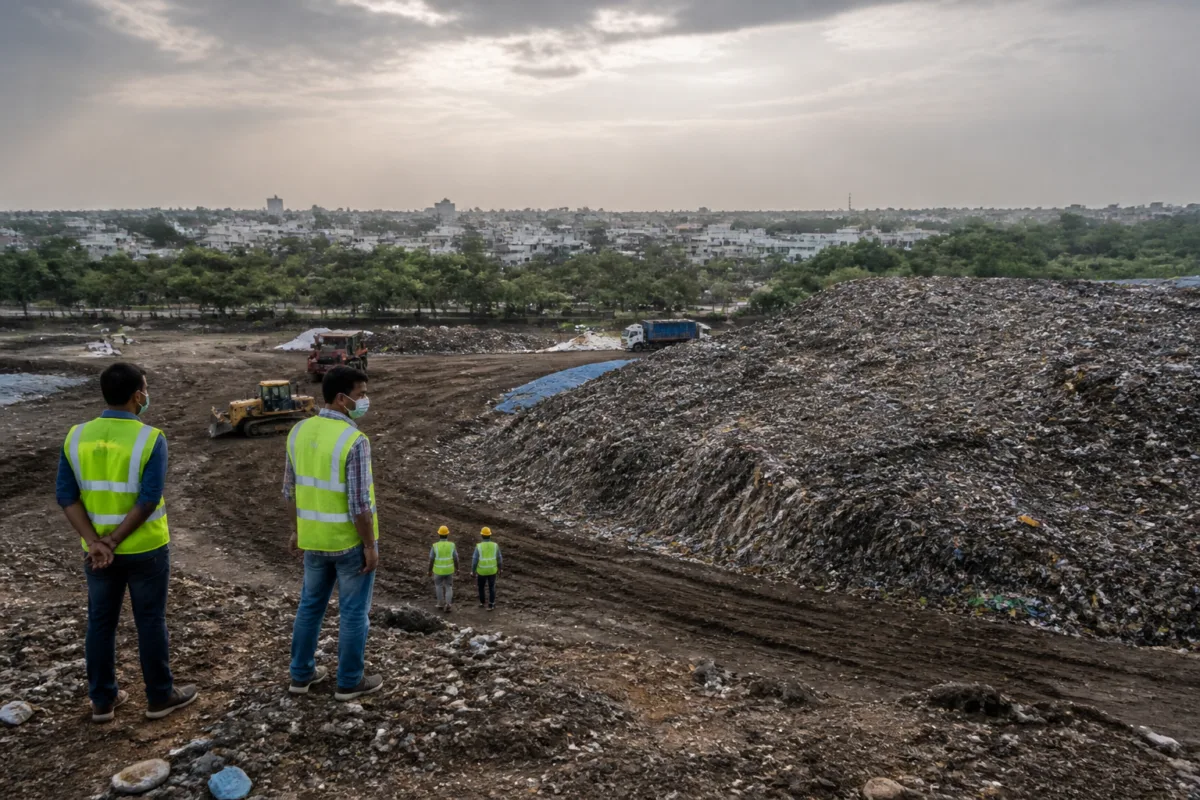
The assessment of the Adampur Chhawani solid waste management site appears to have been another central factor. The site reportedly recorded three instances of fire, raising questions about waste storage, processing and monitoring. Fires at dumpsites are not only cleanliness concerns. They can disrupt surrounding communities, release smoke and pollutants, damage nearby land and expose weaknesses in the management of old and newly collected waste. The supplied report does not provide details on the duration, cause or impact of the fires, but their inclusion in the survey assessment indicates that the dumpsite remains a significant part of Bhopal’s cleanliness challenge.
That challenge is made more difficult by the reported presence of nearly five lakh tonnes of legacy waste at Adampur Chhawani. Legacy waste represents the accumulated material that a city has not fully processed, recovered or disposed of through a scientifically managed system. It is different from the daily waste generated by households, markets and institutions. A city can improve door-to-door collection and public cleanliness while continuing to carry a large historical waste burden at its disposal site. Unless that older material is addressed, the visible cleanliness gains remain exposed to recurring fires, odour, land pressure and operational risk.
The reported Supreme Court attention to the issue adds an institutional layer. It means the waste site is not merely a municipal housekeeping concern but part of a wider regulatory and legal accountability framework. The supplied material does not specify the court’s directions or the current stage of proceedings, so those details cannot be inferred. However, the reference indicates that the legacy-waste problem has consequences beyond the annual survey and may require sustained compliance, documentation and monitoring.
The comparison with Indore should also be treated carefully. Indore’s presence on the invitee list, alongside Depalpur, provides a useful benchmark in the report, but the available figures do not establish that Indore has solved every waste-management problem or that Bhopal’s exclusion was caused by one specific deficiency. The survey appears to combine multiple dimensions, including cleanliness activities, public-space outcomes, participation, inspections and the condition of a major waste-management site. A city’s final position or eligibility therefore reflects an interconnected system rather than one campaign or one municipal department.
For Bhopal, the central policy question is whether cleanliness is being managed as an annual performance exercise or as a continuous urban service. The numbers show substantial activity: hundreds of CTUs transformed, more than a hundred public spaces cleaned and thousands of participants recorded. But the unfinished CTUs, the participation gap in public-space campaigns, the reported dumpsite fires and the large quantity of legacy waste show that activity has not removed the system’s underlying vulnerabilities.
This distinction matters because solid waste management is an infrastructure and governance function. It depends on collection networks, transfer arrangements, processing capacity, disposal-site management, worker safety, financial resources and enforcement of responsibilities across institutions. Public campaigns can support these systems, but they cannot substitute for them. Nor can a city’s earlier reputation guarantee present performance when waste volumes, land constraints and operational demands change.
The evidence supplied in the report confirms Bhopal’s exclusion and identifies several contributing indicators, but it does not provide the complete Swachh Survekshan assessment, the scoring methodology applied to each component, or the municipal corporation’s detailed response to every finding. Those gaps matter. Without the full evaluation, it is not possible to determine the precise weight assigned to inspections, fires, CTU completion, public-space participation or legacy waste.
What is clear is that Bhopal’s cleanliness setback has exposed a structural problem: visible civic activity and deeper waste-system performance are not always the same thing. The next important developments will be the city’s response to the Adampur Chhawani waste burden, the handling of reported fires, the completion of pending cleanliness units and any further clarification from the municipal corporation or the court on legacy-waste management.

