


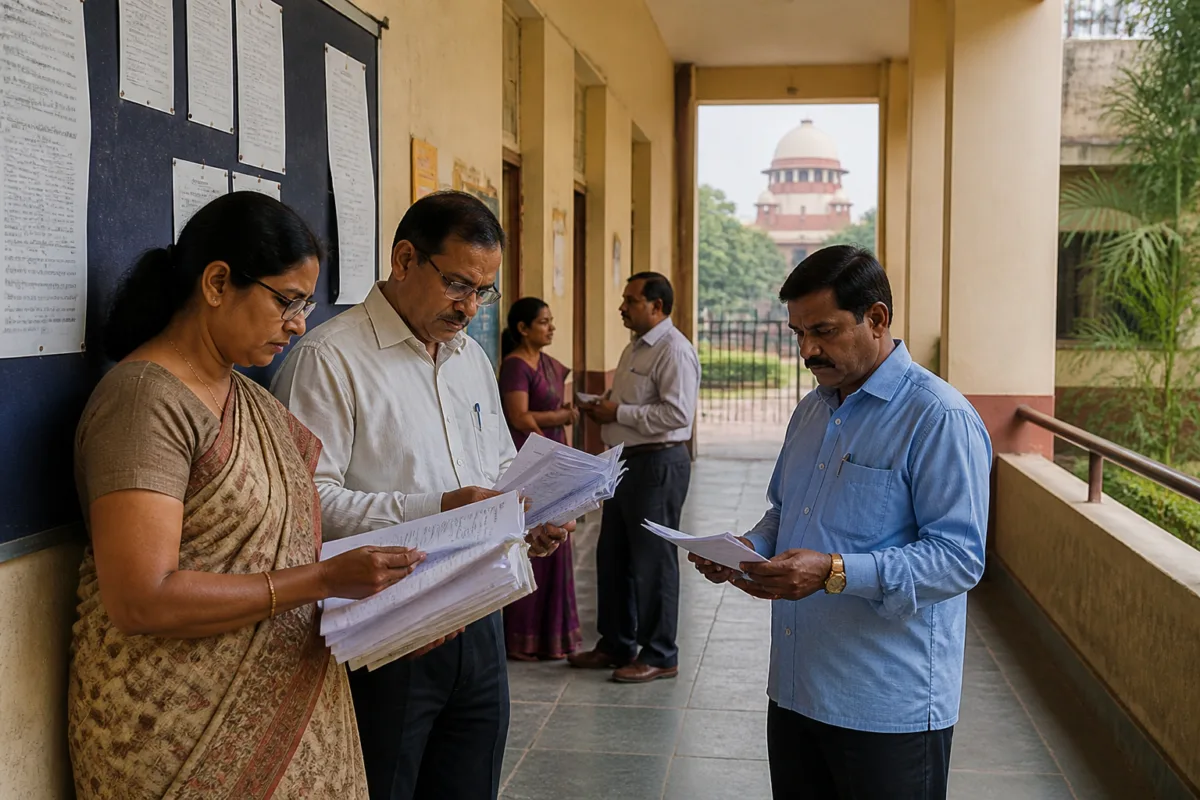
The Supreme Court has temporarily stopped the payment of approximately Rs 80 crore in salary arrears to Nagpur teachers affected by the Shalarth ID scam inquiry, while directing that their current salaries continue. The order follows the Maharashtra government’s challenge to a Bombay High Court ruling that had directed payment of the withheld wages.
The dispute concerns teachers from several educational institutions whose salaries were stopped from March 2025 during an inquiry into alleged bogus appointments linked to the Shalarth ID system. The Shalarth platform is used in Maharashtra’s education administration for processing employee and salary-related information.
The teachers had approached the Nagpur bench of the Bombay High Court after their salaries were withheld. The petitions covered approximately 89 cases. On 21 April 2026, a bench of Justice M. S. Jawalkar and Justice Nandesh S. Deshpande directed that the teachers’ salaries be resumed and also cancelled the related inquiry process.
The High Court’s order created the possibility of an arrears liability of about Rs 80 crore for the state government. The Supreme Court has now restrained payment of those arrears for the time being. At the same time, it has directed that the teachers should continue receiving their current salaries, separating ongoing monthly payments from the disputed past dues.
The state government challenged not only the arrears-related direction but also the High Court’s decision to cancel the inquiry. According to the government’s submission before the Supreme Court, the teachers’ petitions had sought the resumption of their salaries and had not challenged either the appointment of the inquiry officer or the officer’s findings.
The government further argued that the High Court had gone beyond the relief sought by cancelling the entire inquiry process. It told the Supreme Court that the inquiry officer had concluded that the appointments under examination were illegal and fraudulent. The state said that setting aside the inquiry also raised questions about the status of those findings.
The case places two administrative concerns alongside each other: the need to ensure that teachers are not left without current income for an extended period, and the state’s responsibility to investigate alleged irregular appointments before public funds are released as arrears. The Supreme Court’s interim arrangement allows the current salary stream to continue while withholding the disputed backlog.
For the affected teachers, the immediate consequence is that salary payments going forward will remain available, but the arrears accumulated after the stoppage in March 2025 will not be released at this stage. For the state, the order limits the immediate financial exposure that could have followed the High Court’s decision.
The Supreme Court proceedings will determine the next stage of the dispute over the High Court’s directions, the inquiry process and the withheld arrears. Until then, the current salaries will continue while the approximately Rs 80 crore claim remains stayed.

