


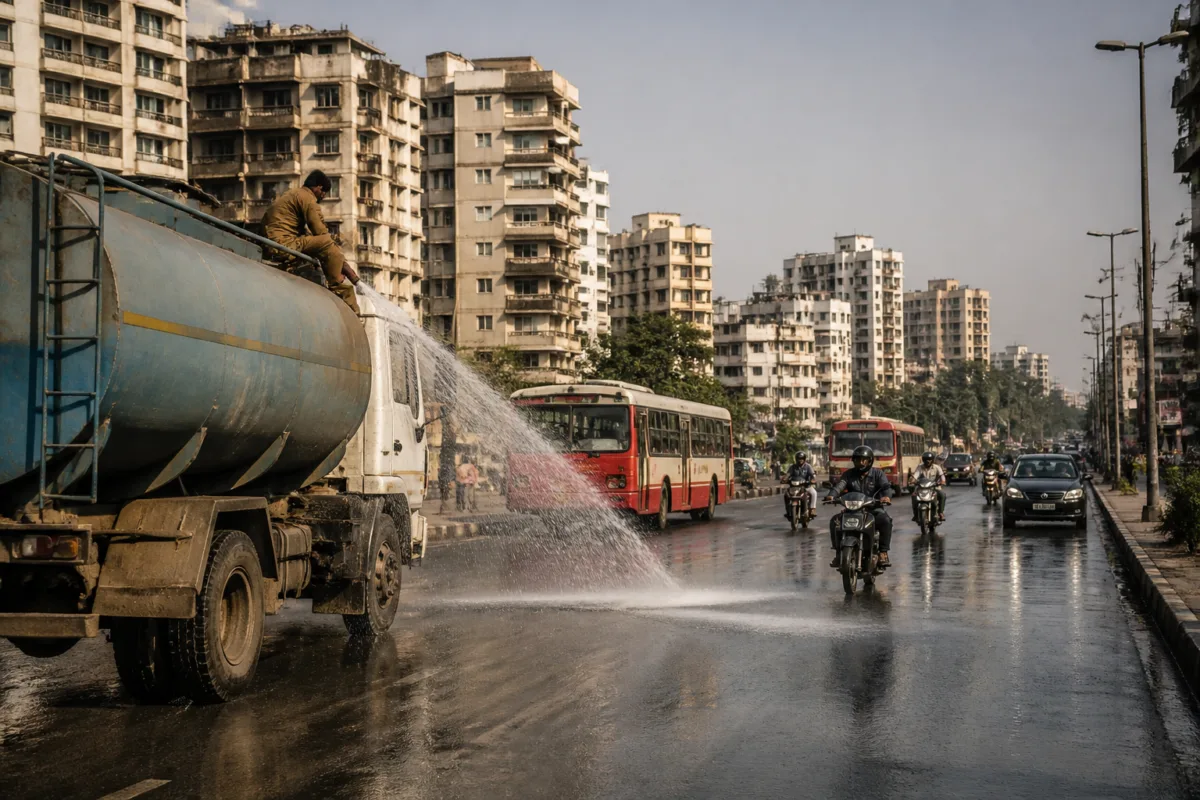
Mumbai’s water crisis is no longer only a question of how much water the city has. It is also a question of how the Brihanmumbai Municipal Corporation allocates water between essential supply, environmental management and routine civic operations. A proposal to wash 377 roads covering approximately 667 kilometres with 213 tankers has brought that conflict into public view.
The plan, reported by Mid-Day, would run for 150 to 159 days. Its stated purpose is to control dust pollution. Kishori Pednekar, Shiv Sena Uddhav Balasaheb Thackeray leader and the BMC’s Leader of Opposition, has questioned what kind of water the tankers would use and whether the exercise could affect drinking water availability in the coming months. Her questions do not establish that potable water would be diverted, but they identify the central administrative gap: the proposal’s public value cannot be assessed without knowing its water source, monitoring system and operating cost.
That distinction matters because road washing sits at the intersection of two civic responsibilities. The first is controlling dust generated by traffic, construction and exposed road surfaces. The second is protecting a reliable water supply for households and other essential uses. The reported proposal treats road washing as a citywide operational exercise, covering hundreds of roads over several months. The scale makes the source and quality of the water a core policy detail rather than a technical footnote.
According to the report, Pednekar asked whether water from wells and borewells would be used, and if so, what the plan was for its utilisation. The question points to the difference between identifying a non-potable source and demonstrating that it can be used safely, legally and sustainably. The supplied report does not state which source the BMC has approved, whether the water would be treated, how withdrawals would be recorded or whether the corporation has published an estimate of the total volume required.
Those missing details are particularly important because the proposed programme would continue for roughly five months. A short-term response to dust may have one water requirement; a daily or periodic operation across 667 kilometres for 150 to 159 days has another. Without a public estimate of tanker trips, litres per trip, filling points and frequency of washing, residents cannot compare the environmental benefit with the water demand. The number of tankers alone does not answer that question.
The proposal also raises a governance issue around measurement. If the objective is dust control, the BMC would need to explain how it will determine whether road washing is reducing dust pollution and where the intervention is most necessary. The report does not provide such a framework. It also does not establish whether all 377 roads face similar dust conditions or whether the programme prioritises construction corridors, heavily trafficked routes or areas with repeated complaints. That information would help distinguish a targeted pollution-control measure from a broad routine service.
Pednekar has questioned whether the plan could benefit tanker operators and referred to opposition to a similar proposal in the past. These are allegations and political questions, not established findings in the supplied material. They nevertheless underline the need for a transparent procurement and water-accounting system. If tankers are hired, the corporation should be able to identify the selected operators, approved rates, filling locations, quantities delivered and roads serviced. Without those records, the public would have difficulty determining whether the programme is achieving its stated purpose.
The groundwater question is equally significant. Pednekar alleged that tanker operators illegally extract water while supplying large housing societies and called for action against unauthorised extraction. The report does not independently verify those allegations. It does, however, place them alongside her demand for information on the revival of old wells and borewells, several of which she alleged were filled during construction and development projects. Together, the claims point to a wider information problem: the city’s water assets and water withdrawals need to be visible enough for the administration and residents to evaluate them.
A well or borewell cannot be treated simply as spare capacity. Its location, condition, recharge potential, ownership, water quality and permitted use would determine whether it can support a public operation. The available report does not say how many such sources exist, how many are operational or whether the BMC has completed an inventory. It also does not say whether the proposed road-washing programme depends on groundwater, treated wastewater, stored rainwater or another source. Until those facts are released, the water-management implications remain unresolved.
The timing described by Pednekar adds another layer to the debate. She identified the period from December to June as crucial for Mumbai’s water planning and urged the administration and residents to conserve water. She also referred to reported supply pressures in Nashik and Thane and warned that deficient rainfall could create shortages in Mumbai in 2027 if El Niño conditions continued until September. The report does not provide independent forecasts, rainfall figures or official supply data to test those claims. They should therefore be treated as concerns raised by a political representative, not as confirmed projections.
The more immediate policy question is whether the BMC has linked the road-washing plan to its seasonal water assessment. A transparent proposal would show the expected water requirement, identify the source, explain safeguards for drinking-water availability and specify how the programme would be adjusted if supply conditions deteriorated. It would also clarify who is responsible for approving withdrawals, inspecting tankers and publishing performance data. These are institutional questions because the programme involves civic departments, contractors, water-source managers and residents.
Pednekar’s comments on desalination further illustrate the difference between adding supply and managing demand. She described seawater conversion into freshwater as a possible future option but cautioned against relying on it as the sole solution to Mumbai’s water requirements. The supplied report contains no details on the desalination project’s capacity, timeline, financing or implementation status, so its role cannot be assessed here. The point that can be established is narrower: a future source does not remove the need to account for water used by present-day municipal operations.
The same principle applies to the call for reviving old wells and borewells. Restoration could expand the city’s information about local water assets, but the report does not establish how much water such sources could provide or whether they would be suitable for road washing. Reusing or restoring infrastructure is not automatically a substitute for a planned supply system. It requires an inventory, quality testing, permissions and a clear operating protocol.
The report also records several other issues raised by Pednekar, including alleged political pressure on BMC Commissioner Ashwini Bhide, demands for white papers on the civic body’s financial position, a possible property-tax increase linked to ready reckoner rates, hospital blood shortages and proposals for underground art galleries, cafeterias and public toilets. Those matters are separate from the road-washing proposal and do not provide evidence about its water requirements. Their inclusion nevertheless reflects the breadth of the accountability questions being directed at the civic administration.
For residents, the practical concern is not simply whether roads appear cleaner. It is whether the BMC can demonstrate that the programme is proportionate, targeted and compatible with water conservation. The current information establishes the programme’s scale and duration, and it records objections from the BMC’s Leader of Opposition. It does not establish the water source, total consumption, cost, dust-reduction results or safeguards against diversion and illegal extraction.
That is the central urban question raised by Mumbai’s water crisis: can a city manage competing public needs when the water used for one civic objective is not publicly accounted for? Before the proposal proceeds, the next meaningful evidence will be the BMC’s disclosure of the source and volume of water, its monitoring and procurement arrangements, and its response to concerns about groundwater, leakage, theft and seasonal shortages. Until those details are available, the debate remains less about whether dust control is necessary than about whether the city’s water decisions are being made transparently.

