


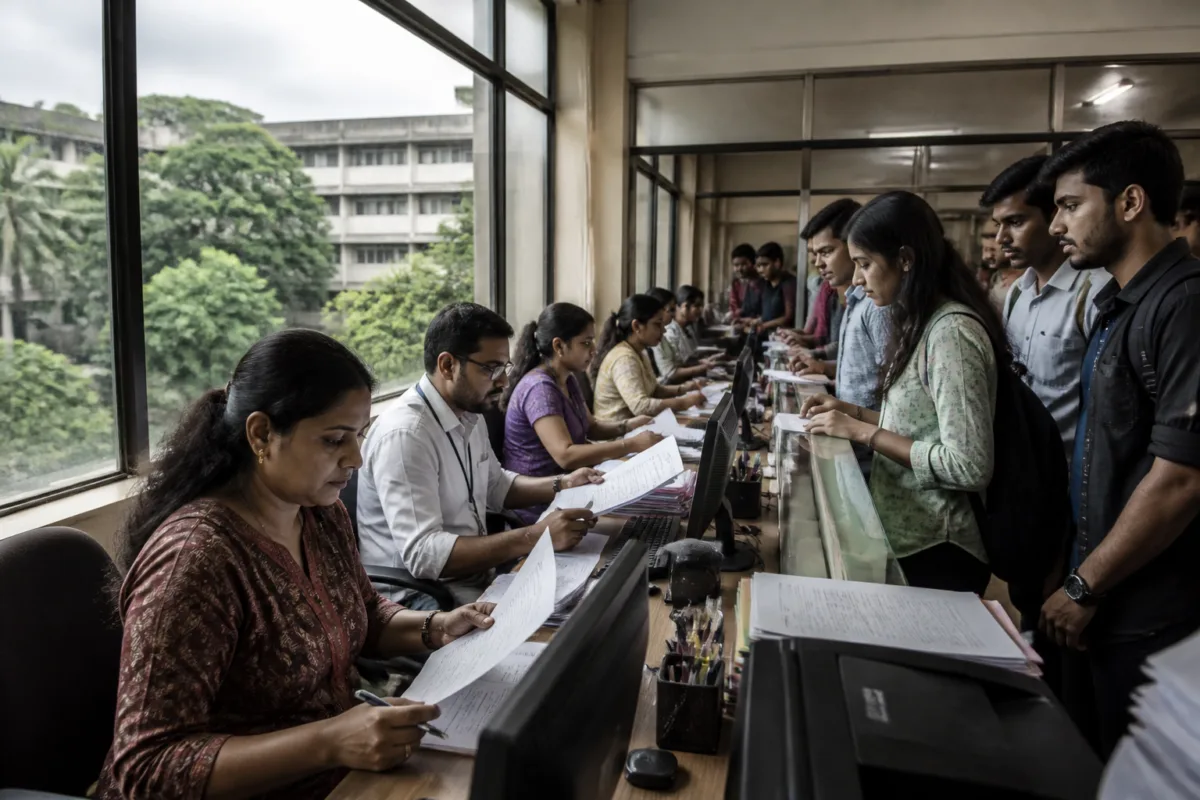
Mumbai University’s examination fee refunds for students from 305 drought-affected talukas are more than a routine administrative instruction. They show how a state relief decision becomes meaningful only when a large, decentralised education system can identify eligible students, remove fees at the point of form submission, return money already collected and demonstrate that no case has been left pending.
The University of Mumbai issued the directive on October 16 after the Maharashtra government declared 305 talukas drought-affected in view of conditions during the 2026 kharif season. The university instructed its affiliated and autonomous colleges to refund examination fees in full to eligible students who had already paid. Students who had not yet paid were not to be charged for the relevant examinations.
That distinction is important. Fee relief is not delivered through a single transaction or a single office. It has to work across colleges, faculties, examination forms and university systems. The university’s circular therefore assigns responsibilities both to colleges and to the examination administration. Principals have been asked to personally monitor refunds, while colleges must maintain faculty-wise and student-wise records and submit a compliance report to the Board of Examinations and Evaluation after the process is completed.
The measure also places a responsibility on the examination portal. While filling examination forms, students or colleges must select the “Drought Affected Taluka” category wherever the option is available. Once that category is correctly recorded, the examination fee is to be excluded from the calculation of mandatory fees. In practice, this means the relief depends not only on eligibility under the government’s drought declaration but also on correct classification at the college and portal levels.
This administrative chain creates several points at which a public benefit can be delayed or missed. A student may be eligible but not know which category to select. A college may fail to record the student correctly. A refund may be made but not reflected in the records required for compliance. The university’s instruction attempts to address these risks by requiring principals to monitor the process and colleges to maintain individual records. The supplied report does not establish how many students are eligible, how much money is involved or how many colleges have completed refunds.
The university has said that the directive applies across all faculties and to colleges located in the designated drought-affected talukas. It has also instructed affiliated and autonomous colleges to begin refunds from the date of the circular and stressed that no eligible student’s refund should remain pending. These directions make the college the operational link between a state-level decision and the student’s household.
The policy mechanism is based on an official government decision on examination-fee relief for students from drought-affected areas. The university’s role is to translate that decision into an examination-administration process. Colleges are expected to identify eligible students, apply the exemption to students who have not paid, refund students who have paid, preserve records and report completion. The Board of Examinations and Evaluation is the designated recipient of compliance reports.
This structure also explains why the university has issued separate instructions for fees already paid and fees not yet paid. Exemption at the form stage prevents a charge from being collected. Refunds require an additional process involving payment records, student identification and institutional accounting. Treating both situations through the same drought-affected category can simplify eligibility, but it does not remove the need for colleges to reconcile their records.
The timing of the directive matters because examination fees are connected to a student’s ability to complete the examination-form process. The university has not provided in the supplied material with a deadline for refunds, a standard refund procedure, a maximum processing time or a public dashboard showing compliance. It has, however, required colleges to act immediately and submit a report after completion. That makes implementation monitoring the next measurable stage of the policy.
The available numbers indicate the scale of the administrative task but not its final financial impact. Maharashtra has identified 305 drought-affected talukas for the 2026 kharif season. The report does not state how many University of Mumbai students come from those talukas, how many affiliated and autonomous colleges fall within the relevant areas, the examination fee charged for each course or the total amount to be returned. Without those figures, the directive’s reach cannot be measured in rupees or beneficiaries.
That absence of data is significant for accountability. A declaration covering 305 talukas establishes the geographical basis for relief, but an effective delivery system also needs a student-level record of eligibility, payment, refund and completion. The university has instructed colleges to maintain records by faculty and individual student, which creates the basic administrative trail. The next question is whether those records will be consolidated into a university-wide account of the number of beneficiaries and the value of refunds.
The University of Mumbai’s wider administrative activity provides a parallel example of formal institutional oversight. In the same report, the university Senate approved its annual accounts for 2025-26 and its balance sheet as of March 31, 2026, after scrutiny by the Finance and Accounts Committee and the Management Council. The accounts were prepared by statutory auditor Sandeep Vyas & Company, Chartered Accountants, and presented under Section 29(g) of the Maharashtra Public Universities Act, 2016.
The accounts approval and the drought-fee directive concern different functions, but together they show the university operating through multiple layers of governance. Financial statements move through committees and the Senate. Student relief moves through the state government’s decision, the university’s circular, college-level implementation and examination-system records. In both cases, an institutional decision becomes credible through documentation, scrutiny and a formal record of action.
For students from drought-affected households, the immediate issue is the difference between an exemption that appears on an examination form and a refund that reaches the student after payment. The university has directed colleges to provide the full amount paid towards examination fees to eligible students. It has also told colleges not to charge students who have not yet paid. The report does not establish whether students must submit separate applications or documents beyond selecting the designated category, so the precise burden placed on students remains unclear.
The directive therefore raises a broader governance question: can relief remain simple for the person receiving it when implementation is distributed across many institutions? The university’s instructions attempt to reduce ambiguity by naming the category to be selected, identifying the colleges responsible and requiring compliance reports. But the success of the process will depend on whether students are correctly classified and whether college records are accurate and complete.
The university has already specified the next administrative steps. Colleges must begin refunds, ensure that the fee is excluded for eligible students who have not paid, maintain faculty-wise and student-wise records, and send a compliance report to the Board of Examinations and Evaluation after the process is completed. These records and reports will determine whether the government’s drought-related fee relief has moved from an official decision to a documented benefit for students.

