


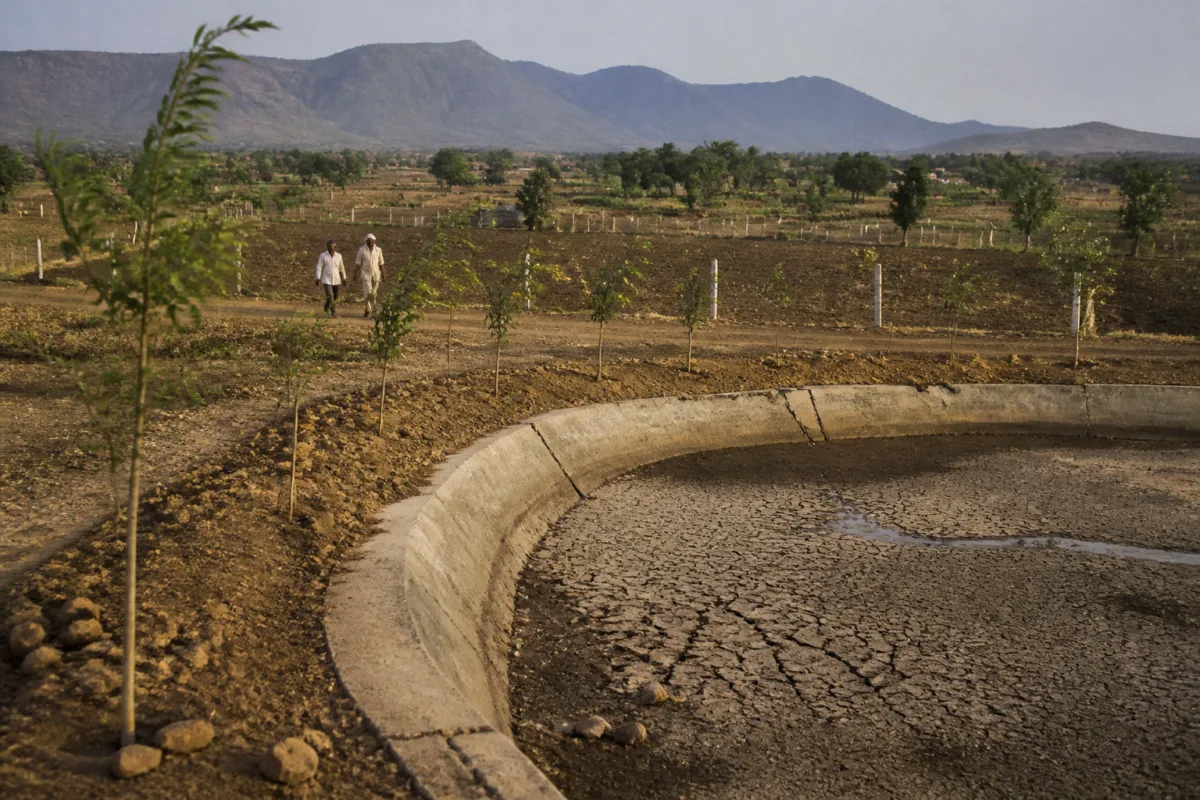
Maharashtra has scaled down its tree-plantation drive this year because of acute water shortages, with Chief Minister Devendra Fadnavis saying that drought conditions across much of the state have made large-scale planting difficult.
Speaking at an event alongside spiritual leader Sadhguru Jaggi Vasudev, Fadnavis said 80-90 per cent of rural Maharashtra was facing drought and a severe water crisis. He said rainfall was averaging only 15-20 per cent of normal, leaving reservoirs and other water-storage facilities depleted.
The state had planned to plant 300 crore trees over five years. Fadnavis said the annual programme had been reduced because of water scarcity, while arguing that tree planting on farmland remained important for soil retention and groundwater recharge.
The drought response is also being linked to the third phase of the Jalyukt Shivar water-conservation scheme. Fadnavis said the government had set a target of creating or rejuvenating 35 lakh water-conservation structures by May 2027. The work will include both the rehabilitation of existing structures and construction of new ones, with tree planting proposed around them.
According to the chief minister, more than 310 of Maharashtra’s 358 talukas have been declared drought-hit. He said nearly 52 per cent of the state’s geographical area was drought-prone despite Maharashtra’s access to the Western Ghats, making water and soil conservation necessary.
The approach marks a shift from treating plantation as a standalone numerical target to linking it with water availability, agricultural land and conservation infrastructure. Fadnavis said water-conservation structures had been created in 25,000 villages after Jalyukt Shivar was launched in 2014, with tree planting undertaken around some of them.
He also agreed to incorporate a suggestion from Sadhguru that trees be planted along farm boundaries. Fadnavis said the state would work with the Isha Foundation, which has collaborated with Maharashtra on tree planting and water-recharge structures. He added that discussions would be facilitated between the foundation’s team and the minister or officials concerned.
Sadhguru said tree-based agriculture had increased farmers’ incomes by 300-800 per cent over six to eight years in parts of Tamil Nadu and Karnataka, while improving soil organic content. He also said that simply planting large numbers of trees would not be sufficient and that scientific planning was needed to deliver the benefits of tree-based agriculture.
For Maharashtra’s water-management programme, the immediate challenge is therefore not only the number of trees planted but whether plantation choices are matched with local water conditions and the performance of conservation structures. The state’s decision to reduce this year’s plantation target reflects the practical limits imposed by drought, while the proposed integration of trees with farmland and water assets points to a broader land and water-conservation strategy.
The report does not provide district-wise plantation targets, details of the revised annual number of trees, the condition of existing Jalyukt Shivar structures or the funding and monitoring arrangements for the 2027 target. Those details will be important for assessing how the scaled-down plantation programme and the proposed conservation works are implemented.

