


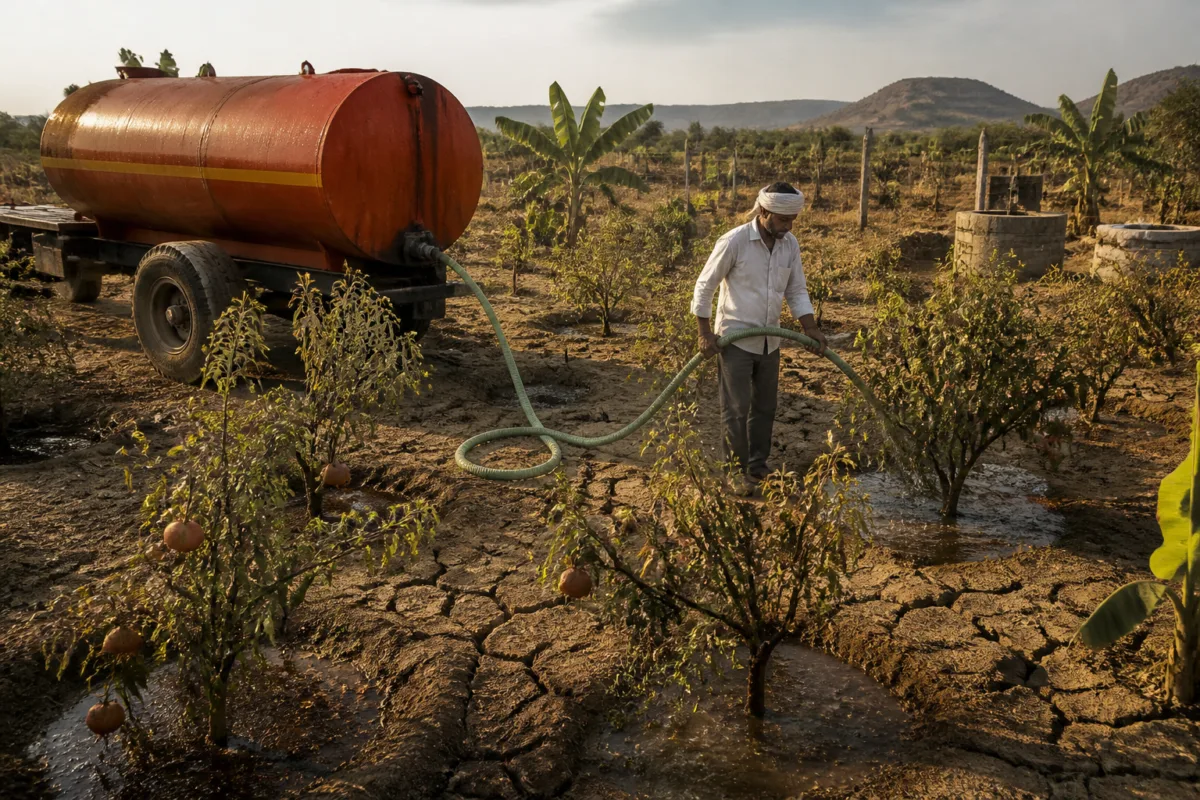
Drought-hit orchard farmers in Maharashtra’s Ahilyanagar and Nandurbar districts are taking gold loans, borrowing from private moneylenders and relying on relatives to pay for tanker water as wells and borewells run dry, according to a Times of India report.
The crisis is particularly acute in Pathardi taluka in Ahilyanagar and Shahada taluka in Nandurbar. Farmers growing pomegranates, oranges, papaya and bananas are paying between Rs 2,000 and Rs 5,000 for tanker supplies, with some farms requiring several trips each day.
For Geetaram Zade, chairperson of the Primary Agriculture Credit Society in Vaiju Babhulgaon, the cost of keeping his orchards alive led him to take a Rs 10 lakh gold loan to buy second-hand water tankers. He told the newspaper that renting a tanker cost about Rs 5,000 a day, while owning one could reduce the expense by half over a prolonged period. However, banks would not finance older tankers, he said, leaving gold as the available collateral.
The account illustrates how a shortage of local water is becoming a financing problem for rural households. Farmers are not only paying for water; they are also borrowing to access the equipment needed to transport it. The reported dependence on tankers indicates that farms with dried-up sources are being sustained through emergency logistics rather than a reliable water supply system.
The pressure is especially severe for fruit growers. Unlike seasonal crops, orchards require years of investment before they generate returns. Zade said nursery-grown fruit trees can require up to two years of care, while trees grown from seeds can take as long as seven years to mature. If established trees die, farmers lose the accumulated investment and face the cost and delay of restarting cultivation.
In Pathardi, sarpanch Jyoti Ghorpade said farmers with holdings of three to 15 acres and dried-up water sources require at least two tankers per acre daily for an average of 300 plants. She described the immediate objective as keeping the plants alive, even if farmers use all their available funds for water and wait for a potentially better harvest in the following year.
The reported costs are creating household-level financial exposure. A woman identified as Sangeeta told the newspaper that she pledged family jewellery worth Rs 7 lakh to help her brother save his farm. She said he intended to repay the money after the first harvest.
Nandurbar, which is described in the report as typically rain-rich, is also facing acute stress in Shahada taluka. Vishal Mahajan, a 27-year-old civil engineer-turned-farmer, is trying to protect a 10-acre papaya and banana plantation at the fruiting stage. He said he was spending Rs 5,000 a day on six tanker trips, while three tankers were needed daily to irrigate 10 of his 15 acres.
Mahajan said he had already spent more than Rs 9 lakh drilling borewells at multiple locations, but the crops failed. He also reported taking Rs 7 lakh in loans, including a Rs 1.5 lakh gold loan, to buy water after receiving a market advance for the crop.
These accounts show how groundwater failure affects more than agricultural output. When wells and borewells cannot provide water, the burden shifts to tanker operators, lenders and household assets. The cost is therefore carried simultaneously through farm expenditure, debt and the loss of savings held as jewellery.
The report does not provide district-wide figures for the number of affected farms, tanker trips or gold loans, nor does it document a government tanker programme or a confirmed groundwater-response plan. Its evidence is based on accounts from affected farmers and local representatives. Even so, the reported figures show the scale of exposure for individual growers: daily water costs of thousands of rupees, failed borewell investments and loans secured against family gold.
For orchard farmers, the immediate urban-infrastructure relevance lies in the dependence on water transport when local sources fail. Tankers can keep crops alive temporarily, but the reported experience also exposes the vulnerability of communities whose livelihoods depend on groundwater without a dependable alternative supply. The central unresolved question is how long farms can sustain this emergency arrangement before tanker costs and debt exceed the value of the crop they are trying to save.

