


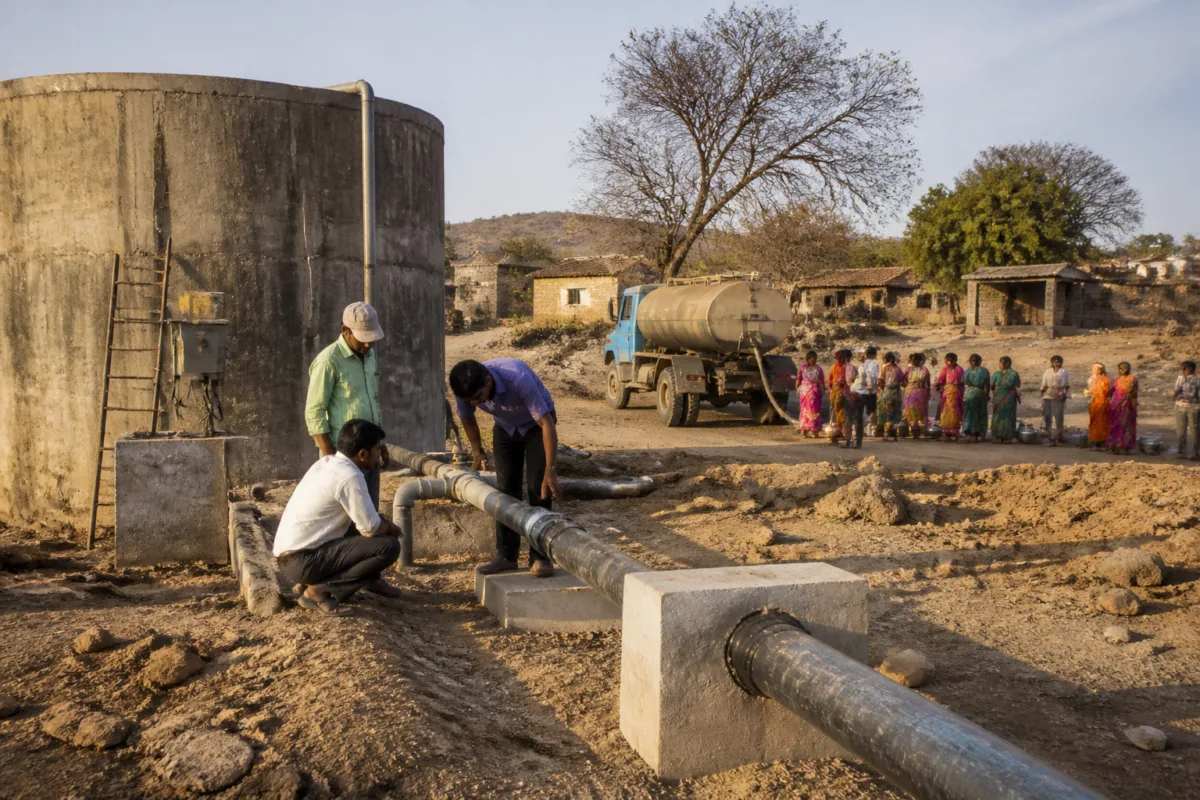
Maharashtra has directed district authorities to defer non-essential new construction in 310 drought-hit talukas and redirect available funds towards drinking water, water conservation and livestock needs, according to a Government Resolution issued by the Planning Department and reported by PTI.
The number of drought-affected talukas rose to 310 out of the state’s 358 talukas after two more were declared drought-hit on Thursday. The order applies during the 2026-27 financial year and will also cover any additional talukas subsequently declared drought-affected or facing scarcity.
The decision shifts the immediate priority of district-level capital spending from projects that can be postponed to works intended to secure water access. District Annual Plan funds must be prioritised for completing incomplete water-supply projects, strengthening existing water sources and ensuring water and fodder availability for livestock.
District collectors have been instructed to review non-essential new projects, including parks, beautification works, new office and administrative buildings, cement roads, drains and other works involving substantial water consumption. Projects that are deferred are to be assessed for fund reallocation towards priority drought-relief measures, with the exercise required to be completed by December 31.
The order does not call for an automatic halt to every ongoing project. Authorities have been told to assess projects individually, taking into account contractual obligations, public safety, the stage of construction, expenditure already incurred and any possible compensation or other financial liabilities.
Works directly connected with drinking-water availability, strengthening existing water sources, creating necessary new sources, livestock water and fodder, water conservation, irrigation, public health and emergency requirements are exempt from the temporary suspension, subject to applicable rules and approvals. The government has also prioritised incomplete pipelines, pumps, electricity connections, storage tanks and distribution systems needed to move water from existing sources to scarcity-hit villages.
The resolution says projects that can be completed during the current scarcity period and provide immediate access to water should receive priority. New projects that cannot normally be completed within the current financial year should not be sanctioned under the special priority framework.
In exceptional cases, essential drinking-water, livestock-water or water-source creation projects may be considered even if they extend beyond the current financial year. However, the additional financial liability for 2027-28 must not exceed 10 per cent of the approved District Annual Plan outlay for 2026-27, according to the report.
The implementation framework gives collectors a short window to translate the policy into project-level decisions. District-level official meetings must be convened within seven days of the resolution, followed by an integrated taluka-wise and project-wise action plan within 15 days.
The order also provides an expedited route for urgent drought-relief measures. If waiting for a District Planning Committee meeting would delay an essential intervention, the collector may submit a proposal to the guardian minister, who heads the committee, for approval. The proposal would then require ratification at the committee’s subsequent meeting.
Collectors must submit monthly reports to the Planning and Finance departments by the 10th of each month, covering fund allocation, expenditure and physical progress. Details of sanctioned works, spending and progress are also required to be published on district collectorate websites or government portals.
For residents of affected talukas, the practical significance of the order will depend on how quickly incomplete water systems become operational and whether reallocated funds reach projects that address immediate shortages. The resolution’s emphasis on pipelines, pumping systems, power connections, storage and distribution recognises that water security depends not only on creating sources but also on completing the infrastructure needed to deliver water to settlements.
At the same time, the case-by-case treatment of ongoing construction leaves district authorities responsible for balancing drought priorities with public safety, contractual commitments and financial exposure. The required project-wise plans, monthly progress reports and online disclosure are intended to make those decisions traceable during the 2026-27 financial year.

