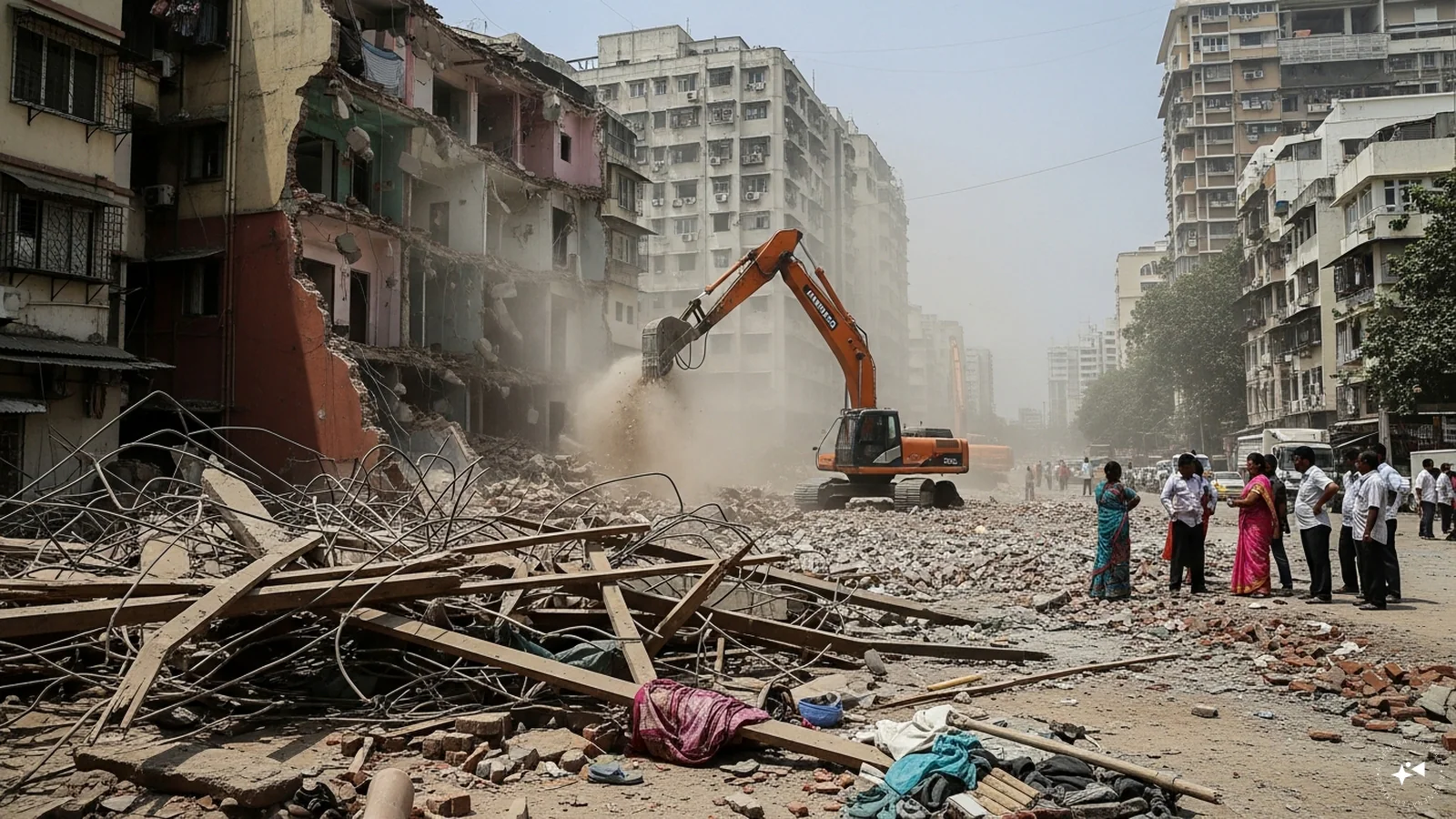
Mumbai’s suburban mobility network is set for a significant capacity upgrade as authorities move ahead with the widening of Swami Vivekanand Road in Andheri, a key arterial stretch that has long struggled with chronic congestion and constrained carriageway width. The project has identified over 500 structures within the proposed alignment, marking one of the more extensive urban road restructuring efforts in the western suburbs.
The intervention is being implemented under statutory planning provisions that enable municipalities to reclaim road setbacks for public infrastructure expansion. In this case, the widening exercise is intended to improve traffic flow along a corridor that runs parallel to the suburban railway line and connects dense residential and commercial clusters across western Mumbai. In the first phase, nearly 200 structures were impacted along a high-pressure segment between two major junctions, with most of the clearance already completed through a combination of voluntary compliance and phased municipal action. Urban governance officials indicate that encouraging property owners to remove encroachments voluntarily has helped reduce resistance and improved execution efficiency in a densely built-up environment where displacement concerns are typically high.
The second and third phases will extend the widening effort further along the corridor, covering additional junctions and a stretch leading towards a river-adjacent zone. Together, these phases account for several hundred structures that fall within the revised road alignment, making coordinated implementation critical to avoiding prolonged disruption. Urban transport analysts highlight that SV Road functions as one of the most heavily used east–west connectors in the suburbs, carrying mixed traffic including private vehicles, buses, and commercial transport. Over the years, incremental increases in vehicle ownership, coupled with metro and station-linked commuter flows, have intensified pressure on the already narrow carriageway. The SV Road widening Mumbai initiative is therefore being positioned as a long-overdue intervention to restore network efficiency in a corridor that frequently experiences peak-hour gridlock.
From a planning perspective, experts note that road expansion projects in mature urban areas often involve complex trade-offs between infrastructure improvement and built-form disruption. While widening can significantly improve throughput, it also requires careful sequencing to minimise displacement impacts and maintain access for residents and businesses during construction phases. Officials overseeing the project have emphasised inter-departmental coordination to ensure that utilities, traffic management systems, and local access routes are synchronised as work progresses. The phased execution strategy is intended to reduce congestion spillovers into adjoining neighbourhoods, which often occur when large-scale road works are undertaken in compact urban zones.
Long-term urban mobility planners suggest that such corridor upgrades must be integrated with public transport strengthening, pedestrian safety improvements, and last-mile connectivity enhancements to achieve sustained congestion relief rather than temporary gains. As Mumbai continues to densify, the SV Road widening Mumbai project reflects a broader shift towards reclaiming road capacity within existing urban footprints while balancing the challenges of high-density redevelopment and equitable urban access.
Mumbai SV Road Expansion Identifies 502 Structures