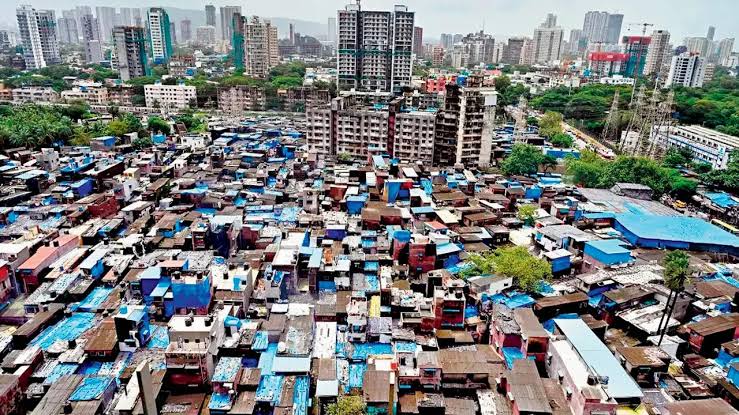
Mumbai Slum Redevelopment Enters A New Delivery Phase
Mumbai’s slum rehabilitation programme is entering a much larger delivery phase, with the Slum Rehabilitation Authority targeting about 5.09 lakh rehabilitation homes by December 2030. The scale of the target signals a shift from individual redevelopment schemes towards larger, coordinated renewal projects, placing housing delivery, infrastructure capacity and the rights of existing communities at the centre of Mumbai’s next urban transformation. The authority’s latest official material records 2,79,307 rehabilitation units completed from its inception, while another 3,35,787 units were under construction. Its 2030 target therefore represents a substantial acceleration in delivery rather than a marginal expansion of the existing pipeline.
The annual milestones are designed to build momentum progressively. The stated targets rise from 90,264 rehabilitation homes by December 2026 to 1,48,219 in 2027, 2,44,356 in 2028 and 3,61,026 in 2029, before reaching 5,09,873 by the end of 2030. Achieving those numbers will depend on resolving land, approvals, financing, construction and resident-consent challenges that have historically slowed redevelopment. A key change is the growing use of cluster redevelopment. Instead of treating each settlement as a separate project, the model brings larger contiguous areas into a single planning framework. The state approved a dedicated cluster redevelopment scheme in November 2025, with the approach intended to address fragmented redevelopment and enable broader infrastructure planning. Several large Mumbai clusters are already being examined, including Majaswadi, Behrampada and areas around Wadala. Recent proposals cover hundreds of acres and potentially tens of thousands of households, showing how redevelopment is increasingly being treated as an urban-planning exercise rather than simply a housing replacement programme.
The economic model remains based on cross-subsidisation. Under the SRA framework, eligible residents receive rehabilitation accommodation while developers can receive additional development rights or sale components that help finance construction. The authority describes this land-and-FSI mechanism as central to funding rehabilitation without charging eligible residents for their replacement homes. That model also creates a wider planning test. Rehousing thousands of families in denser buildings without adequate schools, healthcare, open areas, drainage, transport and employment access could simply relocate urban disadvantage. Successful Mumbai slum redevelopment will therefore need infrastructure to advance alongside housing. Dharavi illustrates the scale of that challenge. Its redevelopment plan includes economic rehabilitation for local businesses, upgraded infrastructure, public transport and additional open and green areas. Protecting existing livelihoods alongside housing is critical because informal settlements often contain dense employment ecosystems as well as homes. Digital monitoring is another part of the authority’s strategy. SRA says it has introduced online services for approvals, complaints and allotments, while satellite-based monitoring is being used to identify new encroachments.
For Mumbai slum redevelopment, the 2030 target will ultimately be judged less by sanctioned units than by completed, liveable neighbourhoods. Faster construction can address a major housing deficit, but durable urban renewal will require transparent implementation, community continuity and infrastructure capable of supporting the population that redevelopment brings together.