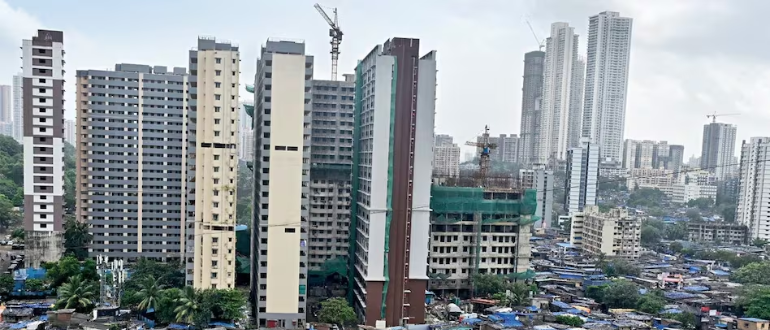
A large-scale Mumbai slum cluster redevelopment initiative is gaining momentum as the Maharashtra government advances plans to rehabilitate nearly seven lakh residents through integrated housing projects. Reviewed at a recent meeting of the Slum Rehabilitation Authority, the programme signals a shift towards consolidating fragmented informal settlements into viable, infrastructure-ready urban districts across Mumbai.
Officials indicated that the approach seeks to resolve persistent bottlenecks that have slowed earlier redevelopment efforts, particularly projects stalled due to limited land parcels, financial constraints, and coordination failures. By grouping smaller slum pockets into larger clusters, planners aim to unlock economies of scale, improve design coherence, and enable better integration of utilities, transport access, and social infrastructure. The proposal was reviewed in the presence of the state’s top leadership, including the office of the Chief Minister, where officials outlined the administrative and financial architecture required to deliver the programme. While land identification is still underway, urban planners say site selection will determine both the pace and inclusivity of implementation, especially in dense, high-value zones where competing land uses complicate redevelopment.
Beyond housing delivery, the Mumbai slum cluster redevelopment framework is being positioned as a broader urban reform tool. Experts note that clustering can help align redevelopment with climate resilience goals by allowing for improved drainage systems, energy-efficient construction, and better open space planning critical in a city increasingly vulnerable to flooding and heat stress. Parallel project approvals also highlight the state’s attempt to fast-track specific redevelopment zones. Additional funding has been cleared for key sites in eastern suburbs, with execution entrusted to agencies such as the Mumbai Metropolitan Region Development Authority. At the same time, provisions are being built in to accommodate residents who may not qualify under existing eligibility norms, including rental housing options to prevent displacement-driven delays.
Institutional capacity is another focus area. Authorities are working to strengthen the Slum Rehabilitation Authority by integrating technical staff and improving continuity in project management. This comes after repeated concerns from industry observers about execution gaps and inconsistent oversight in earlier schemes. For the real estate sector, the cluster model could reshape participation dynamics. Larger land aggregation and clearer regulatory frameworks may attract more organised developers, though financial viability will depend on balancing rehabilitation commitments with market-sale components. For residents, the stakes are higher formal housing, improved services, and tenure security, but also the risk of prolonged transition periods if timelines slip. As Mumbai continues to grapple with housing shortages and land scarcity, the success of the Mumbai slum cluster redevelopment plan will hinge on execution discipline, transparent beneficiary identification, and the ability to align urban growth with social equity and environmental resilience.