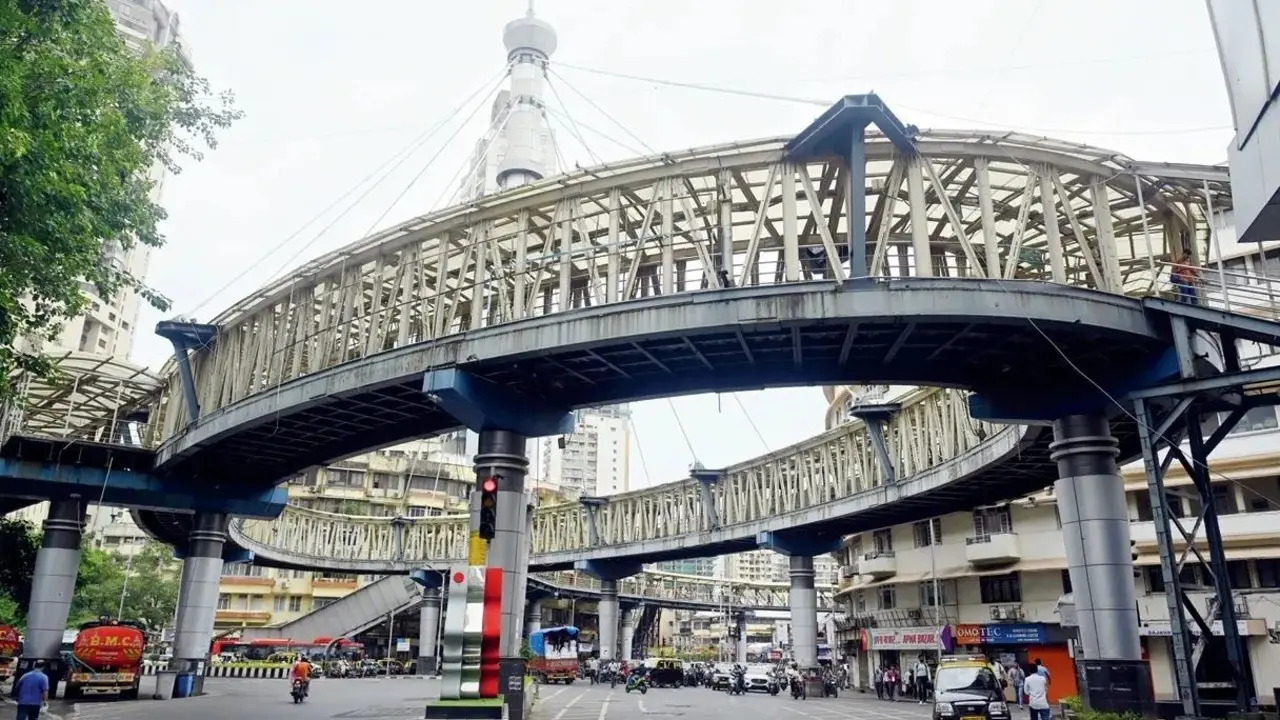
Mumbai Skywalks Struggle To Attract More Pedestrians
Mumbai’s network of 26 skywalks is facing renewed scrutiny over whether the city is getting sufficient pedestrian value from infrastructure built at substantial public cost. BMC data indicates that about 3.98 lakh people use the structures daily, while the civic body has spent ₹286.58 crore on the skywalks under its own jurisdiction. The numbers have revived questions about design, accessibility and whether elevated crossings are being planned around actual walking patterns. The issue is not simply about footfall. A pedestrian facility can remain underused when reaching it requires a steep climb, a long detour or navigating poorly maintained access points. Recent observations across several locations have highlighted concerns around stairs, lighting, escalators, lifts and general upkeep. These factors become particularly important for older citizens, children, people with disabilities and commuters carrying luggage.
Mumbai skywalks were largely conceived to separate pedestrians from heavy traffic near railway stations and busy junctions. Yet pedestrian movement depends on the entire journey, not just the crossing. Urban planners say a structure that begins or ends away from major destinations can encourage people to remain at street level, even when the elevated route is technically safer. The spending question also extends beyond the ₹286.58 crore incurred by BMC. A significant share of Mumbai’s skywalk network was developed by the Mumbai Metropolitan Region Development Authority, making a consolidated assessment of construction and lifecycle costs important. Without a complete public record of expenditure, usage and maintenance, it becomes difficult to compare individual projects or determine which facilities deliver strong value.
The financial burden does not end when construction is completed. Escalators, lifts, lighting, security systems, drainage and structural repairs require recurring expenditure. In July, for example, BMC proposed ₹4.16 crore to replace two failed escalators at the Grant Road skywalk after years of being out of service. Such costs show why pedestrian infrastructure needs to be assessed over its full operating life, rather than only by its construction budget. At the same time, low usage should not automatically be interpreted as proof that every skywalk has failed. Mumbai’s pedestrian demand varies sharply by location and time. The Bandra East skywalk, for instance, has reported daily footfall of roughly 90,000–95,000, showing that well-connected structures can attract substantial use.
The immediate priority is therefore better evidence. Mumbai skywalks need location-wise audits covering footfall, accessibility, maintenance costs, safety and connections to stations, footpaths and commercial areas. Future investment should follow these findings, ensuring that pedestrian infrastructure supports continuous, accessible and comfortable journeys rather than becoming isolated structures above the street.