


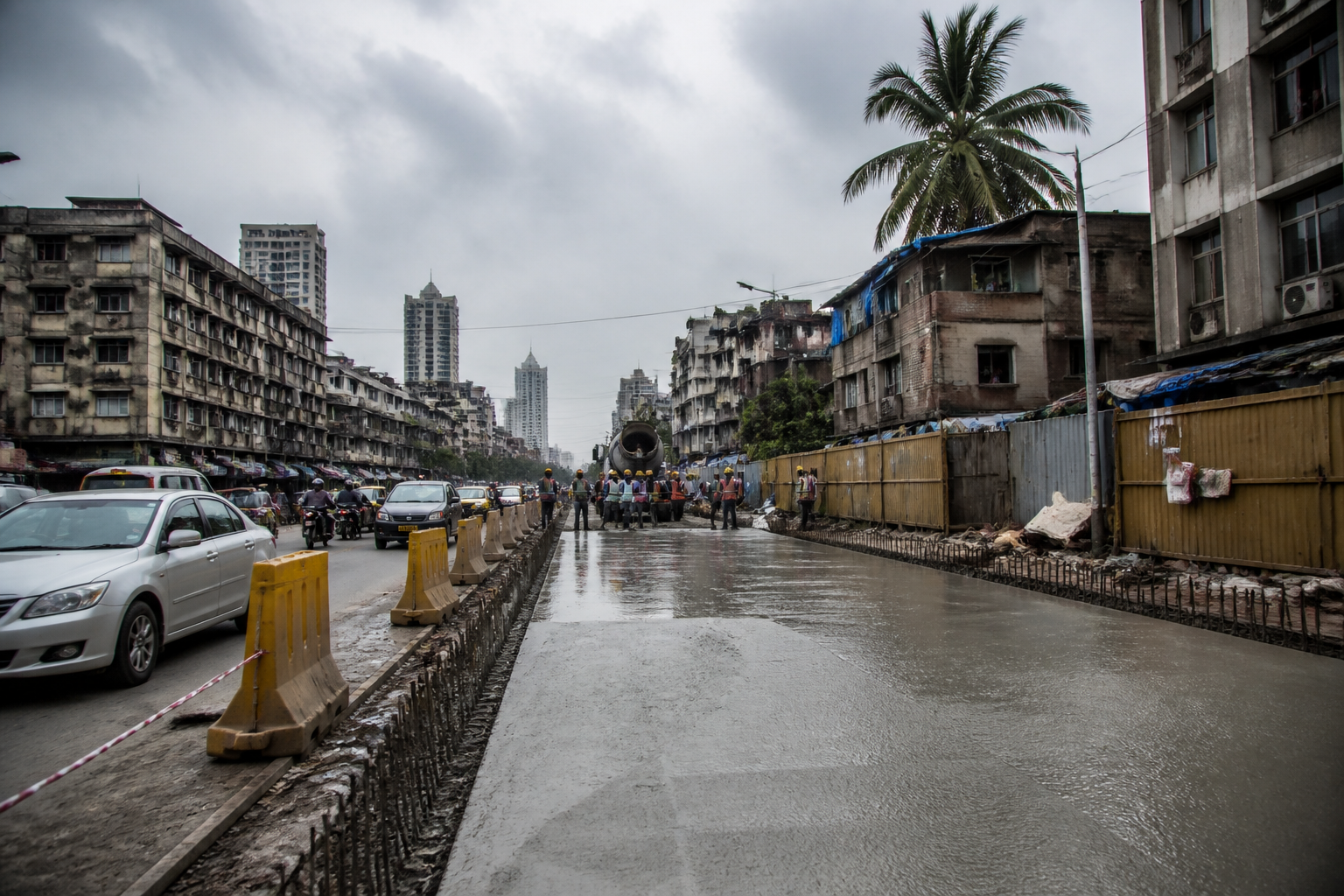
The Brihanmumbai Municipal Corporation’s proposed revocation of two road-concretisation contracts exposes a delivery crisis inside Mumbai’s largest recent road infrastructure programme. Work has yet to begin on 275 roads valued at about Rs 380 crore, while the contractors’ March 2027 deadline is increasingly difficult to meet, according to senior civic officials quoted by The Indian Express.
The proposed action concerns NCC Limited and Eagle Infra India Limited, which were awarded work in Mumbai’s island city and eastern suburbs. The BMC has told the contractors to complete ongoing stretches where roads have already been dug up, but not to start new work covered by the remaining portions of their tenders. Those unstarted roads are expected to be included in a fresh tender, likely to be floated early next year, subject to final approval by Municipal Commissioner Ashwini Bhide.
The decision is significant because it is the first time since the concretisation programme was launched in 2023 that the civic authority is officially moving to revoke contractors’ work. It also raises a more difficult question than whether two agencies have progressed slowly: can a city execute a tightly scheduled, geographically dispersed road programme when the work must be fitted around monsoon restrictions, traffic movement, utility coordination and neighbourhood access?
A citywide programme with uneven progress
The BMC has awarded contracts worth Rs 17,700 crore to concretise 2,175 roads covering 712 km across the island city, eastern suburbs and western suburbs. The programme was announced as a response to Mumbai’s persistent pothole problem, with the stated objective of converting existing asphalt roads into concrete roads.
The available dashboard figures show that progress is not uniform across the programme. In the island city, covering areas between Nariman Point and Byculla, 335 roads were taken up. Of these, 146 have been completed, while the remainder are either partially complete or yet to begin. In the eastern suburbs, 363 roads between Mankhurd and Mulund were included, with 211 completed and the rest either partially complete or untouched.
These numbers do not establish that every delayed road is the result of contractor failure. They do, however, show the scale of the unfinished work and the administrative challenge created when a large number of sites move through different stages at the same time. Completed roads, partially completed roads and roads awaiting commencement each require different forms of supervision, payment, traffic management and public communication.
The proposed contract action therefore creates a second implementation task for the BMC. It must close out ongoing work, determine the exact scope left incomplete, prepare a new tender, appoint another contractor and prevent a gap between the old and new arrangements. The new tender will also need to account for roads where the work environment has changed since the original contracts were awarded.
Why location and access matter
The contractors’ explanations point to the operational complexity of working in different parts of Mumbai. Eagle Infra told The Indian Express that it had been assigned 182 roads in the eastern suburbs and had completed 154 of them, including stretches in Mankhurd, Chembur, Ghatkopar and Mulund. The company said it had handed those completed roads over to the civic body and had not received communication about the proposed revocation.
NCC, which was responsible for work in parts of south Mumbai, cited a different set of constraints. Its spokesperson said roads in areas such as Marine Drive, Churchgate, Colaba and Malabar Hill could not be closed for more than four hours because of their importance and location. The company also pointed to Mumbai’s four-month monsoon period, when road-concretisation work cannot be carried out.
These statements present a dispute over how progress should be assessed. The BMC’s position, as reported by The Indian Express, is that both contractors made slow progress and did not accelerate work despite multiple warnings. The contractors, meanwhile, have described different levels of completion and highlighted limits on working hours and seasonal construction windows.
The disagreement matters because a road contract is not measured only by the length of concrete laid. In a dense city, the practical output depends on whether a road can be closed safely, whether traffic and pedestrian movement can be maintained, whether utilities are clear, and whether the work can be sequenced before the monsoon. A contractor may face genuine site constraints, but those constraints also need to be anticipated in the tender design and monitored through the contract period.
The deadline problem
The contractors’ formal deadline is March 2027. Civic officials told The Indian Express that the pace of work makes completion by that date very unlikely. Their instruction to finish only ongoing work and stop starting new stretches suggests that the BMC is attempting to limit additional disruption while it reworks the unstarted portion of the contracts.
That approach may reduce the risk of opening more sites than can be completed, but it also creates a break in the programme. Roads that have not yet begun will now depend on a new procurement cycle. The timeline for the fresh tender, the selection of a replacement contractor and the mobilisation of equipment and labour has not been specified in the supplied report beyond the indication that the tender is likely to be floated early next year.
The result is a programme whose headline target covers the whole city but whose actual delivery is fragmented by ward, road condition, contractor performance and access restrictions. The dashboard can show how many roads are complete, but the administrative challenge lies in managing the unfinished middle: roads that are partially built, roads that are dug up, roads awaiting utilities or permissions, and roads that have not yet entered construction.
For residents, this fragmentation is experienced locally. A completed stretch may offer a smoother surface, while a nearby road remains vulnerable to potholes or prolonged construction. A partially completed road can create traffic diversions and access problems without delivering the full benefit of the project. The supplied material does not provide a consolidated figure for the number of partially completed roads or the duration of disruption on individual stretches, but the BMC’s own dashboard categorises a substantial portion of the island city and eastern suburban work as either partial or not started.
Procurement is now part of the infrastructure story
The proposed revocation shifts attention from construction alone to contract management. The BMC will have to establish the portion of work that can be completed under the existing arrangements, formally revoke the remaining scope, prepare a replacement tender and coordinate the transition. The proposal has been sent to the municipal commissioner for final approval, so the revocation had not yet become final in the report.
That procedural stage is important. The civic body’s intention, an official proposal and a completed contract termination are separate events. The contractors’ claim that they had not received communication about the proposed revocation further indicates that the process was still underway when the report was published.
The episode also demonstrates why large public works programmes cannot be judged only by their announced road count or total contract value. The BMC’s programme covers 2,175 roads and 712 km, but the operational unit is the individual road, with its own traffic conditions, surrounding buildings, utility network, monsoon exposure and access requirements. A single citywide target can conceal substantial variation in the feasibility and pace of work.
The next stage will determine whether the BMC can convert the proposed corrective action into actual progress. The immediate milestones are the municipal commissioner’s decision, the completion of ongoing work, the formal treatment of the unstarted roads and the launch of a fresh tender. Until those steps are completed, the Rs 380 crore of pending work remains an unresolved part of Mumbai’s road programme.
What the current evidence confirms is narrower but consequential: 275 roads have not yet seen work begin, two contractors face proposed contract revocation, and the March 2027 completion target is under pressure. What remains unsettled is how quickly the BMC can complete the procurement transition and whether the replacement arrangement will address the same access, scheduling and seasonal constraints that affected the original work.
