


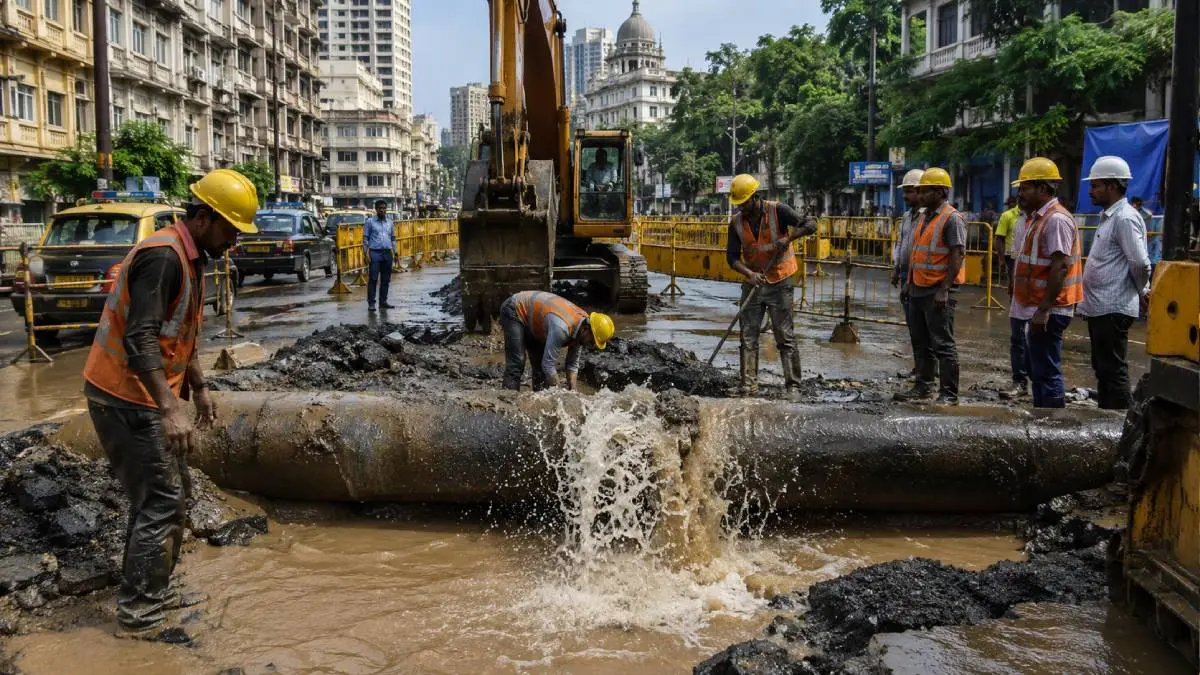
Mumbai’s water cut is no longer only a question of whether the city’s seven supplying lakes are full. Despite usable stocks reaching 14.1 lakh million litres, or 97% of the combined requirement, the Brihanmumbai Municipal Corporation is likely to continue the 10% reduction because the city’s water security also depends on reservoirs controlled by the Maharashtra government and on how the state manages worsening water stress.
The distinction is important. Mumbai’s reservoirs are close to their annual requirement, but they have not yet reached the 14.47 lakh million litres that the civic body considers necessary to meet the city’s water needs. The municipal administration had planned to withdraw the cut if the lakes reached full capacity by September 30. That condition has not been met, and a state directive asking municipal bodies to ensure adequate water availability until August 2027 has added another layer of caution.
The result is a citywide supply policy being shaped by a wider regional water problem. Maharashtra has declared drought-like conditions in 265 of the state’s 358 talukas, according to the report. That is nearly two-thirds of the state’s talukas. Although Mumbai’s own lake system is reporting a high storage level, the city does not operate as a completely self-contained water network. When its principal reservoirs run low, it depends on additional water from state-controlled sources, particularly Bhatsa and Upper Vaitarna.
That dependence means Mumbai’s water position cannot be assessed only by comparing the current lake level with the previous year. The usable stock on September 27 was 14.1 lakh million litres, compared with 14.3 lakh million litres, or 99%, on the same day in 2025 and 14.4 lakh million litres, or 99.4%, in 2024. The current level is therefore marginally lower than in the previous two years, even before the city enters the period during which reserve-water decisions could become more consequential.
The figures also show why the 97% number can be misleading when presented without the operating context. The seven lakes need to reach 14.47 lakh million litres for Mumbai to go through the year without water cuts, according to the civic information cited in the report. The difference between 14.1 lakh million litres and the required total is not simply a technical shortfall. It represents the margin available to the city as it plans supply across the rest of the year and evaluates how much additional water it may need from outside its own lake stock.
### Mumbai’s water cut and the reserve-water question
Mumbai receives around 3,800 million litres of water per day from Modak Sagar, Bhatsa, Upper Vaitarna, Middle Vaitarna, Vihar, Tulsi and Tansa. These lakes form the visible core of the city’s water-supply system and are the basis on which annual storage levels are publicly tracked. But the city’s effective water security also includes reserve arrangements involving reservoirs under state control.
The report identifies Bhatsa as a source from which the BMC receives around 1.4 lakh million litres and Upper Vaitarna as supplying around 93,500 million litres under these arrangements. The civic body makes requests each year when its own lake stocks are low. In a normal assessment, those reserves can provide an additional buffer between the city’s stored water and its annual requirement.
The present situation complicates that buffer. If drought-like conditions have been declared across 265 talukas, the state may face competing demands for water from the same broader reservoir system. The report does not state that reserve supplies have already been reduced. It says civic officials are keeping open the possibility that these supplies could be curtailed because of water stress across Maharashtra. That possibility is enough to make the BMC more cautious about withdrawing the existing cut.
This is an institutional issue as much as a rainfall issue. Mumbai’s municipal administration controls the distribution of water within the city, but its reserve arrangements are linked to decisions made beyond the municipal boundary. The city can therefore have high lake storage and still face uncertainty over the volume of water available to it later. The question is not only how much water exists, but who controls it, which users have priority and when additional supplies can be requested.
A BMC official from the hydraulic departments said the civic body would calculate the requirement for the rest of the year before deciding its future course. The official also said the initial plan was to withdraw the 10% cut only if water levels reached 100% by September 30. That statement places the decision within a defined administrative process rather than treating the current 97% storage level as sufficient on its own.
### Why high storage does not end the risk
The city’s water planning is based on an annual requirement, but the available stock must be managed across changing conditions. A reservoir reading on one date does not establish that supply will remain adequate for the entire planning period. The BMC must account for daily demand, the remaining months of the year, the timing of future replenishment and the possibility that reserve water will not be available at the scale expected.
The current comparison with earlier years provides an additional warning. On September 27, 2024, the seven lakes held 14.4 lakh million litres, or 99.4% of the required quantity. The corresponding figure in 2025 was 14.3 lakh million litres, or 99%. This year’s 14.1 lakh million litres is lower in absolute terms and as a share of the annual requirement. The difference is not presented in the report as proof of an impending shortage, but it explains why the BMC is not treating the latest figure as a basis for immediate relaxation.
The state government’s directive to ensure adequate availability until August 2027 extends the planning horizon beyond the current monsoon cycle. The report links that directive to projections by the World Meteorological Organization of a strong El Niño persisting through February 2027. It says the weather pattern could affect India’s weather, temperatures and agricultural conditions into early 2027. The report does not establish how much Mumbai’s rainfall or reservoir inflows will change, but it shows why officials are planning against uncertainty rather than relying only on the present storage position.
That longer horizon matters because Mumbai’s water system is exposed to conditions outside the city’s direct control. Rainfall in the catchment areas, storage in the seven lakes, demand within the municipal area and the availability of state-controlled reserves all form part of the same supply chain. A decision taken by the BMC on the 10% cut therefore reflects a calculation across multiple institutions and geographies.
### The policy landscape behind the citywide cut
The water cut has been in force since May 15. It affects the entire city rather than being described in the report as a restriction limited to a particular ward, neighbourhood or category of consumer. Its continuation would mean that the BMC is prioritising supply security over an early return to normal distribution, even though the headline storage figure is close to full.
The municipal corporation’s hydraulic departments are responsible for assessing the city’s requirement and determining the future course of the restriction. The state government, however, influences the wider availability of water through its control over reserve reservoirs and through directives to municipal bodies. The drought-like declaration across 265 talukas adds a state-level allocation concern to what might otherwise appear to be a city-level reservoir decision.
This division of responsibility also explains why the end of a water cut cannot be decided solely through a public lake-level dashboard. The BMC needs to establish whether its own stock is enough for the rest of the year, how much water can be drawn from Bhatsa and Upper Vaitarna if required, and whether those additional supplies will remain available while other parts of Maharashtra face water stress. The report identifies these as the issues being weighed by officials.
For residents, the administrative mechanics translate into a familiar but uneven urban experience: a formal percentage reduction applied across the city, with the possibility that the restriction may continue even after reservoirs appear nearly full. The report does not provide ward-level supply data or describe how the cut is being experienced in different neighbourhoods. It does, however, establish that the policy is being maintained as a precaution linked to system-wide availability rather than because Mumbai’s lakes are empty.
### The larger water-security question
Mumbai’s current position reveals the limits of using a single indicator to describe urban water security. The 97% figure is useful, but it does not capture the annual threshold of 14.47 lakh million litres, the lower stock compared with the same date in the previous two years, the daily distribution requirement of around 3,800 million litres or the city’s reliance on state-controlled reserves.
It also shows how municipal resilience can be affected by conditions outside municipal limits. The declaration of drought-like conditions in 265 talukas does not automatically mean Mumbai will lose reserve water, and the supplied report does not say that a curtailment has occurred. But the possibility changes the risk calculation. Mumbai’s water planning must account not only for the water stored for the city, but also for the claims and pressures affecting the wider state system.
The immediate decision is whether to withdraw or continue the 10% cut. The more significant issue is how cities plan for water when storage levels look comfortable but institutional and climatic uncertainties remain. In Mumbai’s case, the evidence confirms that the BMC has not yet reached its stated full-capacity threshold and is reassessing the requirement for the rest of the year. What remains uncertain is whether state-controlled reserve supplies will be available at the expected scale and how the broader drought-like conditions will affect future allocation.
The next formal step is the BMC’s calculation of the city’s water requirement for the remainder of the year. Its decision on the future of the 10% reduction will determine whether Mumbai’s near-full lake stocks translate into a restoration of normal supply or continued conservation.
