


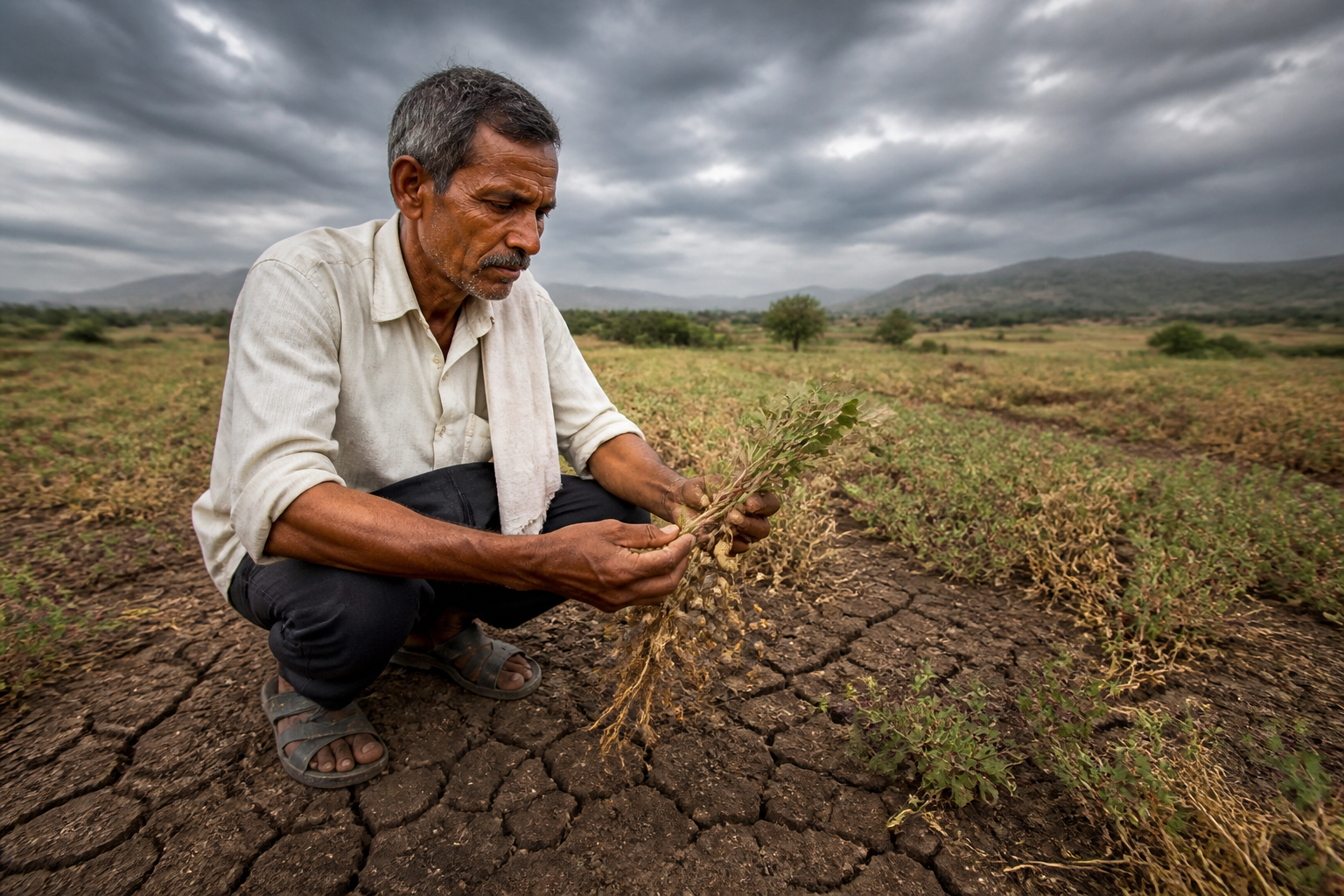
Maharashtra’s latest drought declaration captures a failure that cannot be measured only by seasonal rainfall totals. In Sakri taluka of Dhule district, the monsoon arrived, farmers sowed their crops and expectations of a normal season returned. The crisis came later, when the rain stopped during the period crops needed moisture most. The result has been stunted kharif production, drying fields and little confidence that the rabi season can begin.
The state government has declared 265 of Maharashtra’s 358 talukas drought-affected, covering 32 of the state’s 36 districts. The declaration followed a season in which Maharashtra received 798.2 mm of rainfall between June 1 and September 26, against a normal of 970.9 mm, an overall deficit of 18 per cent. Yet Sakri shows why an average can conceal the actual experience of a farming region. Its seasonal rainfall was around the expected level, but the timing and distribution of that rainfall were damaging.
Official data cited in the report shows that Sakri received no rainfall on 67 of the 102 days between June 1 and September 11. The dry period included 22 consecutive days without rain. An agriculture department official said the taluka, which comprises 227 villages, received only 50 per cent of its average rainfall in August and September. The rains, the official said, were scanty because much of the rainfall remained over the Western Ghats and arrived before the sowing season.
That distinction between rainfall received and rainfall available to crops is central to understanding the crisis. Farmers do not cultivate against a seasonal total. They cultivate against the intervals at which soil moisture is replenished, crops reach key growth stages and water is available for the next sowing cycle. Early showers encouraged farmers in Sakri to invest in seeds and cultivation. When the later rains failed, that investment became an additional source of distress.
In Khori village, 65-year-old farmer Nimbabai Brahmane cultivated groundnut, cotton and bajra on two acres. The groundnut crop had reached the pod development stage when the rain stopped. The seeds inside the pods remained underdeveloped, leaving the crop unfit for consumption or sale and potentially unsuitable even as cattle fodder if it dried further. Farmers in neighbouring Jamade, Lagadwal, Petale and Panhalipada villages reported similar losses.
The geography of Sakri compounds the impact of an erratic monsoon. The region is largely hilly and has limited irrigation facilities. Farmers grow maize, soybean, groundnut, bajra, onion, cotton, pulses and nagli. Most sowed during the first and second weeks of June, after the onset of the monsoon created expectations of a normal season. When the dry spell began, they had already committed their resources to kharif cultivation and had limited capacity to respond with another round of spending.
The crisis therefore operates across two agricultural seasons. The immediate damage is to kharif crops, but the lack of soil moisture also threatens the rabi cycle. Ramlal Gawli, a farmer from Lagadwal, said many smallholders had used everything available from the previous season for kharif cultivation and had nothing left. If fields cannot retain enough moisture for rabi sowing, households face the prospect of losing two cycles of cultivation and carrying the resulting debt forward.
This is where the drought declaration becomes more than an administrative description. Under Maharashtra’s Drought Management Code, the assessment considers rainfall and other factors, including a trigger of at least 21 consecutive days without significant rainfall. The concessions linked to the declaration include a waiver of land revenue, restructuring of crop loans and a stay on recovery of agriculture-related loans. These measures can defer immediate financial pressure, but they do not by themselves restore a failed crop or replace the income that a second season may not produce.
Actual financial assistance for crop losses will be decided after field-level assessments and panchnamas. That creates an important administrative stage between the declaration of drought and the receipt of compensation. The government has recognised the affected talukas, but the amount reaching individual cultivators will depend on local assessment, documentation and eligibility. For farmers whose losses are already visible in damaged crops and drying fields, this gap is not procedural in the abstract; it determines whether relief becomes accessible before the next cycle of expenses arrives.
Access is also tied to land rights. Many farmers in Sakri belong to tribal communities, including Bhil, Kokna, Gamit, Naikda and Pardhi communities. Several have cultivated forest land for generations. They were part of marches in 2018 and 2023 seeking recognition of forest rights and compensation during droughts. Farmers told the report that pending claims for individual forest rights could affect their ability to receive relief, despite a 2019 Government Resolution stating that assistance would also be available to those with pending claims for individual titles.
That issue exposes a second layer of drought governance. Relief systems often depend on the state being able to identify the cultivator, the land and the loss through established administrative records. Where cultivation is linked to pending forest-rights claims, the people facing the crop failure may not fit neatly into the documentation systems used to process assistance. The question in Sakri is not only whether the government has announced relief, but whether its implementation framework can reach cultivators whose claims remain unresolved.
The experience in neighbouring Jalgaon shows that the problem is wider than one taluka. Fifteen talukas in Jalgaon have also been declared drought-hit. In Erandol, farmer Shaligram Gaikwad said the maize crop on his 12 acres had been destroyed. He sowed onions using water from a well whose level was steadily falling. Other farmers are using available irrigation and drip systems to salvage part of the season, but that response requires further investment while the prospect of another crop failure remains.
The numbers in the report point to a mismatch between the scale of administrative geography and the experience of rainfall on the ground. Maharashtra’s overall deficit was 18 per cent, but the critical stress in Sakri was concentrated in August and September, when the taluka received half its average rainfall for those months. The 22-day dry spell crossed the drought code’s stated trigger, while the 67 rainless days within the 102-day period show how frequently crops were left without replenishment.
This also explains why comparisons with the 1972 drought have emerged among older farmers. The comparison is not presented as a statistical equivalence. It reflects a memory of prolonged rural distress, food insecurity and dependence on limited alternatives. Farmers in Sakri and Erandol are using that historical reference to describe the severity of a season that initially appeared promising and therefore encouraged greater exposure to loss.
The wider policy challenge is that drought management has traditionally had to respond to a condition that is both meteorological and institutional. Rainfall measurement can identify deficit and dry spells. Crop assessment can record damage. Loan restructuring can postpone repayment. But relief still depends on how these systems connect with land records, local irrigation, crop timing and the financial position of small farmers. The Sakri account shows that a declaration is an important first step, not the completion of drought response.
The evidence confirms three immediate facts: rainfall was unevenly distributed, crops were damaged at crucial growth stages, and the resulting stress threatens both kharif income and rabi sowing. It also establishes that relief has been announced in principle but that crop-loss assistance remains subject to field assessment. What remains uncertain is the scale of compensation, the speed of panchnamas and whether cultivators with pending forest-rights claims will be included. Those administrative outcomes will determine whether Maharashtra’s drought response becomes accessible relief or remains primarily a government notification.
