


India’s consumer durables market is projected to reach Rs 3-3.25 lakh crore, or USD 30-35 billion, by 2030. But the larger significance of the forecast is not only the size of the consumer opportunity. It is whether India can build the materials, components, testing systems and industrial clusters needed to capture more of that value domestically.
A joint report by Boston Consulting Group and industry body CII estimates that the market will grow by 8-10% annually through 2030, making India one of the fastest-growing major consumer durables markets. Rising household penetration, the increasing number of nuclear families, higher incomes, easier access to finance, wider distribution and premiumisation are expected to drive demand. Room air conditioners are identified as the leading growth segment.
That expansion creates an estimated additional opportunity of Rs 40,000-50,000 crore for domestic value addition in materials and component manufacturing. The figure shifts the story from retail demand to industrial capacity. Every television, air conditioner, refrigerator and washing machine sold in India represents not only a finished product but also a network of suppliers, component makers, testing facilities, logistics operators and skilled workers.
The report’s central warning is that this value may continue to leak through imports unless domestic capacity expands. Localisation of the bill of materials currently ranges from 25% to 70% across consumer durables categories. Televisions and air conditioners are at the lower end of that range, while refrigerators and washing machines have higher levels of domestic localisation. The report estimates that the range could rise to 30-80% by 2030 as domestic component and material manufacturing expands.
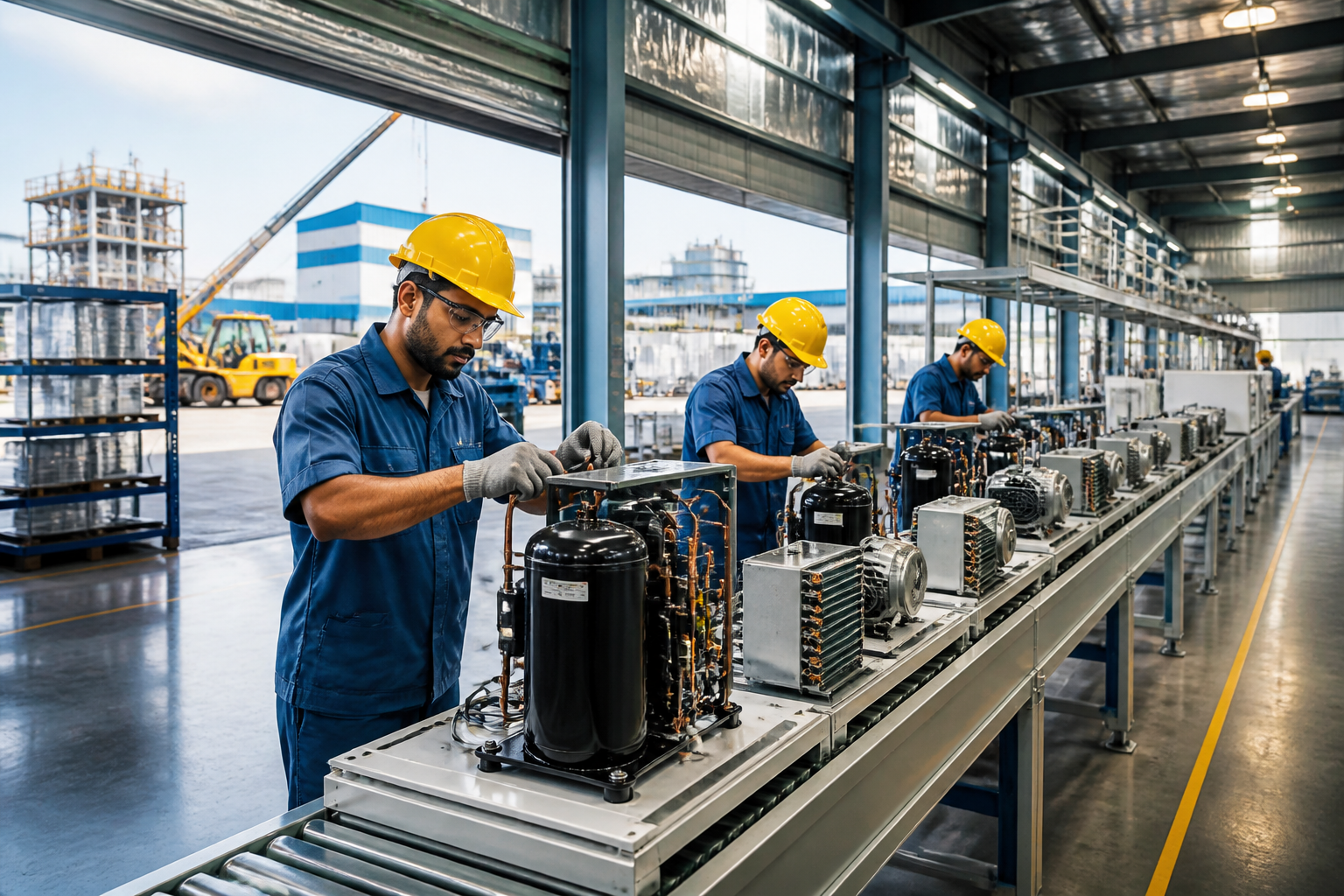
This is an important distinction. A product assembled in India is not necessarily a product whose economic value is largely created in India. The domestic share depends on where the display panels, compressors, insulation, motors, electronics and other inputs are made, as well as where the associated design, testing and technology capabilities sit. The report identifies television display panels, room air conditioner compressors, refrigerator insulation and washing machine motors as areas with significant localisation gaps.
The gap is especially relevant to the geography of manufacturing. Component production requires more than factory space. It depends on reliable industrial infrastructure, supplier density, power, transport links, skilled labour, quality-control systems and access to testing and certification. The BCG-CII report argues that cluster-led manufacturing can help address scale and cost disadvantages by bringing manufacturers and suppliers closer together.
This approach would also change the way industrial growth is measured. The number of assembly plants or finished products is only one indicator. The deeper test is whether an ecosystem can support multiple tiers of suppliers and allow companies to move from importing critical inputs to designing and producing them locally. The report links this transition to technology partnerships, joint ventures and manufacturing clusters connected to component suppliers.
India’s projected market growth provides a strong demand base, but demand alone does not guarantee competitiveness. The report says India’s share of global consumer durables trade remains below 1%, even as global exports are expected to reach USD 900-950 billion by 2030. Indian exports are growing but remain concentrated in neighbouring markets and regions such as SAARC countries and the UAE, with limited presence in major global import markets.
The comparison with other manufacturing economies highlights the scale of the challenge. Thailand’s share of global air conditioner exports rose from 16% in 2010 to 22% in 2025, making it the world’s second-largest air conditioner exporter, according to the report. The comparison is not simply about production volumes. It points to the importance of a coordinated export ecosystem in which component suppliers, manufacturers, logistics networks, testing systems and policy support work together.
The report attributes India’s cost disadvantage against leading exporters to several factors: limited scale, insufficient backward integration, gaps in technology and policy support, and inadequate testing, certification and compliance infrastructure. These constraints can raise the cost and time required to develop products for overseas markets. They can also make it harder for smaller component manufacturers to enter supply chains that require consistent quality and internationally accepted certification.
The policy response therefore extends beyond incentives for finished-product manufacturing. The report refers to existing measures such as duty remission, zero-duty imports of capital goods and export-credit support, but argues that these need to be part of a wider ecosystem. Its proposed framework includes export-oriented manufacturing clusters linked to component ecosystems, support for joint ventures and technology acquisition, shared testing and certification facilities, lower financing costs and stronger access to priority markets.
Shared facilities are particularly significant for a fragmented supplier base. Testing and certification infrastructure can be expensive for individual firms, especially smaller manufacturers. If such facilities are available within industrial clusters, they can reduce duplication and help suppliers meet domestic and export requirements. The report’s emphasis on shared ancillary services indicates that competitiveness depends partly on institutions and infrastructure outside the factory gate.
The localisation question also has implications for industrial planning. If component manufacturing is spread across disconnected sites, suppliers may face higher logistics costs and weaker coordination. Cluster-based production can potentially shorten supply chains and support specialisation, but the report does not establish how many clusters would be required, where they should be located or how they would be financed. Those details remain central to implementation.
Research and development is another weakness identified by the report. India’s top listed consumer durables companies invest less than 1% of their revenue in R&D, compared with 1-4% among global peers. The report says this limits the industry’s ability to move beyond manufacturing scale towards technology leadership. Its conclusion is that support must target innovation, not only capacity creation.
This distinction matters as the market becomes more premiumised. Higher household incomes and easier financing may increase demand for products with better energy performance, connectivity, design and features. The supplied report does not quantify the share of premium products or establish how much R&D spending would be necessary. It does, however, connect the industry’s low R&D intensity with a broader risk: India could expand output without developing enough proprietary technology or high-value components.
Artificial intelligence adds another layer to the industrial transition. The report says Indian business leaders are more optimistic about the potential returns from AI than their global counterparts, while workforce readiness remains limited. That finding places technology adoption alongside the more familiar challenges of components, capital and infrastructure. Optimism about AI can support modernisation, but the report’s reference to limited workforce readiness indicates that technology deployment will also depend on skills and organisational capacity.
The market comparison reinforces why the domestic opportunity is strategically important. China’s consumer durables market is expected to grow by 1-2% annually through 2030, while the US market is projected to expand by around 3% and Japan’s by 1-3%. India’s projected 8-10% annual growth is therefore being driven by a combination of a lower existing penetration base and expanding household purchasing power. The same growth can attract investment into local supply chains, but it can also increase imports if domestic capability does not keep pace.
For cities and industrial regions, the outcome will be shaped by where this capacity is built and how effectively it is connected. Component ecosystems require industrial land, transport infrastructure, utilities, warehousing, worker housing and supporting services. The report focuses on manufacturing competitiveness rather than urban planning, so it does not provide estimates of land, employment, energy or logistics requirements. Nevertheless, its cluster-led approach places the built and industrial environment at the centre of the localisation question.
The evidence available in the report confirms a large demand opportunity and identifies specific weaknesses in components, exports, R&D, testing and workforce readiness. It does not establish that the projected market size or localisation range will be achieved. Nor does it specify the institutional arrangements, locations or investment commitments required to close the gaps.
The central question for the next phase is therefore not whether India’s consumer durables market will grow, but how much of that growth will be supported by domestic materials, component suppliers and technology capabilities. The milestones to watch are the expansion of localisation in air conditioners and televisions, the development of shared testing and certification facilities, growth in export-market access, higher R&D intensity and the emergence of coordinated manufacturing clusters.
