


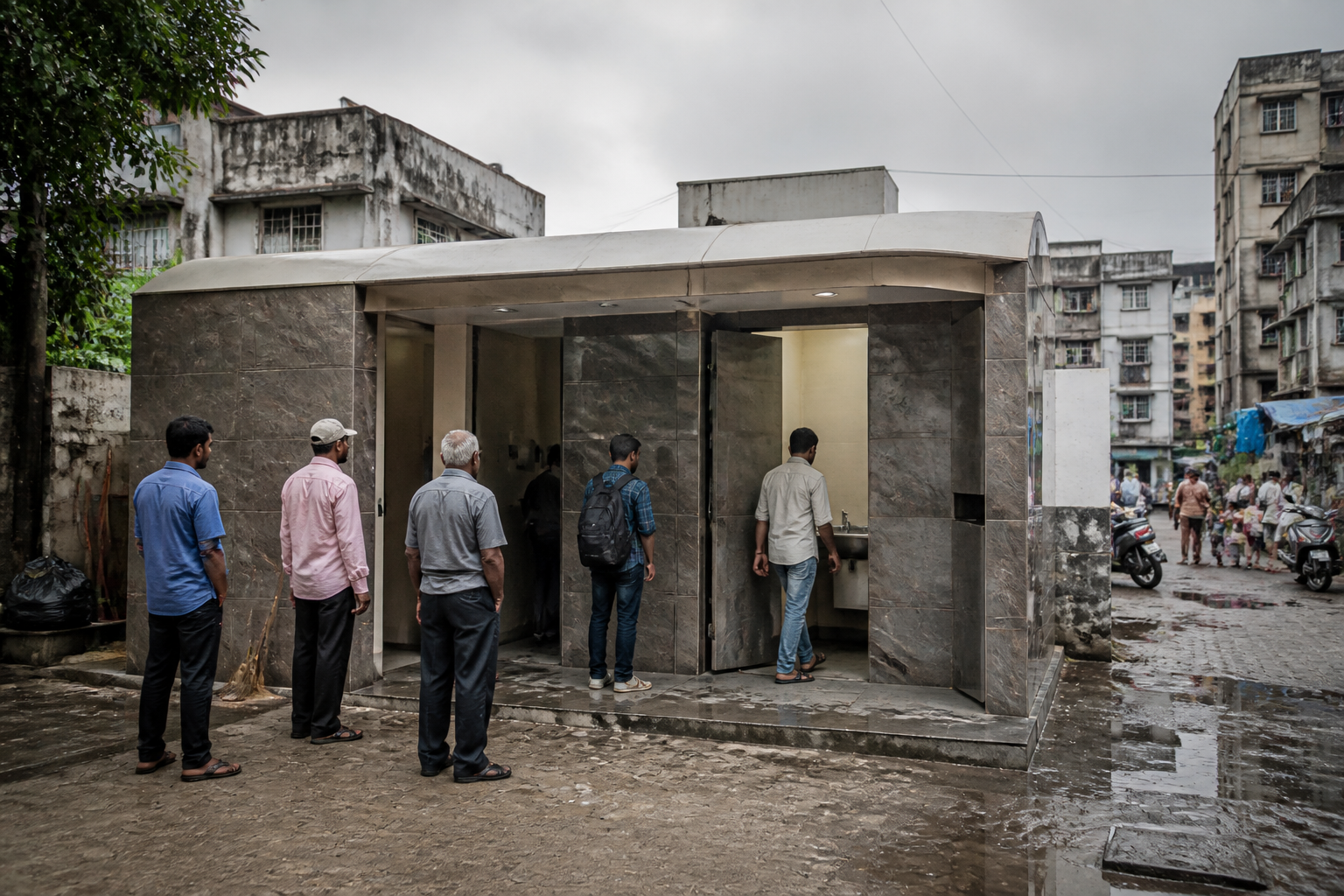
Mumbai’s proposed public toilet fee hike is framed by the Brihanmumbai Municipal Corporation (BMC) as a way to help operators meet rising maintenance costs. But the proposal also exposes a deeper problem in the city’s sanitation system: facilities built by the municipal corporation are being run by private agencies and non-governmental organisations, while the cost of keeping them functional is passed through to users.
Under the proposal submitted to civic group leaders, using a urinal would cost Rs 1, compared with no charge at present. The fee for using a toilet would rise from Rs 2 to Rs 5, while charges for bathing would increase from Rs 5 to Rs 10. The proposed revision would apply to public pay-and-use toilet complexes. Charges at community toilets may remain unchanged.
The numbers are small in absolute terms, but the policy question is significant. A public toilet is not an optional civic amenity for residents without access to private sanitation. It is part of the daily infrastructure of a dense city, used by people living in informal settlements, workers, commuters and others who may not have reliable access to toilets at home or near their place of work. The proposed fee therefore links a routine civic service to the user’s ability to pay each time the facility is used.
The BMC’s own explanation shows why the proposal has emerged. The city has 846 public pay-and-use toilet complexes, built by the civic body but managed by private agencies and non-governmental organisations. According to a senior BMC official quoted by The Indian Express, these operators are responsible for cleaning, washing the premises, repairing damage and bearing other operating costs. They also appoint caretakers to manage the facilities.
This arrangement separates ownership from operation. The BMC creates or supports the physical asset, while the day-to-day functioning is assigned to another entity. The operator must then recover the cost of cleaning, repairs, staffing, water and electricity. The proposed fee increase is intended to make that operating model more viable, with the BMC saying that the additional revenue would be retained by the operators.
The arrangement also makes accountability less straightforward. If a toilet is dirty, damaged or closed, residents encounter the operator at the facility, but the underlying public asset belongs to the municipal corporation. If the operator reports losses, the BMC must decide whether to raise user charges, provide a subsidy, revise utility rates or change the management model. The proposed hike indicates that the immediate answer under consideration is to increase what users pay.
## Mumbai public toilets and the cost of access
The proposal becomes more consequential when viewed alongside the scale of Mumbai’s community sanitation network. The city has around 8,173 community toilet complexes, of which 3,110 are managed by the BMC, according to civic officials cited in the report. These figures show that sanitation provision is not limited to isolated public conveniences. It is a large municipal system involving thousands of facilities and several layers of management.
The distinction between public pay-and-use toilets and community toilets is therefore important. The proposed rates are meant for the former, while charges at community toilets may remain unchanged. However, the source material does not establish how residents are assigned to one category or the other, how consistently the distinction is applied across neighbourhoods, or whether users can shift to a free or lower-cost facility when a pay-and-use toilet is the only accessible option.
That uncertainty matters because sanitation access is experienced locally. The relevant question for a resident is not only whether Mumbai has thousands of toilet complexes, but whether a usable facility is available nearby, whether it is open when needed, whether it has water and lighting, and whether the charge can be paid repeatedly. A citywide count can show the size of the network without showing how evenly or reliably it serves residents.
The proposed Rs 1 urinal charge is especially important because it introduces payment where there was previously no fee. The change may appear modest, but it alters the principle governing access. Once a charge is attached to every use, the operator’s revenue becomes linked to footfall and the user’s capacity to pay. That creates a direct relationship between municipal sanitation finance and everyday behaviour in public space.
The BMC’s stated rationale is maintenance. The official quoted by The Indian Express said operators face costs for cleaning, washing, repairs, commercial electricity and water charges, as well as caretaker salaries. The proposal thus treats fees as an instrument for keeping facilities operational. Yet the report also records a challenge to that logic from Sitaram Shelar, convenor of the citizens’ collective Pani Haq Samiti.
Shelar argued that sanitation is a municipal responsibility and said that the BMC’s commercial rates for electricity and water contribute to operators’ losses. He also questioned the decision to increase charges when, in his view, water and sanitation are among the BMC’s profit-making departments. His criticism places the dispute beyond the question of whether operators need more revenue. It asks whether the city is financing a basic public-health service in a way that makes users bear the cost of administrative and utility decisions.
## The institutional gap behind the proposed fee
The reported policy package includes more than a tariff revision. The BMC is also proposing a policy for the reconstruction, renovation and repair of existing public toilets, as well as the construction of new facilities. Senior officials said the policy would include digital monitoring and a mechanism for addressing public complaints.
That combination is revealing. The civic body is considering higher user charges at the same time as it proposes stronger monitoring and complaint handling. This suggests that the quality of sanitation infrastructure is connected not only to the amount collected at the entrance, but also to how contracts, repairs, inspections and complaints are administered.
Digital monitoring could improve visibility over whether facilities are open, clean and maintained, but the supplied report does not specify what data would be collected, how frequently facilities would be inspected, who would be responsible for responding to complaints, or whether performance information would be made public. Those details will determine whether the proposed monitoring system becomes a management tool or simply another layer of reporting.
The same applies to the repair and reconstruction policy. Existing toilets may require different forms of intervention: routine cleaning, small repairs, major structural work or complete reconstruction. A single user fee cannot resolve all of these needs unless the municipal system also defines who pays for capital work, who pays for daily operations and how performance is measured. The report establishes that the BMC is working on such a policy, but does not provide its final provisions.
The dispute also highlights the tension between public ownership and private operation. The BMC can build the facility, but the operator controls many of the activities that determine the user’s experience. If the operator is expected to fund cleaning, repairs and staffing from user fees, then inadequate revenue can affect service quality. If fees are raised without ensuring access for low-income users, the service may become less affordable. The governance challenge is to reconcile both requirements without treating access and maintenance as competing objectives.
## What remains unresolved
The reported proposal has not been described as a final citywide implementation order. It was submitted to civic group leaders, and the source material does not state whether the BMC has approved the revised rates, when they would take effect, or whether the proposal will be modified after consultation. The distinction is important because the current story concerns a proposed policy rather than a confirmed tariff change.
Several operational questions also remain unanswered. The report does not establish whether concession schemes, exemptions or other protections are being considered for residents unable to pay. It does not specify how the BMC will ensure that a user receives a functioning facility in exchange for the fee, or how complaints about overcharging, closure or poor maintenance will be resolved. It also does not explain whether operators will be required to publish accounts showing how the increased revenue is used.
These questions are central because a fee is only one part of a sanitation contract between the city and its residents. The city provides land, construction or public infrastructure; operators provide daily management; users provide payment where applicable; and the municipal corporation remains responsible for the broader public system. If any part of that arrangement fails, residents experience the failure as an inaccessible, unclean or unaffordable toilet.
Mumbai’s proposed public toilet fee hike therefore offers a clear view of how a basic urban service is being managed. The BMC is attempting to address operator maintenance costs through revised charges, while citizens’ groups are challenging the idea that sanitation access should become more dependent on user payments. The proposed reconstruction, repair and digital monitoring policy could clarify responsibilities, but its effectiveness will depend on the details that have not yet been made public.
For now, the evidence confirms a conflict between two legitimate administrative objectives: keeping a large network of public toilets maintained and ensuring that access remains available to residents who depend on it. The next significant developments will be the BMC’s decision on the proposed rates, the final form of the sanitation management policy and the safeguards, monitoring standards and complaint mechanisms attached to its implementation.

